
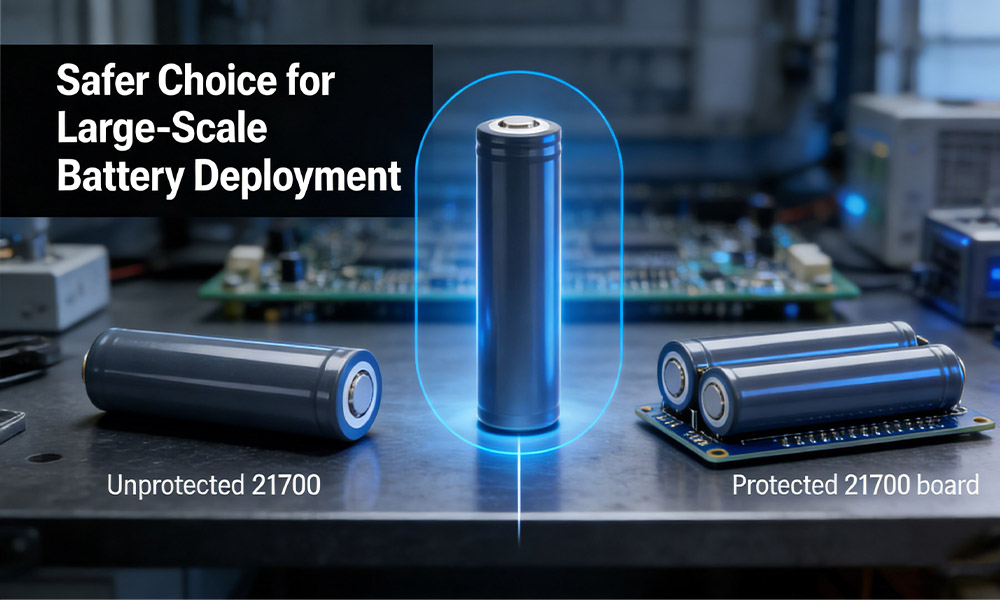
Safety and Integration Risks
When buyers handle large-scale projects or bulk orders, the choice between a protected 21700 battery and an unprotected one often comes down to risk management. Protected 21700 cells include a built-in circuit that prevents overcharge, over-discharge, overcurrent, and short circuits. That small feature can save a lot of trouble when thousands of units move across multiple sites. Unprotected cells skip the protection, which means system integrators must add extra circuitry. Without careful design, this creates a high chance of failure.
Size, Capacity, and Inventory
Protected cells are slightly longer than unprotected ones because of the protection module, but the voltage and capacity remain standard at 3.7V and around 5000mAh. For inventory management, the difference in size is negligible compared to the operational risk unprotected cells bring. When systems need to be deployed quickly and safely, many B2B buyers prefer the protected variant. You can see an example of a well-used model here: 3.7V 21700 Rechargeable Lithium Battery Cells 5000mAh. It delivers stable output and has integrated protection suitable for commercial distribution and project deployments.

Bulk Procurement Considerations
| Feature | Protected 21700 | Unprotected 21700 |
|---|---|---|
| Safety | PCM built-in | Requires external protection |
| Integration | Simple | Complex, needs extra circuitry |
| Bulk Returns | Lower | Higher risk if handling errors occur |
| Project Use | High reliability | Requires careful design |
| Cost | Slightly higher | Lower unit cost, but potential hidden costs |
Procurement and Cost Considerations
In bulk procurement, unprotected cells may look cheaper on the surface. However, adding protection at the system level increases assembly time, BOM complexity, and testing requirements. Protected cells eliminate most of these steps. Integrators also notice fewer returns and lower field maintenance. Over hundreds or thousands of units, the time saved and risks avoided outweigh the small difference in per-unit cost.
Cycle Life and Reliability
Cycle life also matters in large deployments. High-quality protected 21700 cells maintain steady output over repeated charge cycles. Unprotected cells are more vulnerable to misuse and environmental variations, which can cause premature failure. In multi-phase projects where batches arrive at different times, consistency is crucial. Using protected cells reduces the chances of uneven performance across sites.

Choosing for Your Project
Ultimately, the choice depends on scale, risk tolerance, and integration workflow. Projects with multiple teams or less controlled environments benefit from protected cells. Experienced system integrators with strict control over assembly and usage can still use unprotected cells, but they must plan for extra protection. From a B2B perspective, protected 21700 batteries are often the safer and more predictable choice for bulk orders, long-term projects, and multi-site deployment.
You May Also Like
-

18650 2200Mah 10S3P 36V 6.6Ah Electric Scooter Lithium Battery
-

18650 2600Mah 10S3P 36V 7.8ah Scooter Battery
-

18650 36V 5.2Ah Electric Bicyle Battery
-

1S2P 3.7V 1600mAh 14500 Lithium Battery
-

2000Mah 18650 Battery Cell 6Ah 36V Scooter Battery
-

21700 3.7V 4800mAh Rechargeable Lithium-Ion Battery
-

3.7V 21700 Rechargeable Lithium Battery Cells 5000mah
-

3.7V 5000mah 26650 Battery
-

32140 LiFePO4 Battery Cell 3.2V – 10000mAh / 15000mAh
-

32700 Lifepo4 3.2V 6000mah Lithium Battery
-

48V 15ah 720wh Ebike Battery
-

60V 21Ah 18650 16S7P E Bike Battery
-

Customized 48V-72V Triangle Ebike Lithium Battery Pack | 52V 30Ah
Leave a Reply