
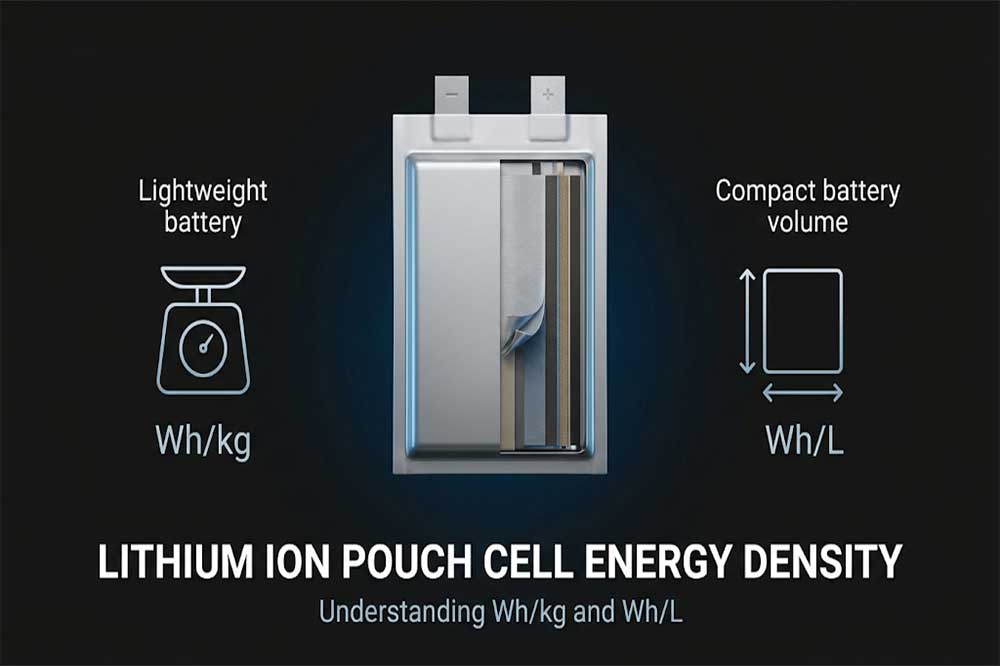
When selecting a lithium ion pouch cell for a new product, capacity is usually one of the first specifications engineers check. However, capacity alone does not tell the whole story. A battery with a higher mAh rating may also be larger or heavier, making it unsuitable for a compact device.
This is where energy density becomes important.
Lithium ion pouch cell energy density describes how much electrical energy a cell can store relative to its weight or physical volume. It helps engineers compare different cell designs, estimate battery performance within limited space, and determine whether a particular cell is suitable for a product.
Two units are commonly used: Wh/kg and Wh/L. Although they describe the same general property, they measure different things. Understanding the difference can prevent problems during battery selection and product development.
What Is Lithium Ion Pouch Cell Energy Density?
Energy density refers to the amount of electrical energy stored in a battery per unit of mass or volume.
The total energy of a lithium ion cell is generally estimated using its capacity and nominal voltage:
\[ Energy\ (Wh)=Capacity\ (Ah)\times Voltage\ (V) \]
For example, a pouch cell rated at 3.7V and 2Ah has a nominal energy of:
\[ 3.7\times2=7.4Wh \]
This means the cell stores approximately 7.4Wh of nominal energy.
However, two cells with the same 7.4Wh capacity may have different energy densities if their weights or dimensions are different.
A lighter cell has higher gravimetric energy density, while a smaller cell has higher volumetric energy density, assuming the stored energy remains the same.
For pouch cells, this distinction is particularly useful because manufacturers can adjust cell dimensions, electrode configurations, and packaging structures to meet different product requirements.

Wh/kg vs Wh/L: What Is the Difference?
Wh/kg and Wh/L are the two main measurements used when evaluating lithium ion pouch cell energy density.
They should not be treated as interchangeable specifications.
Gravimetric Energy Density (Wh/kg)
Gravimetric energy density measures how much energy a battery stores relative to its total weight.
The calculation is:
\[ Wh/kg=\frac{Cell\ Energy\ (Wh)}{Cell\ Weight\ (kg)} \]
For example, consider a pouch cell with:
- Nominal voltage: 3.7V
- Capacity: 2Ah
- Nominal energy: 7.4Wh
- Cell weight: 35g (0.035kg)
Its gravimetric energy density is:
\[ 7.4\div0.035=211.4Wh/kg \]
This measurement is important for products where weight is a major design concern.
Examples include:
- Portable medical equipment
- Wearable electronic devices
- Handheld industrial terminals
- Wireless monitoring devices
- Lightweight consumer electronics
In these applications, reducing battery weight can improve product comfort, portability, and overall design.
However, a high Wh/kg value does not automatically mean that a cell is the best choice. The battery must also satisfy discharge current, cycle life, safety, and dimensional requirements.
Volumetric Energy Density (Wh/L)
Volumetric energy density measures how much energy is stored within a specific volume.
Its formula is:
\[ Wh/L=\frac{Cell\ Energy\ (Wh)}{Cell\ Volume\ (L)} \]
Suppose the same 7.4Wh pouch cell has dimensions of 100 × 60 × 5mm.
Its approximate external volume is:
\[ 100\times60\times5=30,000mm^3 \]
Since one liter equals 1,000,000mm³, the cell volume is 0.03L.
Therefore:
\[ 7.4\div0.03=246.7Wh/L \]
Volumetric energy density is especially relevant when the battery must fit into a limited internal space.
Typical applications include:
- Slim handheld devices
- Smart wearables
- Portable medical instruments
- Compact communication equipment
- Embedded electronic products
For these products, even a small increase in cell thickness can affect the enclosure design, internal layout, and available space for other components.
An important distinction: Wh/kg focuses on weight, while Wh/L focuses on occupied volume. A battery can perform well in one measurement without ranking equally well in the other.

What Affects Lithium Ion Pouch Cell Energy Density?
Energy density is determined by more than the chemistry printed on a battery datasheet. Several design and manufacturing factors influence the final result.
Electrode Materials and Cell Chemistry
Cathode and anode materials have a direct influence on the amount of energy a lithium ion cell can store.
Different lithium battery chemistries offer different combinations of operating voltage, capacity, safety characteristics, and cycle life.
For example, lithium cobalt oxide (LCO) is commonly used in compact electronic applications where high energy density is important. NMC chemistry is also widely used in applications requiring a balance of energy density, power capability, and service life.
LFP chemistry is often selected for applications that prioritize thermal stability and cycle life, although its energy density is generally lower than that of many high-energy lithium-ion chemistries.
The choice should be based on the application rather than energy density alone.
Electrode Thickness and Cell Design
Electrode design also affects how efficiently a cell uses its available space and weight.
Higher electrode loading can increase the amount of active material inside a cell. This may improve energy density because a larger proportion of the cell structure contributes to energy storage.
However, simply making electrodes thicker does not guarantee better performance.
Thicker electrodes can create challenges involving lithium-ion transport, heat distribution, charging speed, and mechanical stability.
Manufacturers need to balance electrode loading, porosity, electrolyte quantity, and other parameters to achieve a practical design.
Packaging and Internal Structure
One characteristic of pouch cells is their flexible aluminum-plastic film packaging.
Compared with rigid metal enclosures, pouch packaging can reduce the weight associated with the outer housing and provide greater flexibility in cell shape.
This can be useful in applications where conventional cylindrical or prismatic batteries cannot fit easily.
However, the packaging is only one part of the cell. Current collectors, separators, electrolyte, tabs, sealing areas, and protective structures also occupy space or contribute weight.
The final energy density depends on the complete cell design, not just the active electrode materials.
How to Calculate Pouch Cell Energy Density
For battery engineers and purchasing teams, energy density can be calculated using three basic specifications: nominal voltage, capacity, and cell dimensions or weight.
Consider the following hypothetical pouch cell:
| Parameter | Specification |
|---|---|
| Nominal voltage | 3.7V |
| Capacity | 3,000mAh |
| Energy | 11.1Wh |
| Weight | 50g |
| Dimensions | 100 × 60 × 6mm |
Step 1: Calculate nominal energy
Convert 3,000mAh into 3Ah.
\[ 3.7\times3=11.1Wh \]
Step 2: Calculate gravimetric energy density
Convert 50g into 0.05kg.
\[ 11.1\div0.05=222Wh/kg \]
Step 3: Calculate volumetric energy density
The external cell volume is:
\[ 100\times60\times6=36,000mm^3 \]
This equals 0.036L.
\[ 11.1\div0.036=308.3Wh/L \]
The calculated results are:
- Gravimetric energy density: 222Wh/kg
- Volumetric energy density: 308.3Wh/L
These figures are illustrative calculations, not specifications for a particular commercial battery.
For accurate engineering comparisons, use measured discharge energy under specified test conditions rather than relying only on nominal voltage multiplied by rated capacity. Also confirm whether the reported volume includes the complete external cell dimensions.

Why Energy Density Matters in Battery Pack Design
A single battery cell is rarely used in isolation. It is usually integrated into a complete product or battery pack.
This changes how engineers should evaluate energy density.
For example, a compact medical device may have a fixed battery compartment. A cell with high Wh/kg but excessive thickness may not fit the available space.
On the other hand, a handheld industrial device may have more room for the battery but a strict overall weight limit. In that situation, gravimetric energy density may be the more useful starting point.
Battery pack design also introduces additional components, including:
- BMS or protection circuits
- Connecting wires and connectors
- Insulation materials
- Mechanical supports
- Outer housings
- Thermal management components, where required
These components increase the total weight and volume without directly adding stored energy.
As a result, pack-level energy density is normally lower than cell-level energy density.
Engineers should therefore distinguish between cell specifications and the performance of the complete battery assembly when estimating the final product’s runtime and dimensions. Natural Resources Canada+1
How to Choose a Pouch Cell Based on Energy Density
Choosing a pouch cell should start with the actual product requirements rather than selecting the highest advertised Wh/kg or Wh/L value.
For a new battery project, several factors deserve attention.
1. Define the available battery space.
Confirm the maximum length, width, and thickness of the battery compartment. Include enough room for manufacturing tolerances, insulation, wiring, and assembly.
2. Calculate the required energy.
Estimate the product’s average power consumption and expected operating time.
For example, a device consuming 1.5W for four hours requires approximately 6Wh of energy before considering conversion losses and operating margins.
3. Set the weight target.
If the battery is installed in a wearable or handheld device, weight may be a major purchasing criterion. Compare Wh/kg alongside the actual cell weight.
4. Check discharge requirements.
A high-energy cell may not necessarily support the current required by the application. Review continuous discharge current, peak current, temperature rise, and charging conditions.
5. Evaluate the complete specification.
Cycle life, operating temperature, charging voltage, protection requirements, and mechanical design all influence the suitability of a cell.
For OEM and ODM battery projects, it is often more practical to discuss the required dimensions, capacity, voltage, discharge current, and application environment with the manufacturer before finalizing the cell model.
A cell designed around the product’s real limitations can be more useful than one selected purely for its energy density rating.
Common Misunderstandings About Pouch Cell Energy Density
Several common mistakes can lead to incorrect comparisons between battery suppliers.
First, a higher mAh rating does not always mean higher energy density. Voltage, weight, and volume must also be considered.
Second, cell-level and pack-level energy density are different. A datasheet value for an individual pouch cell should not be used directly to represent the finished battery pack.
Third, theoretical energy density is not the same as commercially available cell performance. Actual cells include packaging and other inactive components that reduce the energy available per unit of mass or volume.
Finally, energy density should not be confused with power density. Energy density describes how much energy a battery stores, while power density describes how quickly it can deliver that energy.
For applications requiring short, high-current bursts, discharge capability may be just as important as energy density.
Conclusion
Understanding lithium ion pouch cell energy density helps engineers make more informed decisions when designing compact and lightweight battery-powered products.
Wh/kg is useful when weight reduction is the main priority, while Wh/L is more relevant when internal space is limited. In many OEM battery projects, both measurements need to be considered together.
The best pouch cell is not necessarily the one with the highest energy density. It is the one that provides the required energy while meeting the product’s dimensional, electrical, safety, and service-life requirements.
For customized battery applications, working with a manufacturer that can evaluate cell dimensions, capacity, chemistry, and battery pack requirements together can make the selection process more reliable.
FAQs
1. What is the energy density of a lithium ion pouch cell?
Lithium ion pouch cell energy density measures the amount of electrical energy stored per unit of weight or volume. It is commonly expressed in Wh/kg for gravimetric energy density and Wh/L for volumetric energy density.
2. What is the difference between Wh/kg and Wh/L?
Wh/kg measures energy relative to cell weight, while Wh/L measures energy relative to cell volume. Wh/kg is particularly useful for lightweight battery applications, whereas Wh/L is important for products with limited internal space.
3. Does a higher energy density mean a better lithium ion pouch cell?
Not necessarily. A higher energy density can help reduce battery size or weight, but engineers must also consider discharge current, cycle life, operating temperature, safety, and charging requirements.
4. Which lithium battery chemistry offers higher energy density?
LCO and certain NMC chemistries are commonly used in applications requiring relatively high energy density. LFP generally prioritizes safety and cycle life over maximum energy density. The actual result depends on the cell design and manufacturing process.
5. How can I improve the energy density of a custom pouch cell?
Energy density can be improved through electrode material selection, optimized electrode loading, internal structural design, and packaging optimization. However, these changes must be balanced against charging performance, heat generation, cycle life, and safety.
Explore Our Lithium Ion Pouch Cells
Looking for lithium ion pouch cells for your next OEM or ODM battery project? Explore our Lithium Ion Pouch Cell Products to learn more about available cell options for different voltage, capacity, size, and application requirements.
For customized battery requirements, contact our team with your target specifications.
Related Lithium Ion Pouch Cell Articles
Lithium ion pouch cell performance depends on several interconnected factors, including voltage, capacity, electrode materials, and packaging design. If you are evaluating pouch cells for an OEM battery project, the following articles provide additional technical information to help you understand cell specifications and make better design decisions.
Lithium Ion Pouch Cell Capacity: How to Choose the Right mAh and Ah Rating
Lithium Ion Pouch Cell Voltage: Nominal Voltage, Charging and Discharging
What Materials Are Used in Lithium Ion Pouch Cells?
What Is Aluminum Plastic Film in a Lithium Ion Pouch Cell?
Lithium Polymer vs Lithium Ion Pouch Cells
Lithium ion Pouch Cells Products
-

11.1V 3S 850mAh li-ion Polymer Pouch Cell Battery Pack
-

134365 4500mAh 3.7V Rechargeable Lithium Polymer Battery
-

3.7V 1200mAh Li-Polymer Pouch Cell Battery
-

3.7V 15Ah 148198 Pouch Lithium Ion Battery
-

3.7V 1S2P 3000mah lithium Polymer Battery
-

3.7V 2000mAh Pouch Cell Battery
-

3.7V 502248 500mAh Lithium Ion Polymer Battery
-

3.7V 700mAh Li-Polymer Pouch Cell Battery
-

3.7V 800mAh Rechargeable Pouch Li-Polymer Battery
Leave a Reply