
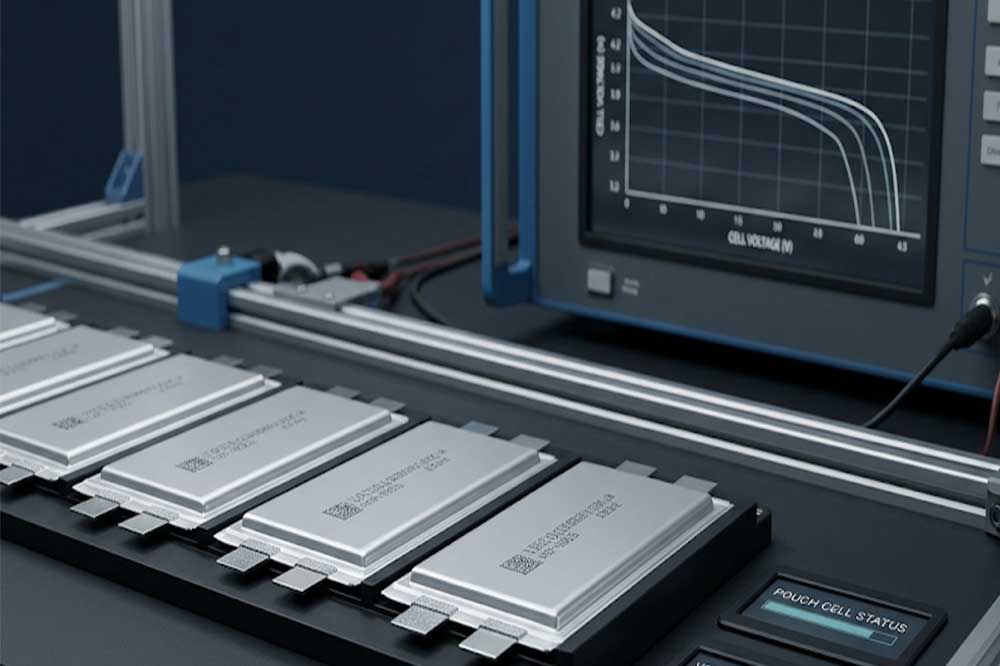
When selecting a lithium ion pouch cell for an electronic device or battery-powered system, voltage is one of the first specifications engineers need to check.
However, the voltage printed on a battery datasheet does not represent its voltage at every moment. A cell rated at 3.7V, for example, may reach 4.2V when fully charged and drop considerably during discharge.
This difference matters when designing charging circuits, selecting a battery management system (BMS), and matching the battery to the operating voltage of the equipment.
Understanding lithium ion pouch cell voltage helps engineers avoid compatibility problems before moving into sample testing and mass production.
What Is the Voltage of a Lithium Ion Pouch Cell?
A lithium ion pouch cell is a rechargeable battery packaged in a flexible aluminum-plastic film. Its voltage depends mainly on the electrode chemistry rather than the pouch packaging itself.
For many conventional lithium-ion pouch cells using LCO or NMC chemistry, the nominal voltage is around 3.6V–3.7V. The maximum charging voltage is commonly 4.2V per cell.
LFP pouch cells operate at a lower nominal voltage, typically around 3.2V, with a common charging limit of 3.65V.
These figures are useful for preliminary selection, but they should not be treated as universal specifications. Different cell designs and material formulations can have different voltage limits.
For example, a manufacturer may offer a high-voltage lithium-ion cell with a charging limit above 4.2V. Such a cell requires a charger and protection system specifically designed for that voltage.
The battery datasheet should always be the reference for final electrical design.

Nominal Voltage vs. Full Charge Voltage vs. Discharge Cutoff
Three voltage values are commonly used when specifying a lithium ion pouch cell.
1. Nominal Voltage
Nominal voltage is the reference voltage used to describe the cell and calculate its rated energy.
For example, a 3.7V, 5000mAh pouch cell has a nominal energy of:
\[ 3.7V \times 5Ah = 18.5Wh \]
This value is useful when estimating battery energy requirements and comparing different cell options.
It is not necessarily the voltage measured when the cell is fully charged or operating under load.
2. Full Charge Voltage
Full charge voltage is the maximum voltage the cell is designed to reach under its specified charging conditions.
Typical examples include:
- Conventional LCO/NMC lithium-ion: 4.2V
- LFP lithium iron phosphate: 3.65V
Some lithium-ion chemistries support higher charging voltages, but this depends on the specific cell design.
Using a charger with an incorrect voltage setting can damage the cell or create a serious safety risk.
3. Discharge Cutoff Voltage
Discharge cutoff voltage is the lower voltage limit defined by the manufacturer.
When the cell reaches this limit, the battery system should stop discharging.
Typical reference values include approximately 2.75V–3.0V for some conventional lithium-ion cells and 2.5V for certain LFP cells.
The actual cutoff depends on chemistry, cell construction, discharge current, temperature, and manufacturer specifications.
A BMS or other protection circuit should be configured according to the selected cell’s requirements.
Lithium Ion Pouch Cell Voltage by Battery Chemistry
Not every lithium ion pouch cell has the same voltage profile. The cathode material plays an important role in determining its nominal and operating voltage.
| Battery Chemistry | Nominal Voltage | Typical Full Charge Voltage |
|---|---|---|
| LCO | 3.6–3.7V | 4.2V |
| NMC | 3.6–3.7V | 4.2V |
| NCA | Around 3.6V | 4.2V |
| LFP | 3.2–3.3V | 3.65V |
Reference values only. Actual voltage limits must be confirmed in the manufacturer’s datasheet.
LCO Pouch Cells
Lithium cobalt oxide (LCO) cells are commonly associated with compact electronic products where energy density and available space are important.
They generally use a 3.6V–3.7V nominal voltage and a 4.2V charging limit.
NMC Pouch Cells
Nickel manganese cobalt (NMC) cells are used in a range of applications, including portable equipment, industrial devices, and battery systems.
Their nominal voltage is commonly around 3.6V–3.7V, with 4.2V as a typical upper charging limit.
LFP Pouch Cells
Lithium iron phosphate (LFP) cells have a lower nominal voltage, generally around 3.2V.
Their common charging limit is 3.65V. This difference becomes important when designing a battery pack because the number of cells required to reach a target voltage may change.
How Does Voltage Change During Charging?
Charging does not increase cell voltage at a constant rate.
Most conventional lithium-ion pouch cells use a CC-CV charging method, which consists of two main stages.
Constant Current (CC) Stage
During the first stage, the charger supplies a controlled current to the cell.
As the battery stores energy, its terminal voltage gradually increases.
For a conventional 3.7V nominal pouch cell, voltage moves toward its specified upper charging limit, commonly 4.2V.
The charging current must remain within the manufacturer’s recommended range.
Constant Voltage (CV) Stage
When the cell reaches its maximum charging voltage, the charger holds that voltage constant.
The charging current gradually decreases as the cell approaches full charge.
Charging is terminated when the current reaches the specified termination threshold.
This process helps prevent overcharging while allowing the cell to reach its designed capacity.
For OEM battery projects, the charger profile must match the cell specifications. A charger designed for a 4.2V cell should not automatically be used with a 3.65V LFP cell.

What Happens to Voltage During Discharging?
During discharge, the cell supplies electrical energy to the connected equipment. Its voltage gradually decreases as the stored energy is consumed.
The voltage curve is not always linear.
At the beginning of discharge, voltage may drop relatively quickly from its fully charged level. It then enters a more stable operating region before falling more sharply near the end.
The exact curve depends on several factors:
- Battery chemistry
- Discharge current
- Cell capacity and internal resistance
- Operating temperature
- Age and cycle history
A high discharge current can cause a greater voltage drop because of internal resistance.
This is particularly relevant for equipment with motors, wireless transmitters, heating elements, or other loads that draw current in short bursts.
For example, a device may operate normally at a light load but experience a low-voltage shutdown when its motor starts.
In this situation, checking nominal voltage alone is not enough. Engineers should also examine the discharge curve and voltage drop under the actual operating load.
How to Calculate Voltage in a Lithium Ion Pouch Cell Battery Pack
When multiple cells are connected in series, their voltages add together.
The basic calculation is:
\[ V_{\text{pack}}=V_{\text{cell}}\times N_s \]
Here, \(N_s\) represents the number of cells connected in series.
For conventional 3.7V nominal lithium-ion cells:
| Configuration | Nominal Voltage | Full Charge Voltage |
|---|---|---|
| 1S | 3.7V | 4.2V |
| 2S | 7.4V | 8.4V |
| 3S | 11.1V | 12.6V |
| 4S | 14.8V | 16.8V |
For LFP cells with a nominal voltage of 3.2V and a 3.65V charging limit:
| Configuration | Nominal Voltage | Full Charge Voltage |
|---|---|---|
| 1S | 3.2V | 3.65V |
| 2S | 6.4V | 7.3V |
| 3S | 9.6V | 10.95V |
| 4S | 12.8V | 14.6V |
Parallel connections increase capacity and current capability, but do not increase nominal voltage.
For example, a 2S2P pack made from 3.7V, 5000mAh cells has a nominal voltage of 7.4V and a nominal capacity of 10,000mAh, assuming suitable matched cells and a properly designed pack.
The BMS, charger, wiring, and connected equipment must all support the pack’s actual voltage range.

Why Voltage Matters When Selecting a Pouch Cell
For battery manufacturers and OEM buyers, voltage selection affects more than the battery itself.
It determines whether the cell can work with the device’s power management system.
A few points should be checked before confirming a cell model.
Equipment input voltage: Confirm the minimum, nominal, and maximum voltage accepted by the device.
Charging requirements: Check the charging voltage, current, and termination conditions.
Discharge requirements: Review the operating voltage range under the expected load.
Battery configuration: Decide whether a single cell or a series-parallel battery pack is needed.
Protection design: Make sure the BMS or PCM supports the selected chemistry and voltage limits.
A battery may have the correct physical dimensions and capacity but still be unsuitable because its voltage range does not match the equipment.
For this reason, voltage should be confirmed together with capacity, discharge current, dimensions, and operating temperature.
Common Voltage Mistakes in OEM Battery Projects
Several voltage-related issues appear during battery development.
One common mistake is treating nominal voltage as the maximum operating voltage. A 3.7V cell can reach 4.2V during charging, so the device circuit must tolerate this higher input.
Another problem is using a charger based only on the battery’s nominal voltage. The correct charging voltage depends on the cell chemistry and manufacturer specification.
Some projects also select cells based on voltage alone without checking the discharge curve. This can lead to unexpected shutdowns when the equipment draws more current than anticipated.
Finally, replacing one chemistry with another without reviewing the BMS and charger can create compatibility problems. A 3.7V NMC cell and a 3.2V LFP cell are not interchangeable simply because both are lithium-based batteries.
For OEM development, it is better to confirm the electrical specifications before finalizing the cell dimensions and mechanical design.
Apsenx provides lithium-ion pouch cell options for different battery development requirements. Buyers can discuss nominal voltage, capacity, dimensions, discharge performance, and protection requirements when selecting a suitable cell.
Explore the Apsenx Lithium Ion Pouch Cell Battery Category for available product options.
4. Frequently Asked Questions
Q1: What is the nominal voltage of a lithium ion pouch cell?
Most conventional LCO and NMC pouch cells have a nominal voltage of 3.6V–3.7V. LFP pouch cells generally have a nominal voltage of 3.2V–3.3V.
Q2: What is the full charge voltage of a 3.7V lithium ion pouch cell?
A conventional 3.7V lithium-ion pouch cell typically has a maximum charging voltage of 4.2V. Always confirm the exact value in the manufacturer’s datasheet.
Q3: Can a lithium ion pouch cell be charged to 4.35V?
Some specially designed high-voltage lithium-ion cells support 4.35V charging. However, standard 4.2V cells must not be charged to 4.35V.
Q4: Does connecting pouch cells in parallel increase voltage?
No. Parallel connections increase total capacity and available current capability while maintaining the same nominal voltage. Series connections increase voltage.
Q5: Why does lithium ion pouch cell voltage drop under load?
Voltage drops under load because of internal resistance and electrochemical polarization. Higher discharge current generally produces a greater voltage drop.
Related Lithium Ion Pouch Cell Articles
- What Is Aluminum Plastic Film in a Lithium Ion Pouch Cell? — Understand the outer packaging material and its role in protecting the internal battery structure.
- What Materials Are Used in Lithium Ion Pouch Cells? — Explore the cathode, anode, separator, electrolyte and packaging materials used in pouch cell manufacturing.
- Lithium Polymer vs. Lithium Ion Pouch Cell — Compare battery structures, materials and application considerations.
- Lithium Ion Pouch Cell Voltage: Nominal Voltage, Charging and Discharging — Learn how voltage specifications affect charging systems, battery pack configurations and equipment compatibility.
- how to choose lithium ion pouch cell capacity.Voltage alone does not determine how long a battery can operate. Capacity and energy ratings are equally important when calculating runtime and selecting a suitable cell.
The electrical specifications of a pouch cell are closely connected to its internal materials and construction. Understanding both aspects helps engineers make better decisions when selecting cells for OEM products, designing charging circuits and developing customized battery packs. Explore the related articles above for a more complete understanding of lithium-ion pouch cell technology.
Lithium Ion Pouch Cell
-

11.1V 3S 850mAh li-ion Polymer Pouch Cell Battery Pack
-

134365 4500mAh 3.7V Rechargeable Lithium Polymer Battery
-

3.7V 1200mAh Li-Polymer Pouch Cell Battery
-

3.7V 15Ah 148198 Pouch Lithium Ion Battery
-

3.7V 1S2P 3000mah lithium Polymer Battery
-

3.7V 2000mAh Pouch Cell Battery
-

3.7V 502248 500mAh Lithium Ion Polymer Battery
-

3.7V 700mAh Li-Polymer Pouch Cell Battery
-

3.7V 800mAh Rechargeable Pouch Li-Polymer Battery
Leave a Reply