
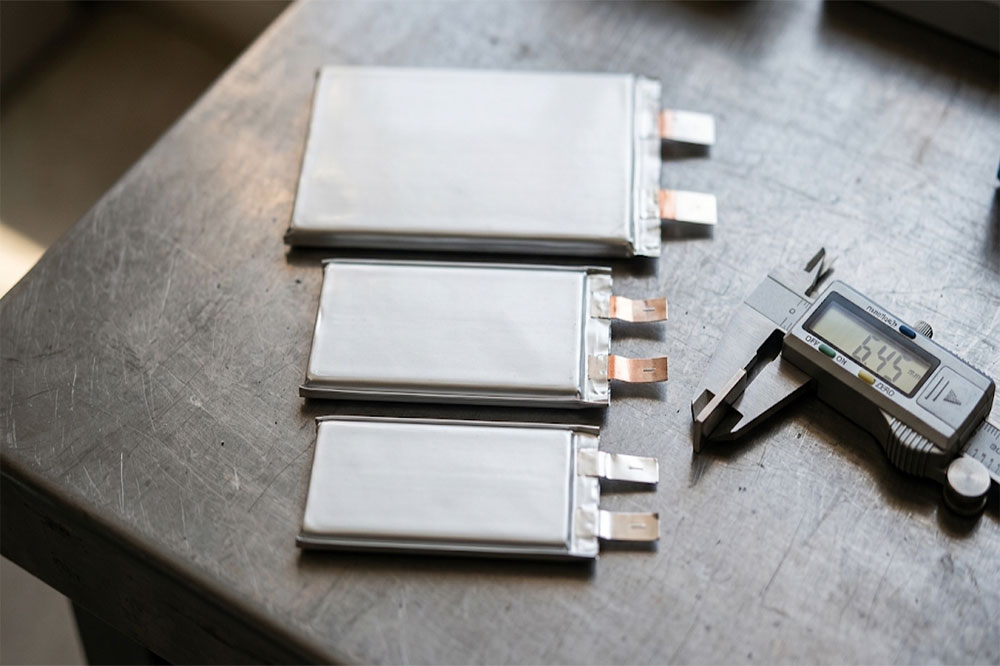
A 3.7V 2000mAh pouch cell sold as “10C” will not deliver 20A in your product. On a bench at 25°C it might, for a few seconds, while the voltage falls and the surface climbs past 50°C. Ten minutes of that and your calculated runtime is off by a third.
What a pouch cell can actually push comes down to three things: rated capacity, the cross-section of the tabs carrying current out, and how fast heat leaves the stack.
What a C rating means in amps
A C rating is a multiple of capacity, not a current. Multiply by the capacity in amp-hours to get amps.
I (A) = C × capacity (Ah)
| You want | Formula | On a 4500mAh cell |
| Amps from a C rating | I = C × Ah | 2C = 9A |
| C rating from amps | C = I ÷ Ah | 15A = 3.3C |
| Run time | minutes ≈ 60 ÷ C | 2C = 30 min |
On a 2000mAh cell, 1C is 2A and 3C is 6A. On the 3.7V 15Ah 148198, 1C is 15A. Same C number, seven and a half times the current.
Rated capacity is measured at 0.2C, and what you get at 2C is usually 5 to 10% lower before the cutoff steals more. The pouch cell capacity guide covers how much survives.
Why a pouch cell usually rates lower than a cylinder
The cathode is rarely the limit. LiCoO₂ and NCM move lithium fast enough for 20C pulses. What separates a pouch from an 18650 is the path current takes out, and the distance heat travels.
Tab width and foil thickness set the ceiling
Foils collect current and weld to tabs through the seal. On a small cell those tabs are often 3 to 5mm wide and 0.1mm thick, so 0.3 to 0.5mm² of copper. At a few amps per mm², that tab is good for 2 to 3A and warm well before 10A. A cylinder ends in a solid cap and a steel can that spreads heat. A pouch has one narrow window, and everything passes through it.
Heat has nowhere to go
A pouch is a flat stack inside 0.1mm laminate that insulates well in the through-plane direction. Heat born mid-stack travels sideways to the tabs or out through the face, and in a 100mm cell that is a long way. Hence the same electrodes can carry 3C in a 20mm cylinder and 1C in a 10mm pouch. The aluminum plastic film seals well and conducts heat badly.

Reading a discharge spec without getting fooled
Continuous and peak are different products
Continuous means current until cutoff with the cell under its temperature limit. Peak means something shorter, and the length of “shorter” is the whole specification.
| The sheet says | Ask | A straight answer |
| “20C discharge” | How long, at what temperature? | 20C for 10s at 25°C |
| “3C continuous” | Surface temperature at the end? | 45°C, 25°C ambient |
| “800 cycles” | What depth, what rate? | 80% DoD, 1C |
| “No loss at high rate” | Against what baseline? | 92% of the 0.2C figure |
A C rating with no time window is a marketing figure. Ask for the window, ambient temperature, cutoff and end-of-test surface temperature.
Small print that moves the number
Internal resistance roughly doubles between 25°C and 0°C, and at −10°C a cell rated 2C may take only 0.5C without plating lithium on the next charge. A figure measured to 2.5V also includes capacity a device cutting off at 3.3V never sees; the voltage and discharge curve guide shows how much.
What high current costs you
IR drop. A 2000mAh LiCoO₂ pouch sits around 50 to 80mΩ. At 2A that costs 0.12V, at 6A it costs 0.4V. With cutoff near 3.3V, a slice of stored energy never gets used: you paid for 2000mAh and shipped 1600.

I²R heating. Double the current and heat in the tabs and foils quadruples. Heat raises resistance, and resistance raises heat.
Electrode stress. The stack flexes and the SEI pays.
| Discharge rate | Capacity retention after 300 cycles |
| 0.5C | 90 to 93% |
| 1C | 85 to 88% |
| 2C | 78 to 82% |
| 3C and above | 65 to 75% |
Read those as typical; the spread is mostly heat management. Swelling is the visible symptom: a pouch that has grown 3 to 4% after a few hundred hard cycles has been run past its window, and once the laminate pillows it is finished.
[IMAGE 2 HERE] Discharge curves at 0.5C, 1C and 2C, with the 3.3V device cutoff marked.
Worked example: sizing from a load profile
A handheld medical monitor on a 3.7V rail draws 0.4A average, pulls 1.8A for 20 seconds per measurement cycle, and needs 8 hours at up to 40°C.
| Step | Work | Result |
| Energy | 0.4A × 8h | 3.2Ah |
| Peaks | 1.8A × 20s, 12 cycles/h | under 0.1Ah |
| Derate for 40°C | +20% for cycle life | 3.8Ah target |
| Peak C rate | 1.8 ÷ 3.8 | 0.47C |
| Model | 8025100, 4000mAh build | comfortable margin |
A half-C peak is nothing. Most handheld products sit here, where thickness picks the cell and rate never binds. A drone at 12A on a 4500mAh pack runs 2.7C, and a 30A punch is 6.7C; there, tabs and airflow drive the design.
Series and parallel: what changes per cell
Parallel cells split current. Series cells do not. A 3S pack at 2C pushes 2C through every cell in the string; a 3S2P pack at 2C pushes 1C through each.
| Build | Pack voltage | Pack capacity | Pack 2C | Per cell |
| 1S1P | 3.7V | 2.0Ah | 4.0A | 4.0A |
| 3S1P | 11.1V | 0.85Ah | 1.7A | 1.7A |
| 1S2P | 3.7V | 3.0Ah | 6.0A | 3.0A |
| 3S2P | 11.1V | 1.7Ah | 3.4A | 1.7A |
If a cell cannot take the current alone, put a second one beside it, not behind it. The 3S 850mAh pack and the 1S2P 3000mAh pack are two arrangements of that idea.
The parts that fail before the cell does
Protection board. A 15Ah cell behind a 5A PCM is a 5A battery. PCM ratings are often the real ceiling.
Wire. 22AWG carries 1.5 to 2A on short internal runs, 20AWG 2.5 to 3A, 18AWG 4 to 5A. Thin wire adds series resistance, so sag at the connector is worse than at the tab.
Connector. JST PH 2.0 is rated 2A, an XT30 30A, an XT60 60A.
Pouch cell models and their discharge headroom
| Model | Capacity | Energy | Size (mm) | 1C | Typical continuous | Fits |
| 8025100 | 2000mAh | 7.4Wh | 8 × 25 × 100 | 2A | 2A, peaks to 4A | GPS, handhelds, medical |
| 134365 | 4500mAh | 16.65Wh | 13 × 43 × 65 | 4.5A | 4.5A, high-rate on request | drones, RC, power tools |
| 148198 | 15Ah | 55.5Wh | 14 × 81 × 98 | 15A | 15 to 30A with wide tabs | power banks, solar, light EV |

The 148198 puts 55.5Wh into 111cm³, near 500Wh/L. That density costs rate headroom, which the Wh/kg vs Wh/L comparison sets out.
Continuous figures depend on tab width, PCM rating and mounting. The 134365 platform can be built far higher, with 20C quoted for specific builds; ask for the pulse window and surface temperature first.
Every model in the pouch cell battery range takes the tab, wire, connector and PCM the load needs. Send a load profile rather than a part number.
FAQ
Does a higher C rating always mean a better cell?
No. Rate capability is bought with thinner electrodes, wider tabs and more electrolyte, all trading against energy density. A 20C cell holds less energy than a 1C cell of the same size, and costs more. Pick the lowest rating that covers your peak.
Can I exceed the continuous rating occasionally?
Usually, if the excursion is short and the start temperature low. 3C for five seconds at 25°C is reasonable. 3C for two minutes in a sealed 45°C housing is a warranty claim in progress.
What limits pouch cell discharge rate more, chemistry or tabs?
Below about 10Ah, usually the tabs and the heat path. Chemistry sets the ceiling; tab area and laminate thermal resistance decide how much of it you reach.
Does discharge rate affect cycle life?
Yes, more than most datasheets admit. 1C costs a few points of retention over 300 cycles against 0.5C, and 3C costs a lot more. Heat is the mechanism, so a well-cooled 2C pack can outlast a badly housed 1C one.
Choose the rate before you choose the cell
Start with the load profile: continuous amps, peak amps, peak duration, and the ambient temperature inside the enclosure. Convert to a C rate against the capacity you chose for runtime. Then check tab, PCM, wire and connector, in that order.
Do that and the C rating stops being a claim to argue about.
Lithium ion Pouch Cells Products
-

11.1V 3S 850mAh li-ion Polymer Pouch Cell Battery Pack
-

134365 4500mAh 3.7V Rechargeable Lithium Polymer Battery
-

3.7V 1200mAh Li-Polymer Pouch Cell Battery
-

3.7V 15Ah 148198 Pouch Lithium Ion Battery
-

3.7V 1S2P 3000mah lithium Polymer Battery
-

3.7V 2000mAh Pouch Cell Battery
-

3.7V 502248 500mAh Lithium Ion Polymer Battery
-

3.7V 700mAh Li-Polymer Pouch Cell Battery
-

3.7V 800mAh Rechargeable Pouch Li-Polymer Battery
Leave a Reply