
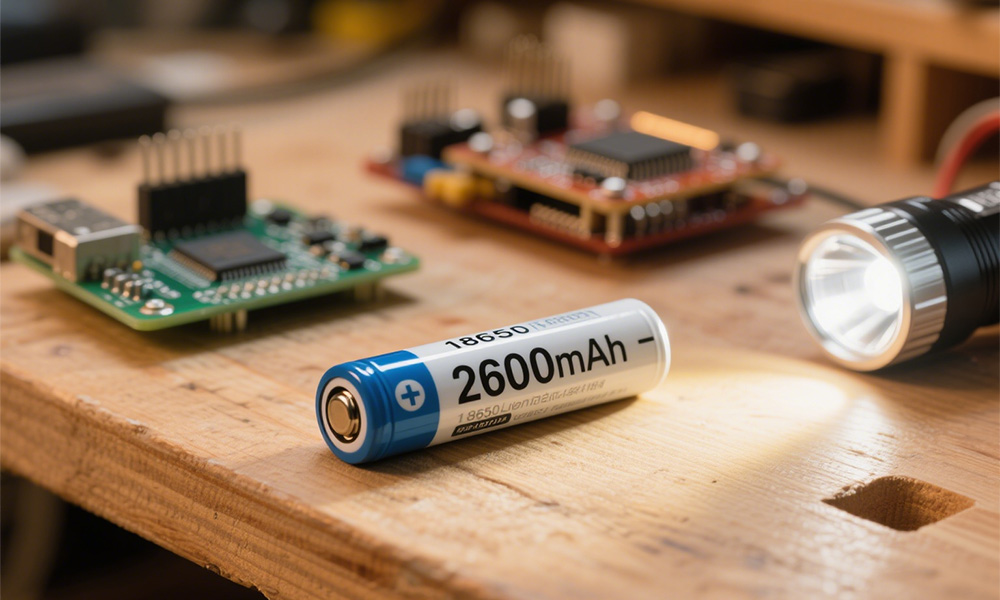
What is an 18650 Li Ion Battery 2600mAh?
If you’ve ever replaced the battery in a flashlight, built a DIY power pack, or tinkered with small electronics, chances are you’ve come across the 18650. The name simply refers to its size — about 18mm in diameter and 65mm in length, shaped like a beefed-up AA battery. The 2600mAh rating tells you how much charge it can store under standard conditions.

Compared with 2000mAh or 3000mAh versions, the 2600mAh model sits right in the middle. It offers a balance between runtime and discharge capability, which is why it’s still widely used.
Key Specs and Parameters (in plain words)
Numbers on spec sheets can be confusing if you’re not used to them. Here are the essentials you’ll actually care about:
- Nominal Voltage: Usually 3.6V–3.7V. Fully charged at about 4.2V, and considered empty at around 2.5V–2.75V.
- Capacity: Rated at 2600mAh, though real-world results can swing a little between 2500 and 2650mAh depending on load and environment.
- Discharge Current: Standard cells handle 5A–10A; performance-oriented ones can go up to 20A. For flashlights or doorbells, 5A is plenty.
- Charging: Uses CC/CV (constant current / constant voltage). A safe rate is around 0.5C (≈1.3A). Faster charging at 2.6A is possible, but it runs hotter.
- Size and Weight: Roughly 18.3mm diameter, 65mm in length, 44–48g in weight. Protected versions are longer (closer to 69mm), which can cause fit issues.
Personal note: I once bought a protected version for my flashlight, only to realize it was too long for the battery tube. Lesson learned — always measure the space before ordering, especially if you’re building your own pack.

Where It’s Commonly Used
The 18650 2600mAh is a workhorse cell with a wide range of applications:
- Flashlights & Headlamps: Good runtime and safe discharge rates.
- Household Devices: Doorbells, cameras, small sensors, anything that doesn’t draw crazy amps.
- Battery Packs: Laptops, DIY power banks, e-bike packs — often built with multiple cells in series/parallel.
- DIY Projects: Raspberry Pi portable setups, small robots, solar-powered storage projects.
Buying & Usage Tips
- Match to your load: High-drain motors? Look for high-discharge versions. Low-power electronics? Standard cells are fine.
- Protected vs. unprotected: Beginners are better off with built-in protection. For custom packs, use a proper BMS.
- Chargers matter: Always use a lithium-ion charger with CC/CV. Cheap “universal” chargers are risky.
- Storage: Don’t leave them fully charged or fully empty for months. Around 50% charge is best for long-term storage.

Final Thoughts
The 18650 li ion battery 2600mAh has stayed relevant because it’s a balanced option. It delivers enough capacity, fits standard holders, and works in all sorts of projects.
The only real catch is that not all 2600mAh cells are created equal. Some focus on higher current output, some on safer everyday use. If you pay attention to details like discharge rate, protection circuit, and physical size, you’ll end up with a reliable power source that just works.
Leave a Reply