
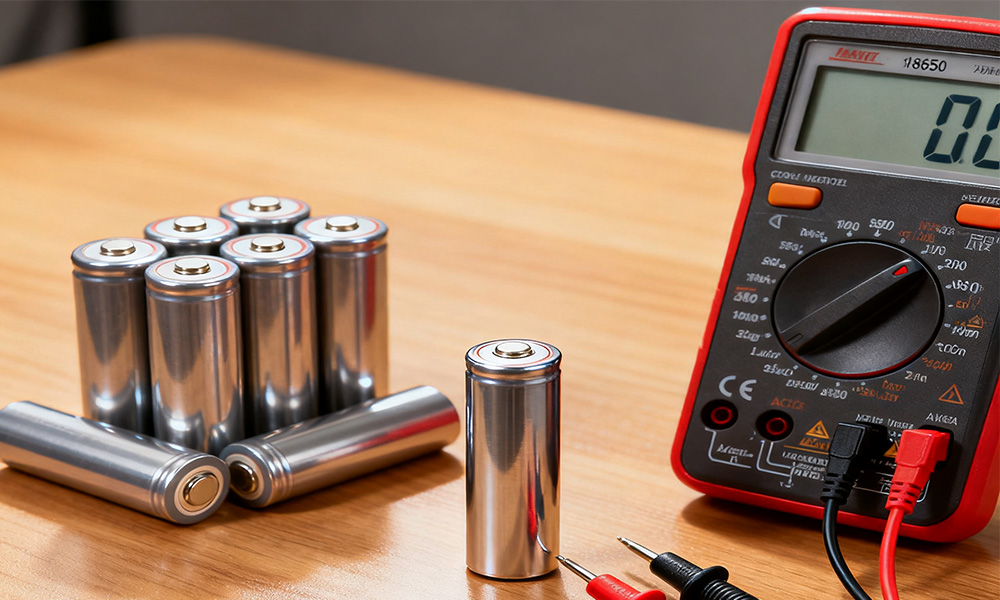
You’ve probably seen them advertised online: “5000mAh 18650 lithium battery, 3.7V, rechargeable.” Sounds amazing—tiny cylinder, fingertip width, yet packed with 5000mAh of energy. But how real is that number?
Many first-time buyers are drawn to that “5000” because in daily life, it represents long runtime, reliability, and convenience. Yet when you actually put it into a flashlight, wireless camera, or DIY battery pack, the measured performance often disappoints. In some tests, a battery claiming 5000mAh delivered barely over 1000mAh. That gap feels like ordering a large latte and getting half a cup of milk.
True Capacity Is Rarely the Label
18650 is a standard size: 18mm diameter, 65mm length. Physically, there’s only so much active material you can pack inside. Even with top-tier manufacturing, pushing beyond 3500mAh is extremely difficult. So when you see “5000mAh,” pause and consider—is this marketing, or lab magic?
Many low-cost batteries simply print the theoretical maximum as the “rated” capacity. It’s not always malicious; sometimes it’s just a sales tactic. The actual chemical density and materials may be lower, or they might reuse old cells.
Real Value Lies in Usage, Not Numbers
Professionals in e-bike, security, or energy storage sectors rarely start with mAh. They ask practical questions first:
- Maximum discharge current?
- Does it include a protection circuit?
- Internal resistance?
- Thermal stability?
These factors matter more than the printed number. A 3000mAh cell with stable 10A discharge often outperforms a “5000mAh” cell that drops voltage under load.
For example, one workshop using wireless security cameras initially relied on “5000mAh” cells. In high summer heat, the batteries lost half their power in one hour and damaged two mainboards because they lacked protection. Switching to modest 3000mAh protected cells solved the problem. Less advertised capacity, but better real-world runtime.
Market Illusions vs Rational Choice
The “5000mAh” hype in the battery market is like fashion brands and their “slim sizes”: looks good on the label, but doesn’t always fit. Cheap online cells with exaggerated ratings are everywhere. A few dollars per cell rarely buys true high-capacity chemistry. Reliable 18650 cells with stable chemistry typically reach 3000–3500mAh.
So when you see “5000mAh 18650 lithium battery,” approach with skepticism. Check reviews, discharge curves, temperature behavior, and request datasheets. Those numbers printed on the wrapper are just marketing; chemistry tells the real story.
Conclusion: Reality Matters More Than Numbers
We live in a world of numeric illusions—megapixels, download speeds, battery mAh. But energy density, chemical stability, and cycle life—these invisible metrics—define a battery’s true worth.
Chasing a larger number alone can be misleading. A modest 3000mAh cell, stable over dozens of cycles, may outperform a flashy 5000mAh cell. Next time you search “5000mAh 18650 lithium battery,” remember: labels are superficial, real energy lies in chemistry, not packaging.
Leave a Reply