
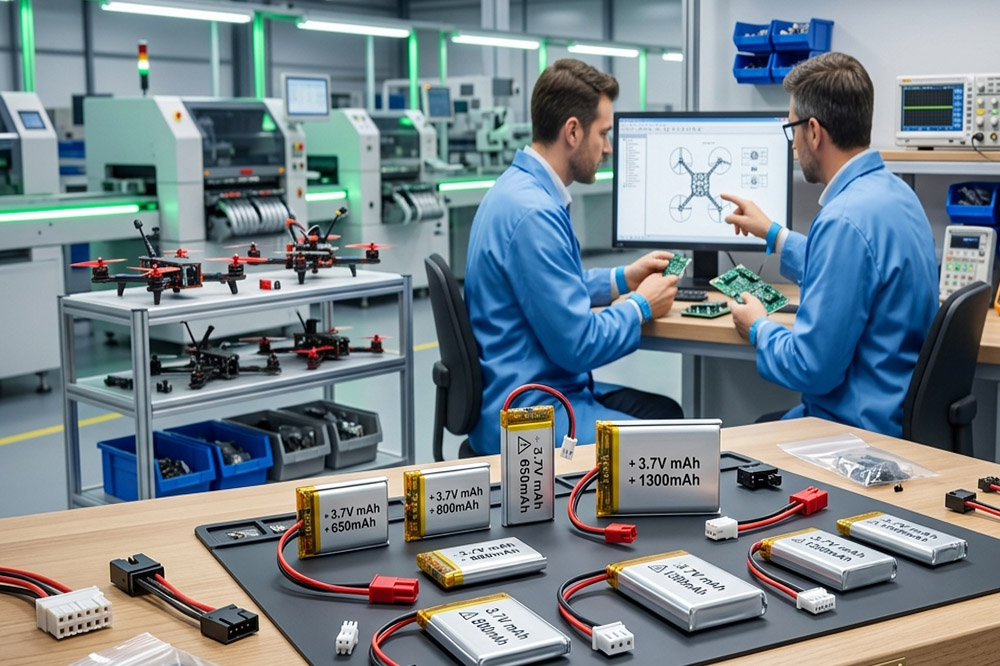
A common question from drone users is: “I have a 3.7V LiPo battery. Can I just buy another 3.7V battery and plug it in?”
It sounds reasonable, but the answer is usually no.
A few times we have seen customers choose a replacement battery based only on voltage. The battery was 3.7V, the capacity looked close, and the size was almost right. However, when they received it, the connector did not fit their drone.
The problem is that 3.7V only describes the battery voltage. It does not define the connector type.
Two different 3.7V LiPo batteries can have completely different plugs, wire layouts and connection methods.
For drone manufacturers and battery buyers, the connector is a small detail that can become a big problem during production.
A 3.7V LiPo Battery Does Not Mean the Same Connector
A single-cell LiPo battery normally has a nominal voltage of 3.7V.
This specification tells us about the electrical characteristics of the battery cell, but not the physical connection.
A 3.7V drone LiPo battery may use:
- JST-PH connector
- JST 1.25 connector
- Molex PicoBlade connector
- custom OEM connector
These connectors may look similar, especially on small batteries, but they are not always interchangeable.
The connector affects:
- whether the battery can physically connect
- how much current can safely pass
- whether the polarity matches
- whether the battery fits the drone design
So when replacing a drone battery, checking only “3.7V LiPo” is not enough.
Why Do Different Drones Use Different LiPo Connectors?
The reason is simple: drones are designed differently.
A small toy drone and a professional UAV may both use LiPo batteries, but their requirements are not the same.
A mini indoor drone usually focuses on:
- low weight
- compact size
- simple connection
A larger UAV may care more about:
- higher current output
- stronger mechanical connection
- long-term reliability
For example, a small camera drone might use a lightweight JST connector because the power requirement is limited.
But a drone designed for heavier payloads may need a stronger connector with thicker wires because the battery must deliver more current.
The connector is not just a plug. It is part of the battery system design.

Common 3.7V LiPo Battery Connectors Used in Small Drones
JST-PH 2.0
This is one of the most common connectors for small electronics and mini drones.
Advantages:
- lightweight
- easy to install
- widely available
It is often used in low-power applications.
JST 1.25
This connector is smaller than JST-PH 2.0.
It is popular in very compact drones where every millimeter matters.
Molex Connectors
Molex connectors are often selected when manufacturers need more stable connections.
They can provide better reliability in some designs.
Custom Connectors
Many drone companies choose custom connectors when producing their own products.
This allows them to control:
- battery installation method
- cable position
- assembly process
- user experience
For mass production, this is actually quite common.
Voltage Matching Is Not Enough When Replacing a Drone Battery
Imagine a customer finds a 3.7V LiPo battery online.
The capacity is similar.
The connector looks close.
Can it replace the original battery?
Not always.
Before replacement, several points should be checked.
Connector Shape
Check:
- plug size
- number of pins
- locking structure
A connector that looks similar may still not connect correctly.
Polarity
This is one of the most important points.
The positive and negative wires must match.
A wrong polarity connection can damage the drone electronics.
Battery Size
The battery must physically fit inside the drone.
Check:
- length
- width
- thickness
- cable position
For OEM drone projects, these details are normally confirmed before battery production starts.

Can You Change the Connector on a 3.7V LiPo Battery?
Technically, yes.
Some repair shops replace connectors when the original plug is unavailable.
However, it is not always the best solution.
Changing connectors requires:
- correct soldering
- polarity checking
- avoiding short circuits
- proper insulation
For one repair, it may be acceptable.
For hundreds or thousands of drones, changing connectors manually is not practical.
This is why drone manufacturers usually work with battery suppliers who can provide the correct connector from the beginning.
Why UAV Companies Need Custom LiPo Battery Packs
When a drone company develops a new product, they rarely only ask for “a 3.7V battery.”
They usually need a complete battery solution.
For example:
A drone designer may have a battery compartment with limited space:
- fixed length
- special cable position
- specific connector location
The battery supplier may need to adjust:
- cell size
- capacity
- wire length
- connector type
- protection design
This is where OEM battery manufacturing becomes important.
A standard battery may work for testing, but a production drone usually needs a battery designed around the final product.

What Should Drone Manufacturers Ask a LiPo Battery Supplier?
When selecting a battery supplier, companies usually look beyond price.
Important questions include:
Can you customize connectors?
Different drone projects may require different plugs.
Can you customize battery size?
Small changes in dimensions can affect drone assembly.
Can you provide battery testing?
Reliable suppliers normally test:
- capacity
- discharge performance
- cycle life
- safety performance
Can you provide certifications?
Depending on the market, customers may require:
- UN38.3
- IEC62133
- CE
- UL related certifications
Final Thoughts for Drone Battery Buyers
Not all 3.7V LiPo drone batteries have the same connector.
The voltage may be identical, but the connector, wiring, size and current requirements can be completely different.
For hobby drone users, checking the original connector before replacement can prevent compatibility problems.
For drone manufacturers, choosing the battery design early is usually a better approach than modifying batteries later.
A reliable LiPo battery supplier can help match the right cell, connector and battery structure for the drone application, especially when moving from prototype testing to mass production.


Leave a Reply