
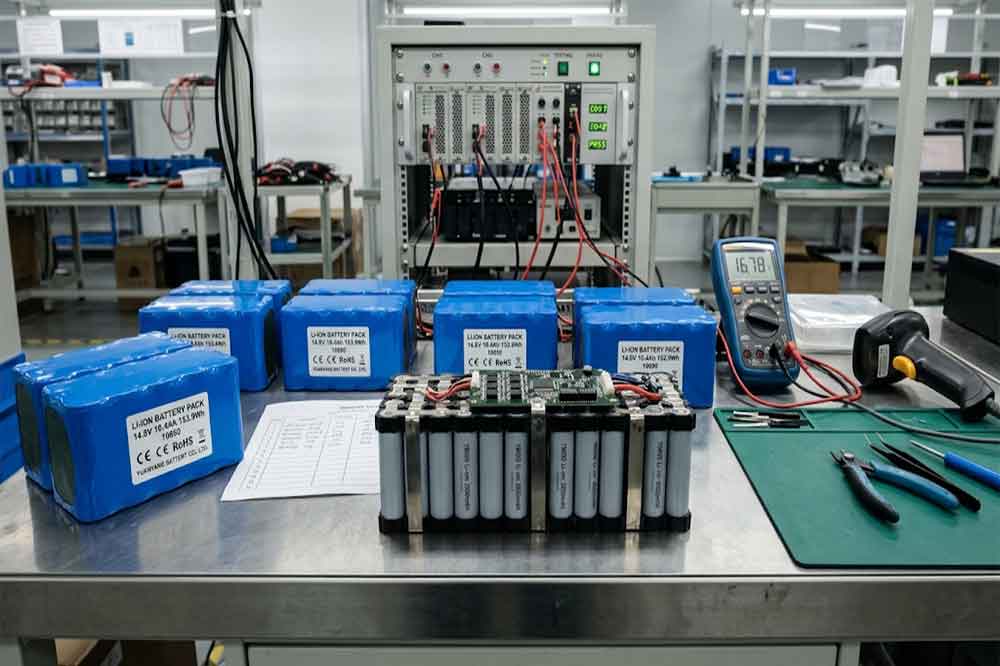
Finding a manufacturer for protected 18650 battery packs is not simply a matter of comparing quotations. Two suppliers may offer packs with the same nominal voltage and capacity, but their products can differ significantly in cell consistency, protection circuit design, assembly quality, and long-term reliability.
For equipment manufacturers and distributors, these differences can affect product performance, warranty costs, and the stability of future orders.
A reliable manufacturer should be able to explain how the battery pack is designed, which cells are used, how the protection circuit works, and what testing is performed before shipment. Buyers should also look beyond the sample stage and consider whether the factory can maintain consistent quality during mass production.
Before placing an OEM or wholesale order, there are several points worth checking.
Explore our [18650 Lithium Battery] range for different cell and battery pack requirements, including options for OEM projects.
Why Choosing the Right Manufacturer Matters
A protected 18650 battery pack combines lithium-ion cells with a protection circuit, connecting materials, insulation, and an external enclosure or wrapping.
The protection circuit is an important part of the assembly. Depending on the design, it may help prevent overcharging, over-discharging, overcurrent, and short circuits. However, protection functions alone do not guarantee a reliable battery pack.
Cell quality, electrical connections, heat management, and assembly workmanship also influence performance.
For example, a battery pack designed for a handheld industrial terminal may have different requirements from one used in a portable medical device or an outdoor monitoring system. The operating current, available space, charging method, and expected service life all need to be considered.
A manufacturer should understand the actual equipment requirements rather than simply recommend a standard battery configuration.
Check the Quality and Traceability of Battery Cells
The battery cells are the foundation of the entire pack. Even a well-designed protection circuit cannot compensate for poor-quality or inconsistent cells.
Buyers should ask manufacturers where their 18650 cells come from and whether the cell models can be identified and traced.
Several details deserve attention:
- Cell brand and model: Confirm the actual cell manufacturer and model number rather than accepting a general description such as Grade A cells.
- Capacity consistency: Check whether the cells meet the required minimum and typical capacity.
- Internal resistance: Cells with significantly different internal resistance may behave differently during charging and discharging.
- Voltage consistency: Cells should be checked and matched before pack assembly.
- Batch traceability: The manufacturer should have a process for identifying cell batches used in production.
For multi-cell battery packs, consistency becomes particularly important. A weak cell in a series-connected configuration can affect the usable capacity and overall performance of the pack.
Ask whether the factory performs incoming inspection, capacity testing, internal resistance measurement, and voltage sorting.
It is also useful to request actual test records for the proposed cell model. A product specification sheet alone does not show how the cells perform in a production batch.

Understand the BMS Protection Design
A protected 18650 battery pack needs a protection circuit that matches its electrical requirements.
Some buyers focus mainly on voltage and capacity when requesting quotations. However, the protection board specification is equally important.
Before approving a design, confirm the following:
Overcharge protection
The protection circuit should disconnect charging when the cell voltage reaches its specified protection threshold.
Over-discharge protection
The circuit should prevent the cell voltage from dropping below the specified safe limit during use.
Overcurrent protection
The protection board must support the equipment’s normal operating current and expected peak current. A board selected only according to nominal operating current may cause unwanted shutdowns during startup.
Short-circuit protection
The circuit should respond appropriately to an output short circuit and help prevent damage to the battery assembly.
Temperature protection
Depending on the application, temperature monitoring or additional thermal protection may be required.
Buyers should also check the protection board’s continuous discharge current, peak current, recovery conditions, and charging current.
One common problem in custom battery projects is selecting a protection board that technically matches the battery voltage but cannot support the actual equipment load.
A professional manufacturer should review the equipment’s current consumption and charging requirements before confirming the BMS design.

Evaluate Customization Capabilities
Not every protected 18650 battery pack can be used as a direct replacement for a standard battery.
OEM projects often involve restrictions on dimensions, connectors, installation positions, and communication requirements.
A manufacturer should be able to support customization in several areas.
| Customization Item | What Buyers Should Confirm |
|---|---|
| Voltage | Series connection and nominal voltage |
| Capacity | Cell capacity and parallel configuration |
| Dimensions | Maximum length, width, and thickness |
| BMS | Protection functions and current rating |
| Connector | Model, pinout, and cable length |
| Housing | PVC, plastic enclosure, or custom casing |
| Label | Logo, model number, and warning information |
For example, a 2S2P protected 18650 battery pack uses four cells, with two cells connected in series and two parallel strings. However, the final design still depends on the required voltage, capacity, discharge current, and available installation space.
Mechanical details should not be overlooked. A battery pack that is slightly too thick may not fit inside the customer’s equipment, even when its electrical specifications are correct.
Ask the manufacturer whether it can review drawings, produce samples, modify connectors, and adjust the BMS or enclosure before mass production.
For more details about the information required for a custom project, see our guide: [Custom Protected 18650 Battery Packs: What Specifications Are Needed?] (Article 28).
Examine Manufacturing and Quality Control
A supplier’s production capability should be evaluated through its actual manufacturing processes, not just its factory photos or company introduction.
A reliable battery pack manufacturer should have defined procedures for cell inspection, sorting, connection, insulation, protection board installation, and final testing.
Pay particular attention to the following production stages.
Cell inspection and matching
Cells should be checked before assembly. Capacity, voltage, and internal resistance are important parameters.
Connection and assembly
Depending on the design, nickel strips, welding parameters, wiring, and insulation materials should be controlled. Poor connections can increase resistance and create unnecessary heat.
BMS installation
The protection board should be installed according to the electrical design, with correct wiring polarity and secure connections.
Insulation and mechanical protection
The finished pack should have appropriate insulation between conductive parts. The wrapping or enclosure should protect the assembly from normal handling and installation conditions.
Final electrical testing
The finished battery pack should be checked for voltage, polarity, output performance, and relevant protection functions.
For OEM buyers, it is worth asking whether the manufacturer maintains production records and inspection reports for each batch.
A sample that works correctly is a useful starting point, but it does not automatically prove that every unit in a large production order will meet the same requirements.

Verify Certifications and Shipping Documents
Certification requirements depend on the battery design, destination market, and application.
For lithium-ion battery packs, buyers may need to review documents such as:
- UN38.3 test report and test summary for applicable transportation requirements.
- MSDS or SDS documentation.
- CE documentation where applicable to the product and market.
- RoHS documentation where relevant.
- UL certification or component recognition when required by the end product or customer specification.
- ISO 9001 certification as supporting evidence of the manufacturer’s quality management system.
One important point: a factory should not simply claim that all its products are certified. Buyers need to check whether the actual battery model and configuration are covered by the available reports or certificates.
For example, a test report for a different battery configuration should not automatically be treated as evidence for a newly customized pack.
Before ordering, confirm which documents are available, which model numbers they cover, and whether additional testing will be required.
Check Production Capacity and Delivery Time
A manufacturer may be able to produce several samples but struggle to handle repeat orders or large-volume production.
This is particularly important for distributors and equipment manufacturers that need stable supply over several months.
Ask about:
- Monthly battery pack production capacity.
- Number of assembly and testing lines.
- Availability of key cell models.
- Standard sample lead time.
- Mass production lead time.
- Capacity for repeat orders.
- Procedures for handling urgent orders or component shortages.
It is also worth distinguishing between cell inventory and finished battery pack inventory.
A factory may have cells in stock but still need time to manufacture custom packs, install the BMS, perform testing, and complete packaging.
For customized projects, sample approval should be followed by a clearly defined production specification. This helps reduce differences between the approved sample and later orders.
Compare Quotations Beyond the Unit Price
A lower quotation does not necessarily represent a lower purchasing cost.
When comparing two protected 18650 battery pack manufacturers, make sure both quotations are based on the same technical requirements.
Check whether the quoted price includes:
- The specified cell brand and capacity.
- The correct number of cells and connection configuration.
- BMS protection functions and current rating.
- Connectors and cables.
- Insulation or external housing.
- Testing and quality inspection.
- Required labels and packaging.
- Applicable certification and documentation costs.
A quotation that uses different cells or a lower-rated protection board should not be compared directly with one based on your complete specification.
For long-term OEM cooperation, also discuss warranty terms, defective product handling, engineering support, and the availability of replacement components.
These details can have a greater impact on the overall purchasing cost than a small difference in the initial unit price.
Questions to Ask Before Placing an Order
Before selecting a protected 18650 battery pack manufacturer, buyers can use the following questions during supplier evaluation:
- Which 18650 cell brand and model will be used?
- What are the BMS continuous and peak discharge current ratings?
- Can you customize battery dimensions, connectors, and housing?
- What electrical tests are performed on every finished battery pack?
- Can you provide UN38.3 documentation and other applicable certificates?
- Can you produce samples before mass production?
- What are your sample and bulk production lead times?
- How do you ensure consistency between sample approval and repeat orders?
The answers should be specific and supported by technical documents whenever possible. General statements such as good quality, professional factory, or competitive price are not enough to evaluate a battery supplier.
Final Thoughts: Choose a Manufacturer, Not Just a Supplier
Choosing a protected 18650 battery pack manufacturer is a technical and commercial decision.
Cell traceability, BMS selection, customization capabilities, manufacturing quality, testing procedures, and delivery reliability all deserve attention before an order is confirmed.
For OEM projects, it is usually better to provide the equipment requirements and let the manufacturer review the battery design before requesting a final quotation. This makes it easier to identify technical problems early and avoid unnecessary changes after sample approval.
At Apsenx, we support customized lithium battery pack development for industrial equipment, portable electronics, and other OEM applications. Buyers can discuss cell selection, voltage, capacity, protection circuit requirements, connectors, dimensions, and packaging according to their project specifications.
If you are sourcing protected 18650 battery packs for an OEM project or wholesale order, contact our team with your technical requirements for a battery solution review.
FAQ
Q1: How do I choose a reliable protected 18650 battery pack manufacturer?
Check cell traceability, BMS design, customization capability, manufacturing processes, testing records, certifications, and production capacity. Requesting samples and technical documents is also recommended.
Q2: Can manufacturers customize protected 18650 battery packs?
Yes. OEM manufacturers can customize voltage, capacity, dimensions, cell configuration, BMS, connectors, wiring, enclosure, labels, and packaging according to project requirements.
Q3: What certifications should a protected 18650 battery pack have?
Depending on the application and destination, buyers may need UN38.3, MSDS/SDS, CE, RoHS, or UL-related documentation. Requirements should be confirmed for the specific battery model.
Q4: How can buyers check battery pack quality before bulk ordering?
Request samples, cell specifications, BMS details, electrical test reports, and inspection records. Confirm that the approved sample specification will be used for mass production.
Q5: What information should I provide when requesting a quotation?
Provide required voltage, capacity, discharge current, charging requirements, dimensions, connector details, application, estimated quantity, and any certification requirements.
Related Articles
Before selecting a manufacturer, it is useful to understand how different series and parallel configurations affect battery voltage and capacity. Read our guide to [1S, 2S, 3S and 4S Protected 18650 Battery Packs] to compare common battery pack configurations.
For buyers developing a new OEM product, understanding the complete development process is equally important. Our guide explains [how to build a protected 18650 battery pack for OEM applications], from cell selection to final assembly.
If your project has specific size, voltage, capacity, or connector requirements, see [custom protected 18650 battery pack specifications] before sending an RFQ to a manufacturer.
For a broader understanding of cell specifications, battery protection, capacity, and applications, read our [complete guide to 18650 protected batteries].
Comparing protected 18650 battery manufacturers? Our [wholesale protected 18650 batteries buyer’s guide] explains what wholesale buyers should check, from cell quality and protection circuit specifications to production capacity and delivery arrangements.
Related Products
-

12V 4400 mah Lithium ion 3S2P 18650 Battery Pack
-

18650 2000mAh 3.7 volt Lithium-ion Battery
-

18650 20V 3.0Ah Cordless Drill battery
-

18650 22.2V 7.8Ah 2600Mah 6S3P Rechargeable Battery Pack
-

18650 2600mAh Rechargeable Lithium-Ion Battery 3.7V
-

18650 3.7V 10Ah Li-Ion Power Battery Pack
-

18650 3.7V 3300mah Rechargeable Lithium ion Battery
-

18650 7S7P 24V 14Ah Lithium ion Electric Scooter Battery Pack
-

18650 battery 3.7V 1500mAh Lithium-Ion Battery
-

18650 Battery 3500 mah Rechargeable Battery Cells
-

18650 Electric Scooter 48V 13000mAh Lithium Battery
-

2600mAh 3S1P 11.1V 18650 Battery Packs
-

3.7V Li ion Rechargeable 3000mah 18650 Battery Cell
-

36V 5200mAh 10S2P 18650 Battery Pack
-

48v 4400mah 13S2P 18650 Rechargeable Battery Pack
-

7S2P 24V 18650 Lithium Battery Pack
-

Electric Scooter 36V 4400mAH 10S2P 18650 Battery Pack
-

ICR 18650 Battery 2200mah 3.7V
Leave a Reply