
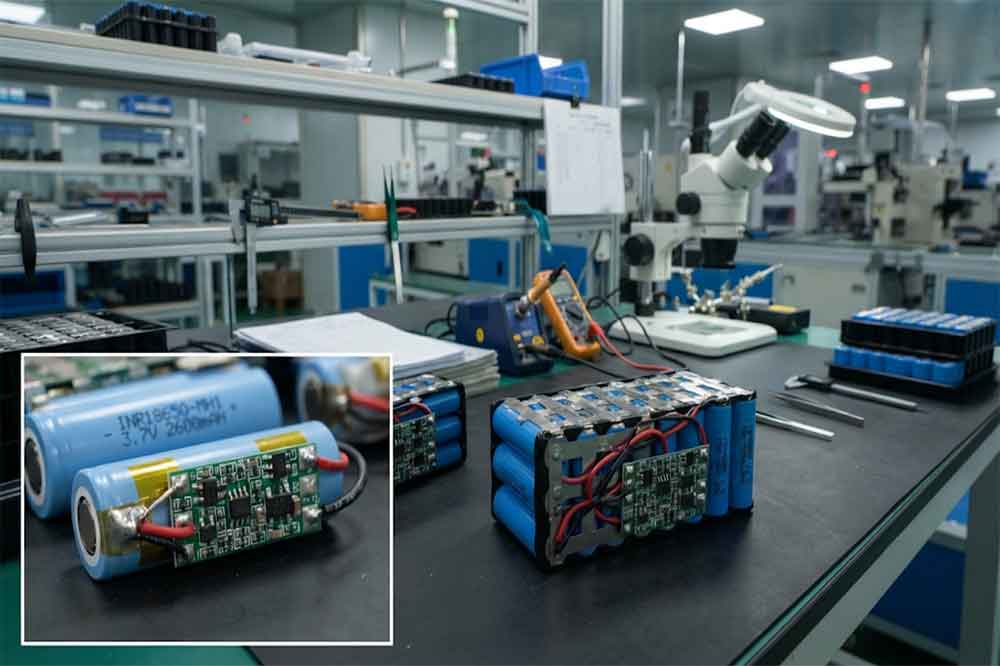
18650 protected battery is an 18650 lithium-ion cell combined with a protection circuit designed to help manage common battery risks such as overcharge, over-discharge, and short circuits. For equipment manufacturers, distributors, engineers, and battery pack buyers, the protection circuit can be just as important as the cell capacity itself.
However, not every 18650 application needs the same type of protection. The required protection current, cell capacity, battery configuration, physical dimensions, and connector can change depending on the final device.
This guide explains how protected 18650 batteries work, what to check before purchasing them, and when a protected cell or custom battery pack may be more suitable for an OEM project.
What Is 18650 Protected Battery?
A protected 18650 battery is usually built around a cylindrical 18650 lithium-ion cell with a small protection circuit attached to the battery.
The basic idea is simple:
18650 cell + protection circuit = protected 18650 battery
The cell stores the electrical energy, while the protection circuit monitors electrical conditions and disconnects the battery when certain abnormal conditions occur.
A typical protection circuit may provide protection against:
- Overcharge
- Over-discharge
- Short circuit
- Excessive current
The exact protection functions depend on the protection board design and battery configuration.
For a buyer, this means that two batteries with the same nominal voltage and capacity may still be different products because their protection circuits, discharge limits, dimensions, and connectors are different.
How Does 18650 Protection Circuit Work?
The protection circuit monitors the electrical condition of the cell during charging and discharging.
For example, when a lithium-ion cell reaches its upper voltage limit during charging, the protection circuit can disconnect the charging path. During discharge, if the cell voltage falls below the specified threshold, the circuit can disconnect the load.
Short-circuit and over-current protection work in a similar way. When the detected current exceeds the protection circuit’s designed limit, the circuit can interrupt the electrical connection.
This is why the protection board should not be treated as an accessory added after the battery is selected.
The protection circuit needs to match the cell and the application.
A flashlight, portable electronic device, industrial instrument, or custom battery pack may have very different current requirements.
For a deeper explanation, see our supporting article about how 18650 battery protection works.
Protected vs. Unprotected 18650 Batteries
One of the most common questions from battery buyers is the difference between protected and unprotected 18650 cells.
An unprotected 18650 cell normally consists of the lithium-ion cell itself without an integrated protection circuit.
A protected 18650 battery includes additional protection electronics.
The difference becomes important when selecting a battery for equipment that does not already have a suitable battery management or protection system.
Protected batteries can be useful for standalone battery applications where protection needs to be integrated into the individual cell or battery.
Unprotected cells may be more suitable for certain multi-cell battery packs where a dedicated BMS is already designed into the pack.
Neither option should automatically be considered suitable for every application. The right choice depends on the electrical design of the equipment.
Read our detailed comparison of protected vs unprotected 18650 batteries for a closer look at the differences.

What Voltage Is 18650 Protected Battery?
Most conventional 18650 lithium-ion cells have a nominal voltage around 3.6V or 3.7V, depending on the cell chemistry and manufacturer’s specification.
The fully charged voltage of a typical lithium-ion 18650 cell is around 4.2V.
The protection circuit does not normally change the basic chemistry or nominal voltage of the cell. Instead, it monitors the cell and helps prevent operation outside the designed electrical limits.
For OEM buyers, voltage should therefore be checked together with:
- Nominal voltage
- Full-charge voltage
- Discharge cutoff
- Maximum continuous current
- Protection current
- Cell capacity
A battery specification should never be selected from nominal voltage alone.
How to Choose the Capacity of Protected 18650 Battery
Capacity is usually expressed in mAh, such as 2000mAh, 2600mAh, 3000mAh, 3300mAh, or 3500mAh.
A higher capacity can provide longer operating time, but it does not automatically mean that the battery is better for every device.
The required capacity depends on the device’s current consumption, expected operating time, available space, and required discharge performance.
For example, a device with a relatively low current draw may prioritize capacity and operating time. Another application may need a higher discharge current even if its total capacity is lower.
The physical design also matters.
Adding a protection circuit can increase the overall length of a protected 18650 battery compared with a bare 18650 cell. This extra length needs to be considered when the battery is installed inside a narrow battery compartment.
Does 18650 Protected Battery Need a BMS?
This depends on the battery configuration and system design.
For a single-cell application, a protected 18650 battery may provide the required basic protection at the battery level.
For a multi-cell battery pack, the design may instead use a dedicated BMS or PCM that manages the entire battery pack.
For example, a 3S battery pack has three cells connected in series. The protection requirements are different from those of a single 18650 cell.
This is why OEM projects should not simply add a protected cell to an existing battery pack design without checking the electrical architecture.
The protection strategy should be designed around the complete battery system.
Protected 18650 Battery for OEM Applications
OEM battery requirements are usually more detailed than simply asking for a “protected 18650.”
A battery manufacturer may need to confirm:
- Cell chemistry
- Nominal voltage
- Capacity
- Maximum discharge current
- Protection current
- Protection thresholds
- Battery dimensions
- Connector type
- Wire length
- Charging requirements
- Operating temperature
- Battery configuration
- Label and logo requirements
- Packaging requirements
For a custom project, the protection board can also be selected according to the application’s current and voltage requirements.
The battery may then be supplied as a single protected cell or assembled into a custom battery pack.
This is particularly relevant for equipment manufacturers that need a repeatable battery specification rather than a general-purpose consumer battery.

Custom Protected 18650 Battery Packs
Protected 18650 cells can also be used as part of a larger custom battery pack.
For example, a pack can use multiple 18650 cells connected in series, parallel, or a series-parallel configuration.
The configuration determines the final voltage and capacity.
A simplified example:
1S1P
One cell in series and one cell in parallel.
2S1P
Two cells connected in series to increase voltage.
1S2P
Two cells connected in parallel to increase capacity.
2S2P
Four cells arranged as two series groups with two cells in each parallel group.
The protection system needs to match the complete configuration.
For multi-cell packs, a dedicated BMS may be more appropriate than treating each individual protected cell as an independent battery.
When Should You Buy Protected 18650 Batteries?
Protected 18650 batteries can make sense when the equipment requires individual-cell protection and does not already provide an appropriate protection system.
They may also be useful for certain portable electronics, instruments, lighting products, and other equipment designed around individual rechargeable cells.
For OEM buyers, however, the more important question is not simply:
“Do I need a protected 18650?”
The better question is:
“What protection architecture does my complete device require?”
That question helps prevent problems caused by choosing a battery based only on capacity or price.
What Should Wholesale Buyers Check?
For bulk purchasing, buyers should confirm the complete battery specification before placing an order.
Important points include:
Cell quality:
Confirm the cell model, chemistry, capacity, and discharge performance.
Protection:
Specify the protection functions and electrical thresholds.
Dimensions:
Check the total dimensions of the protected battery rather than the bare cell dimensions.
Connector:
Specify the connector model, cable length, polarity, and wire gauge when required.
Consistency:
For production applications, battery-to-battery consistency is important.
Testing and documentation:
Depending on the destination market and application, buyers may require documents and certifications such as UN38.3, MSDS, CE, RoHS, or other project-specific requirements.
For wholesale and OEM projects, the battery should be treated as a component of the final product rather than a generic commodity.
18650 Protected Battery for Wholesale and OEM Projects
For manufacturers and distributors, a protected 18650 battery can be supplied in different capacity and configuration options according to the application.
The available battery design can include different cell capacities, protection circuits, connectors, wires, labels, PVC colors, packaging, and other customization requirements.
For larger battery projects, it is also possible to move from a single protected 18650 cell to a custom 18650 battery pack.
The first step is to define the electrical and mechanical requirements clearly.
A useful RFQ should include the required voltage, capacity, current, dimensions, connector, quantity, application, and any available drawings.

Conclusion
An 18650 protected battery is more than an 18650 cell with an extra circuit. The cell, protection circuit, mechanical dimensions, discharge requirements, and final application all need to work together.
For a simple single-cell application, an integrated protection circuit may be appropriate. For a multi-cell OEM battery pack, a dedicated BMS and custom pack design may provide a more suitable system architecture.
Understanding this difference helps engineers and purchasing teams avoid selecting a battery based only on capacity or nominal voltage.
For current 18650 battery options, capacity choices, and OEM supply requirements, visit the 18650 Lithium Battery product category.
FAQ
1. What is 18650 protected battery?
18650 protected battery combines a rechargeable 18650 lithium-ion cell with a protection circuit. The circuit can help protect against conditions such as overcharge, over-discharge, short circuit, and excessive current.
2. What is the difference between protected and unprotected 18650 batteries?
A protected 18650 includes an integrated protection circuit, while an unprotected cell normally does not. The correct option depends on whether the device or battery pack already has its own protection system.
3. Can protected 18650 batteries be used in battery packs?
Yes, but the protection design must match the battery configuration. Multi-cell packs commonly require a dedicated BMS or PCM designed for the complete pack.
4. What capacities are available for protected 18650 batteries?
Common 18650 capacities include around 2000mAh, 2600mAh, 3000mAh, 3300mAh, and 3500mAh. The appropriate capacity depends on the device’s operating time, current demand, and available space.
5. Can 18650 protected battery be customized?
Yes. OEM customization can include cell capacity, protection circuit, dimensions, connector, wires, PVC, labeling, packaging, and battery-pack configuration.
-

12V 4400 mah Lithium ion 3S2P 18650 Battery Pack
-

18650 2000mAh 3.7 volt Lithium-ion Battery
-

18650 20V 3.0Ah Cordless Drill battery
-

18650 22.2V 7.8Ah 2600Mah 6S3P Rechargeable Battery Pack
-

18650 2600mAh Rechargeable Lithium-Ion Battery 3.7V
-

18650 3.7V 10Ah Li-Ion Power Battery Pack
-

18650 3.7V 3300mah Rechargeable Lithium ion Battery
-

18650 7S7P 24V 14Ah Lithium ion Electric Scooter Battery Pack
-

18650 battery 3.7V 1500mAh Lithium-Ion Battery
-

18650 Battery 3500 mah Rechargeable Battery Cells
-

18650 Electric Scooter 48V 13000mAh Lithium Battery
-

2600mAh 3S1P 11.1V 18650 Battery Packs
-

3.7V Li ion Rechargeable 3000mah 18650 Battery Cell
-

36V 5200mAh 10S2P 18650 Battery Pack
-

48v 4400mah 13S2P 18650 Rechargeable Battery Pack
-

7S2P 24V 18650 Lithium Battery Pack
-

Electric Scooter 36V 4400mAH 10S2P 18650 Battery Pack
-

ICR 18650 Battery 2200mah 3.7V
Leave a Reply