
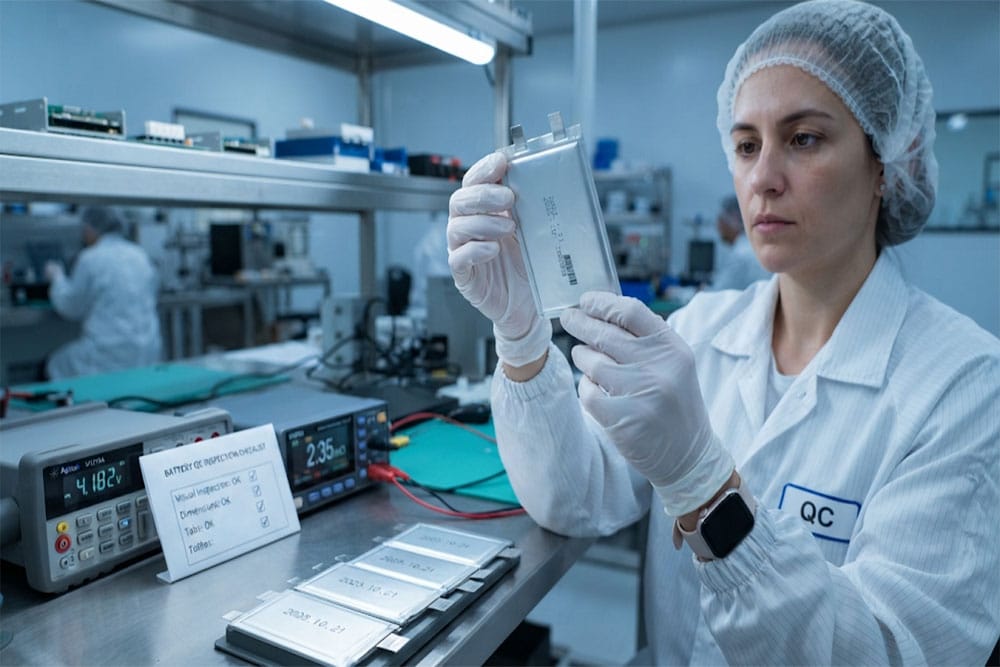
You found a supplier online. The price looks right and the datasheet reads well. None of that tells you whether the cells will survive twelve months in your product. A structured pouch cell quality inspection does, and it starts before you place a deposit.
The difference between a good batch and a bad one usually shows up in documents and sample tests, not in the quotation. This article walks through the checks professional buyers run in order, from paperwork to physical inspection, so you can audit a supplier in a week.
Start With Certificates, But Read Them Properly
Ask for four documents before anything else: UN38.3 test summary, IEC 62133 report, MSDS, and a capacity grading report for the specific model you are buying.
The common mistake is checking that the certificates exist. The real check is whether they match your model. A UN38.3 report issued for a 2000mAh cell says nothing about the 5000mAh cell quoted to you. Verify the model number, capacity, voltage, and test laboratory on every page. If the supplier ships freight without a matching UN38.3 summary, your shipment can be held at the airport and your production line stops with it.
Reputable factories provide these per model without being asked twice. At Apsenx, every pouch cell model ships with a UN38.3 test summary and MSDS, with IEC 62133 and CB reports available on request — see the pouch cell battery category for the standard documentation package included with wholesale orders.
Check Capacity Grading and Internal Resistance Matching
Two cells with the same printed capacity can differ by 15% in real measured capacity, and that spread is what kills multi-cell packs.
What to request:
- Capacity grading report — each cell’s measured capacity at 0.2C discharge, grouped into grades
- Internal resistance (IR) report — measured in milliohms per cell
- Voltage spread — open circuit voltage range across the batch after storage
A factory that grades cells sorts them into tight bins, for example all cells within 2% capacity and matched IR. A factory that skips grading ships you whatever comes off the line. In a 2S2P pack, one weak cell drags the whole pack down and cycles the strong cells harder, which shortens pack life for no visible reason until customers start returning units.
Ask the supplier to state their grading tolerance in writing — anything wider than ±3% on capacity is a red flag for pack projects. Our overview of how pouch batteries are connected in series and parallel explains why matching matters more as pack size grows.

Inspect the Physical Cell: Swelling, Wrinkles, and Seal Edges
Pouch cells fail mechanically before they fail electrically. When you receive samples, check every unit against these points:
Flatness and swelling. Lay the cell on a flat surface and check for a visible dome. Small gas generation is normal in the first cycles, but a swollen cell straight out of the box means electrolyte decomposition or a manufacturing fault. Our article on lithium ion pouch cell swelling: causes, risks and prevention covers how to read swelling rates from supplier test data — anything above roughly 5–6% after 500 cycles deserves a question.
Seal edges. The heat-sealed edges are the weakest part of the cell. Look for wrinkles, creases, or aluminum laminate exposed outside the seal area — a wrinkled edge can crack over cycles and let moisture in. The seal width should be even along its whole length; our technical guide on how lithium ion pouch cells are sealed shows what a correct heat seal and edge fold look like.
Tabs and surface. Nickel or aluminum tabs should be firmly welded with no flux residue, and the pouch surface should carry a legible date code and lot number. If the surface printing is inconsistent between cells in the same box, ask which production runs are mixed in the shipment.

Verify Batch Traceability
Traceability is the check most buyers skip and the one they regret most. When a field failure happens eight months later, the only way to contain it is mapping the failed unit back to a production date, material lot, and operator. Ask the supplier two questions:
- Is there a date code and lot number printed on every cell?
- Can you send a traceability report for a given lot on request?
A factory with in-house production and clean lot management answers both in one message. A trading company forwarding to some workshop usually cannot, and that gap will cost you during any warranty dispute.
Run a Small Incoming Inspection on Samples
Before mass production, order 10–50 sample units and test them in conditions that match your product:
| Check | Method | Pass Criteria (typical) |
| Capacity | 0.2C discharge after full charge | Within ±3% of rated capacity |
| Internal resistance | IR tester | Within supplier’s stated spread |
| OCV after 24h storage | Multimeter | ≥ 3.85V, uniform across batch |
| Weight | Precision scale | Within datasheet tolerance |
| Visual | Flat surface check | No swelling, no seal wrinkles |
| Discharge test in device | Real product | Runtime within 5% of target |
Cost of this inspection: a few hours of an engineer’s time. Cost of skipping it: a field recall on 5,000 units.

Review Cycle-Life and Swelling Data, Not Just Datasheet Claims
Every datasheet claims 500 cycles. The question is what the test report behind the claim shows. Ask for the actual cycle test curve: capacity retention versus cycle count at a stated C-rate, temperature, and cutoff. Then ask for swelling measurements at the same checkpoints.
Two suppliers can both claim “500 cycles to 80%” while one cell swells 8% at cycle 300 and the other stays under 4%. In a slim wearable enclosure, that is the difference between a product that still fits its housing and one that pops its screen off. For chemistry-dependent differences, our comparison of NMC vs LFP pouch cells breaks down which chemistry holds up better under your duty cycle.
Put the Agreement in Writing
The last check is contractual. A signed quality agreement should cover AQL inspection standard (AQL 0.65 or 1.0 is common for cells), grading tolerances for capacity, IR, and voltage, swelling rate limits at a defined cycle count, traceability commitments, and warranty terms with a claim procedure for dead-on-arrival rate.
Without this paper, a 2% DOA rate is an argument. With it, it is a claim procedure.
Put the Checks Together
A serious pouch cell quality inspection is not one test, it is a sequence: certificates matched to your model, grading and IR reports for the batch, physical inspection of seal edges and flatness, traceability confirmed, sample incoming inspection, and a written quality agreement. A supplier that clears all six will clear your field reliability targets too. If you are still building your sourcing shortlist, the pouch cell buyer’s guide for wholesalers covers MOQ tiers and supplier vetting in depth, and the Apsenx pouch cell range lists standard models from 500mAh to 15Ah with sample quantities available for incoming inspection.
Frequently Asked Questions
UN38.3 test summary and MSDS are mandatory for shipping lithium cells by air or sea. IEC 62133 (or CB report) is required by most markets for consumer devices. On top of those, request a capacity grading report and internal resistance data for your specific model — certificates prove legality, grading data proves quality.
Ten to fifty units is enough for a meaningful incoming inspection. Test capacity at 0.2C, measure internal resistance across all units, check open circuit voltage after 24 hours of storage, and inspect seal edges visually. If your product is a multi-cell pack, test cells from the same graded bin together.
A healthy NMC pouch cell typically stays under 4–5% thickness growth after 500 full cycles at room temperature. Growth above 8% at the same cycle count usually indicates electrolyte issues or poor stack pressure design. Always ask for the swelling curve, not just the cycle-life curve.
You can inspect the cells, but you cannot audit the process. Trading companies rarely control grading, sealing parameters, or traceability, so your reports come from a third party who may not reproduce them for the next batch. For pack projects, buying direct from a factory that performs cell grading and pack assembly in-house removes that risk.
Whoever defined the acceptance criteria loses the argument. That is why the quality agreement matters: with AQL standards and grading tolerances signed before production, an under-capacity batch has an agreed claim procedure instead of a dispute. Run the incoming inspection within the agreed window (usually 30 days) to keep the claim valid.
Lithium Ion Pouch Cell Series
-

11.1V 3S 850mAh li-ion Polymer Pouch Cell Battery Pack
-

134365 4500mAh 3.7V Rechargeable Lithium Polymer Battery
-

3.7V 1200mAh Li-Polymer Pouch Cell Battery
-

3.7V 15Ah 148198 Pouch Lithium Ion Battery
-

3.7V 1S2P 3000mah lithium Polymer Battery
-

3.7V 2000mAh Pouch Cell Battery
-

3.7V 502248 500mAh Lithium Ion Polymer Battery
-

3.7V 700mAh Li-Polymer Pouch Cell Battery
-

3.7V 800mAh Rechargeable Pouch Li-Polymer Battery
Leave a Reply