
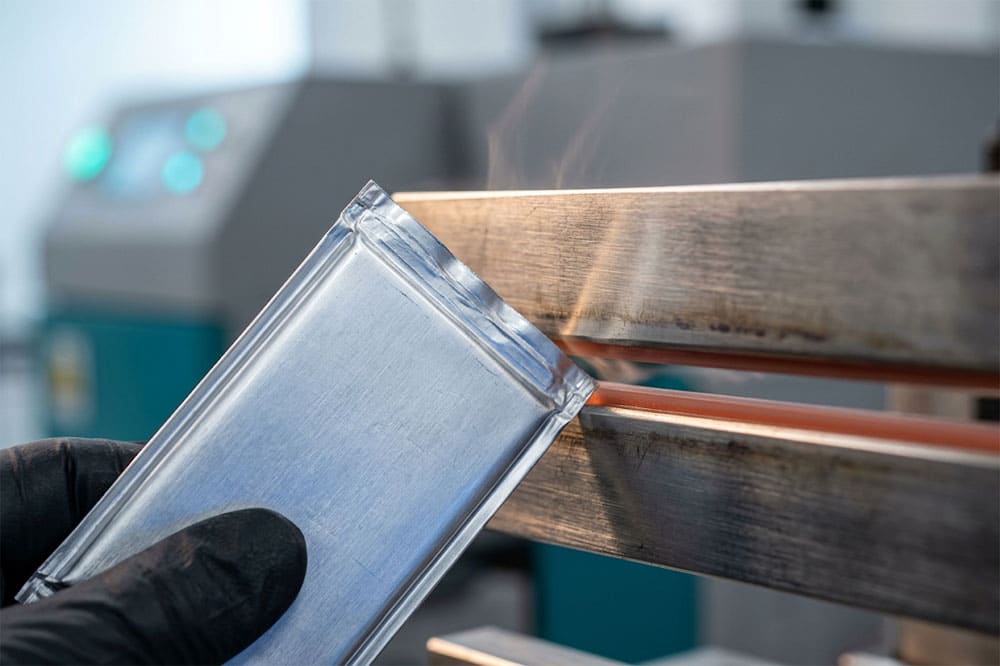
A pouch cell has no metal can. Its only boundary is a laminate film, 100 to 120 µm thick, heat sealed to itself around the perimeter. Cycle life, shelf life and the safety rating rest on four narrow strips of fused polypropylene holding that boundary shut.
Lithium ion pouch cell sealing gets more engineering attention per millimetre than any other step in assembly. A seal peeling at 60 N/15 mm and one peeling at 25 N/15 mm come off the machine looking identical. The difference appears eighteen months later, as a swollen cell.
What the Seal Actually Has to Do
Three jobs: keep electrolyte in, moisture out, carry load.
Moisture is the harder one. Water vapour crosses a sealed PP interface far faster than aluminium foil, so any path through the seal sets the real shelf-life limit. HF formation follows, then capacity fade no BMS can hide.
Mechanical load matters too. A cell goes through pouch cell swelling of 2–5% over its first fifty cycles, and each cycle pulls on the seal. High peel strength with poor creep resistance fails before a lower number with better fusion.
The laminate, and the only layer that seals
Standard pouch film is a five-layer sandwich: an outer nylon or PET layer for abrasion and deep-draw strength, an adhesive, a 30–40 µm aluminium foil, a second adhesive, and 40–80 µm of cast polypropylene on the inside face.
Only the PP seals. The aluminium blocks moisture. The nylon carries forming stress. When two laminate faces meet at temperature under pressure, the PP skins melt, entangle and re-crystallise into one layer. Seal strength is the strength of that block, minus whatever sat in the interface when the bar closed. That last clause explains most of this industry’s defects.

The Three Seals on Every Pouch Cell
1. The top seal, where the tabs exit
Aluminium and nickel tabs are metal, and PP does not bond to metal. Each tab carries a tab film, usually 50–100 µm of maleic-anhydride-grafted PP, pre-laminated before assembly. The bar welds tab film to PP, and tab film to the adhesive face over the foil. It is the only three-material joint on the cell, and in field data the seal that leaks first. Thick tabs for high discharge rate designs make it harder, because the step at the tab edge is deeper.
2. Side seals on the drawn edges
After deep drawing, both side edges are sealed at the flange, where a formed pocket meets flat film. The bar has to bridge that step, and wrinkles form there. A wrinkle running across the seal width is a leak channel with a fixed cross-section. Radius on the forming tool reduces them — on special-shaped cells the radius has to follow the outline. Extra bar pressure only flattens the wrinkle and thins the seal.
3. The final vacuum seal
One edge stays open through filling and formation so gas can escape. It is closed in a vacuum chamber in two passes: a primary seal, trimming and folding of the gas pocket, then the finished seal. Chamber pressure, dwell and how much electrolyte has wicked toward the seal line decide whether this edge holds. On a large 3.7V 15Ah pouch cell the gas pocket is big and the seal line is long, so yield is won or lost here.

Heat Sealing Parameters That Matter
Temperature: interface, not setpoint
PP sealant melts at 160–165 °C. Windows usually sit at 170–200 °C bar temperature, 0.3–0.6 MPa, 2–4 s dwell. What decides the bond is the interface temperature, which always sits below the bar — by 15–25 °C, depending on film thickness, foil gauge and how much nylon the heat crosses. A bar at 185 °C gives one interface temperature on 113 µm film and another on 152 µm film. Same setpoint, two processes.
Pressure and dwell
Pressure pushes air out of the interface and drives molten PP into micro-voids. Too little leaves a seal that peels at low force with glossy, unmelted surfaces. Too much extrudes PP sideways, thins the seal edge and, on tab seals, displaces the tab film. Dwell trades against temperature: plus 10 °C buys 20–30% shorter dwell, at the cost of flatness sensitivity.
Flatness and buffer hardness
A bar 0.05 mm out of parallel across 200 mm does not deliver even pressure. A silicone buffer on the anvil absorbs part of that error; one that is too hard passes it to the film. Check flatness with pressure film, not by eye.

Edge Sealing: Where Most Leaks Start
Seal width, trim width, exposed aluminium
Specify two numbers, not one. Seal width runs 5–8 mm at the side edges and wider at the tabs. Trim width — material left outside the seal — is 1.5–3 mm. Cut too tight and aluminium is exposed at the cut face, where humidity corrodes it and corrosion creeps under the seal. Cut too wide and the flap folds, cracks and rubs against the next cell — a risk in a drone battery pack where cells sit under compression.
The corner where two seals cross
Top seal and side seal overlap at each corner. That overlap is fused twice, thins the PP and leaves a brittle patch where the cell is stiffest. Tooling therefore carries an R0.5–R1 radius and a separate corner cycle at lower pressure.
Electrolyte in the seal zone
The most frequent cause of a channel leak on the final seal is liquid electrolyte in the seal area when the bar closes. Electrolyte wets PP, and a wetted interface will not fuse at any temperature. Four controls: cap the fill volume, keep a defined wicking distance between fill line and seal line, extend vacuum dwell so liquid pulls back first, and weigh the trimmed gas pocket — the waste tells you how much was in the seal.
How Seal Quality Is Checked
Peel test at 180°, 50 mm/min, in N/15 mm, run dry at 24 h and again after 48 h in electrolyte at 60 °C. The wet figure predicts field behaviour; 60 N/15 mm dry falling to 25 N/15 mm wet means the seal never fused.
Then leak detection. Helium vacuum testing down to 1×10⁻⁶ mbar·L/s finds channels a water-bath bubble test misses, and bubble testing passes most genuine leaks. Burst testing and CCIT complete it.
Failure Modes and What Causes Them
| What you see | What usually caused it |
|---|---|
| Clean peel at low force, glossy surfaces | Bar too cold, pressure too low, dwell too short |
| Seal edge thinning, PP squeezed out | Pressure too high, dwell too long, buffer too hard |
| Leak at the tab, white deposit | Tab film misaligned or too narrow, burr on the tab edge |
| Leak at a corner | Double-fused overlap, no corner radius, pressure spike |
| Peel strength drops after humidity test | Trim too narrow, aluminium exposed at the cut face |
| Channel leak after filling | Electrolyte in the seal zone, vacuum dwell too short |
Design Rules Worth Putting on the Drawing
- 5–8 mm seal land, 1.5–3 mm trim, radiused corners on tooling and bar.
- Tab film 2 mm wider than the seal on each side, with a deburred tab edge.
- Fill line 8–10 mm clear of the final seal.
- Peel strength specified wet, after electrolyte soak, not only dry.
- Bar temperature and pressure logged per lot, not just a “passed” stamp.
FAQ
No. Past about 8 mm the added width lifts peel area without improving fusion and eats footprint from the stack, which is why pouch cell energy density depends partly on sealing geometry.
Not in the field. Once electrolyte has wet the seal and air has entered, resealing traps moisture and HF inside the pouch. Scrap the cell.
Peel testing measures the average bond across a 15 mm strip. A helium test finds the worst single point. A 0.1 mm channel at a corner barely moves the average and ruins the cell.
Electrolyte chemistry changes how the liquid wets PP, and high-voltage systems run hotter. Ask for seal validation at 85 °C/85% RH and wet peel data in the real electrolyte.
Seal land plus trim consume 6–9% of the footprint on a small cell and 3–5% on a large one. One reason pouch cells suit thin, space-limited products better than prismatic cans at small formats.
If you are sourcing pouch cells, treat lithium ion pouch cell sealing as a line item on the drawing: seal land, trim, tab film spec, wet peel requirement. Then ask for the parameter sheet that ships with the first lot. Browse the full pouch cell battery range, or send your dimensions and we will quote against them.
Pouch Cell Products
-

11.1V 3S 850mAh li-ion Polymer Pouch Cell Battery Pack
-

134365 4500mAh 3.7V Rechargeable Lithium Polymer Battery
-

3.7V 1200mAh Li-Polymer Pouch Cell Battery
-

3.7V 15Ah 148198 Pouch Lithium Ion Battery
-

3.7V 1S2P 3000mah lithium Polymer Battery
-

3.7V 2000mAh Pouch Cell Battery
-

3.7V 502248 500mAh Lithium Ion Polymer Battery
-

3.7V 700mAh Li-Polymer Pouch Cell Battery
-

3.7V 800mAh Rechargeable Pouch Li-Polymer Battery
Leave a Reply