
Most pouch vs prismatic cell comparisons online are datasheet exercises: two columns, a winner declared, done. That is not how the decision actually gets made inside an OEM project.
In a real project, the choice arrives attached to a fixed enclosure, a certification deadline, a tooling budget that has already been trimmed twice, and a volume forecast everyone privately knows is wrong. At that point the question is no longer which cell is better. It is which cell can my project absorb — in tooling, in mechanical hardware, in assembly steps, in test hours, and in the cost of being wrong at revision two.
This article compares the two formats at that level. If you want the three-way version including cylindrical cells, start with our pouch vs prismatic vs cylindrical cell overview. If you are already past that and need to defend a decision to your mechanical and sourcing teams, keep reading.
The Short Answer
| Dimension | Pouch cell (aluminum laminate) | Prismatic cell (hard can) |
| Construction | Heat-sealed foil laminate, no rigid shell | Welded aluminum/steel can with designed vent |
| Gravimetric density | Higher — typically 240–300 Wh/kg (NMC/LCO) | ~150–190 Wh/kg for LFP, 200–250 Wh/kg for NMC |
| Volumetric density | ~500–650 Wh/L | ~350–450 Wh/L |
| Shape freedom | Size is a design variable | Fixed catalog footprints (280Ah, 320Ah…) |
| Mechanical strength | Low — needs pack-level support | High — self-supporting |
| Stack pressure | Swelling must be accommodated | Compression must be applied and maintained |
| Failure signature | Swelling first, then gas/rupture | Vent opens, directed release |
| Typical cycle life | 500–2,000 (chemistry dependent) | 3,000–8,000 for LFP |
| Sweet spot | Slim, curved, weight-critical devices | Energy storage, 48V systems, long-cycle packs |
The rest of this article is the reasoning behind that table — and the places where the table misleads people.
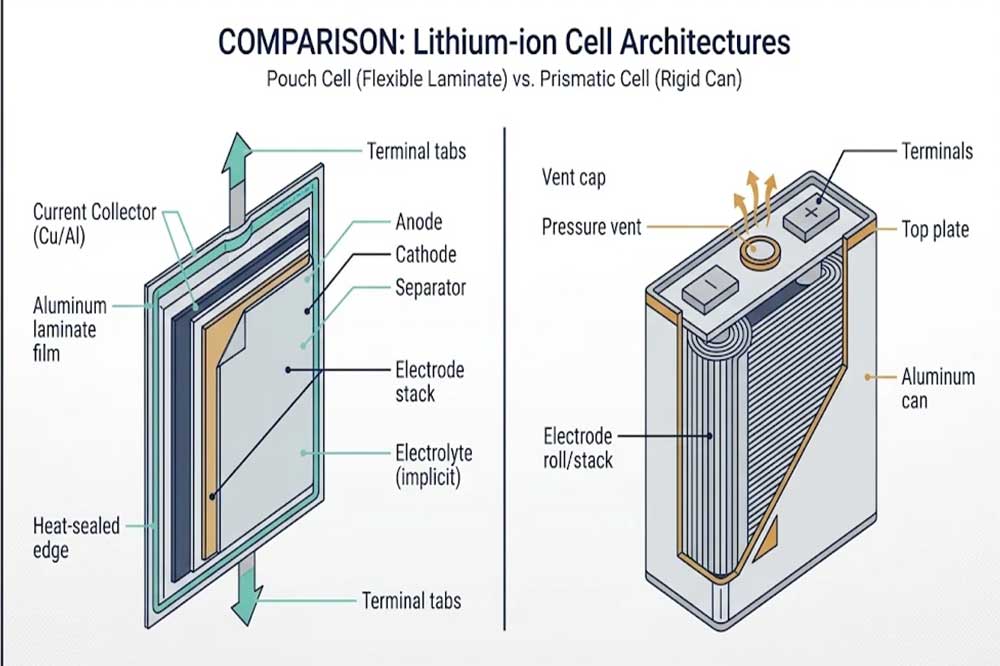
Where the Difference Really Comes From: A Sealed Bag and a Sealed Can
Everything downstream of this section follows from one structural fact. A pouch cell is a bag. A prismatic cell is a pressure vessel. Both are sealed, both hold the same electrochemistry, and neither fact is a defect.
The pouch cell has no structure of its own
A lithium ion pouch cell is built from an aluminum laminate film roughly 100–120 µm thick, cold-formed into a pocket on one or both sides, filled with the electrode stack, then heat-sealed on three edges under vacuum. There is no can, no terminal feedthrough, no vent.
Three consequences matter to a project team:
- There is no internal headroom for gas. Any gas generated during formation, overcharge or ageing shows up as thickness growth, because there is nowhere else for it to go.
- The cell contributes no structural stiffness. Every load path — vibration, drop, stack compression, tab retention — has to come from your enclosure.
- The packaging is nearly all active material. A 100 µm laminate replaces a 0.5–1 mm can wall, which is where the density advantage comes from, and it is not free: you pay for it in mechanical fragility.
The prismatic cell is a pressure vessel with a designed weak point
A prismatic cell is deep-drawn or welded from aluminum (occasionally steel), with a top plate carrying terminals, a fill port, and a vent that opens at a defined internal pressure. The can carries load, resists swelling by design, and gives you a predictable release direction when things go wrong.
The trade is symmetrical: you gain robustness and lose both density and shape freedom. The can wall and top plate are dead weight, and the footprint is whatever the tooling says it is. Off-the-shelf sizes such as a 3.2V 280Ah LiFePO4 prismatic cell at 71.5 × 173.6 × 204.8 mm are genuinely excellent because thousands of pack designs have already been built around that box — but you are building around it, not the other way round.
Energy Density: Cell Level vs Pack Level
Pouch wins at cell level. That is real, and it is measurable in Wh/kg and Wh/L on a datasheet. It is also the number most often quoted in a meeting where the wrong decision gets made.
At pack level, three things eat into the advantage:
- Volume utilization. A prismatic pack fills a rectangular cavity at roughly 85–90% because the cells are rectangular. A pouch stack in the same cavity needs restraint frames, compression foam and edge protection, and typically lands at 75–85%.
- Structural mass. The enclosure that a prismatic can partly provides for free has to be designed and paid for in a pouch pack. At small pack sizes this can erase most of the cell-level gain.
- Interconnect overhead. A 280Ah prismatic pack reaches 48V with 16 cells and 15 busbars. The equivalent pouch pack might use 60–100 cells, with proportionally more tab, busbar and sensing hardware.
Rule of thumb we use in quoting: expect roughly 60–70% of the cell-level gravimetric advantage to survive into a production pack. That is still a decisive win for a wearable or a drone. It is close to noise for a floor-standing energy storage cabinet, where prismatic LFP’s cost and cycle life dominate anyway.
Design Flexibility and Tooling: Where OEM Budgets Are Won or Lost
This is the single biggest project-level difference, and it is rarely discussed in comparison articles.
Pouch sizing is a design variable. Capacity is set by electrode area and coating loading; thickness moves in roughly 1 mm steps; footprint is set by a cutting die. Changing a pouch dimension between EVT and DVT means a new die and a new forming fixture — cheap and fast, typically low hundreds to a few thousand dollars of NRE, with samples in weeks.
That is why one supplier can offer a 3.7V 2000mAh pouch cell at 8 × 25 × 100 mm for a slim handheld terminal and a 3.7V 15Ah cell at 14 × 81 × 98 mm for a power bank or light EV module from the same electrode stock. Same factory, radically different formats, no mold in sight.
Prismatic sizing is a capital decision. Standard footprints cost you nothing in tooling because the tooling already exists and is amortized across the industry. A custom can requires deep-draw tooling, welding fixtures, leak-test fixtures and a fresh qualification cycle — the kind of NRE that only makes sense above roughly 100,000 units per year.
Practical guidance that holds up across most projects:
- Under ~5,000 units/year with a space constraint → pouch, and treat the cell as a mechanical component designed around your enclosure.
- Over ~50,000 units/year with a standardized energy block → prismatic in a catalog size, and design the enclosure around the cell.
- Never spec a custom prismatic can below ~100k units/year. The NRE will outlive the product.
You can browse the full pouch cell battery range to see how wide the size envelope actually is before assuming you need a new tool.
Mechanical Support and Compression: The Cost Nobody Budgets For
Both formats need mechanical work. They need different mechanical work, and the cost lands in different line items — which is why cell-level quotes mislead.

Pouch pack. You need a restraint frame or end plates, compliant pads (silicone or PU foam) sized to accommodate 5–10% thickness growth over life, edge protection over the seal area, and strain relief on the tabs. There is no compression target in the cell datasheet, but there is a stack pressure window: too little and the electrode interfaces go slack and impedance climbs; too much and you crush the separator edges. Your pack drawing should state the window explicitly.
Prismatic pack. You need compression. Large LFP prismatics are typically specified with a clamping force in the 3,000–5,000 N range (roughly 300–500 kgf) held across the whole service life — always confirm against your specific cell datasheet, because the number is not universal. Delivering that means end plates, tie rods or welded frames, and compression foam that keeps force on the stack as the cell breathes and ages. It also means a compression step on the assembly line with a measured value, not a guess.
So the cost does not disappear in either case. Pouch pushes structural cost into the enclosure and the foam. Prismatic pushes it into end plates, hardware, and process time. The right question is not “which is cheaper” but “which one can my mechanical team execute and my line repeat at rate”.
Thermal Behavior and Failure Signature
Safety is not a scoreline — it is a failure shape. The two formats fail differently, and your pack design has to match the shape.
Prismatic. Heat exits through large flat faces, so a cold plate bonded to the base or side is straightforward and effective. The vent gives a directed release, which makes enclosure venting design tractable. The complication is scale: a 280Ah cell holds a lot of energy, so a single-cell event is a significant event, and cell-to-cell propagation across a clamped block becomes the actual design problem — hence thermal barriers, defined spacing, and UL 9540A propagation testing for stationary storage.
Pouch. High surface-to-volume ratio means each cell is easy to cool, which is why high-C drone packs are almost always pouch. But with no vent, gas has to deform the laminate or find a seam. In practice that means swelling is your early warning system — a genuine advantage if you instrument for it. A pack that monitors stack thickness (or even just inspects it at service intervals) can catch degradation months before a vent would have opened. We cover the mechanism in detail in lithium ion pouch cell swelling: causes, risks and prevention.
Design implication: don’t ask “which is safer”. Ask “what does the first failing cell do in my enclosure, and how do I find out about it before a customer does”. Pouch answers with thickness monitoring and a vented enclosure cavity. Prismatic answers with barriers, spacing, and temperature/pressure sensing.

Cycle Life: Make Sure You’re Comparing Chemistry, Not Format
This is the most common error in the pouch vs prismatic cell conversation, and it is worth calling out directly.
Most pouch cells quoted to OEMs are LCO or NMC. Most prismatic cells quoted to OEMs are LFP. So the “500 cycles vs 6,000 cycles” comparison that circulates in procurement decks is usually a chemistry comparison wearing a format costume.
Fair comparisons:
| Pairing | Cycle life reality |
| LCO pouch vs LFP prismatic | 500–800 vs 4,000–8,000. Meaningless as a format comparison. |
| NMC pouch vs NMC prismatic | Both 1,000–2,500. Prismatic often edges ahead on calendar life because compression is consistent; pouch can match it only if the pack manages swelling. |
| LFP prismatic (the mainstream) | 4,000–8,000 at 80% DoD. This is where the format genuinely dominates. |
One pack-level caveat that costs projects real money: pouch cycle life is far more pack-dependent than prismatic. An unrestrained pouch stack swells, interfaces gap, impedance rises, and the last 20% of rated cycles quietly disappears. A well-designed pouch pack hits its datasheet number; a casually designed one loses 30% of it and blames the cell.
If long cycle life is the top requirement, the prismatic LFP route is the rational one — the LiFePO4 battery range covers everything from a single 3.2V 320Ah cell to a finished 48V 200Ah solar power wall. For procurement-side considerations on large prismatics, see wholesale prismatic cells at scale.
BMS and Pack Architecture: The Differences That Reach the Firmware
Cell format changes what your BMS has to do, and this shows up late — usually during software integration, when hardware is frozen.
- Granularity. A 48V prismatic LFP pack is 15S or 16S: one sense line per cell, coarse but clean balancing, and each cell is a meaningful fraction of pack capacity. The same 48V built from 15Ah pouches is 15S?P: many parallel strings, current-sharing between them, fuse strategy per string, and balancing resolution that is coarse relative to pack capacity.
- Interconnect. Prismatic means bolted busbars — serviceable, torque-specified, replaceable in the field. Pouch means ultrasonically or laser-welded tabs — not serviceable, so weld schedule and pull-test QC become safety-critical process controls.
- Sensing. NTC on the can face for prismatic (good thermal coupling, slower response). NTC on the flat face under restraint for pouch, plus optionally a thickness or pressure sensor if you want the swelling signal.
- SOH estimation. Pouch stack pressure changes with age, and pressure shifts impedance. If your SOH algorithm is impedance-based, it needs to know that or it will drift.
Net: fewer, larger cells means a simpler BMS, cheaper harness, easier service, and a bigger single-point energy risk. More, smaller cells means finer control and better redundancy, at the cost of harness complexity and weld process control.
Certification: Same Standards, Different Pressure Points
Both formats go through the same gates. The stress concentrates differently inside them.
| Requirement | Where pouch feels it | Where prismatic feels it |
| UN38.3 (T1–T8) | T2 thermal, T6 crush — no can to share the load | T5 short circuit, T7 overcharge — more energy per cell |
| IEC 62133-2 | Cell + pack, plus a documented swelling criterion | Cell + pack, vent behavior documented |
| UL 1642 / UL 2054 | Common for consumer packs | Common for packs and ESS modules |
| UL 1973 / UL 9540A | Rare in ESS, format not mainstream there | Core requirement — propagation testing drives spacing and barriers |
One documentation burden is unique to pouch: because the cell assumes external restraint, your pack specification must state the allowed stack pressure window and the swelling acceptance criterion. If that is missing, the certification file has a hole in it, and a reviewer will find it. Full test scope and reports live on our battery certifications page; incoming and outgoing inspection criteria are on quality control.
Cost, MOQ and Lead Time: A Structural View
Unit price per Wh is the least useful number in this decision. Here is where the money actually goes.
| Cost element | Pouch | Prismatic |
| Cell tooling / NRE | Low — dies and fixtures, fast to change | Zero for catalog sizes; high for a custom can |
| Cell $/Wh at volume | Competitive, but thinner margin at small volume | Lowest for LFP at volume |
| Pack hardware | Restraint frame, foam, edge protection | End plates, tie rods, busbars, compression foam |
| Assembly labor | Tab welding, more parts, more handling | Fewer parts, bolted busbars, one compression step |
| Scrap / rework | Swelling rejects, weld defects | Weld leaks, compression errors, handling damage |
| Freight | Light, good volume utilization | Heavy, poor volume utilization, higher Class 9 cost |
| Cost of changing your mind | Low — resize the die | High — new tooling and re-qualification |
The TCO trap: a cell-level $/Wh comparison can flip completely once compression hardware, welding capex and scrap rate are included. Always request pack-level quotes against the identical electrical specification — same voltage, same continuous and peak current, same cycle target, same enclosure volume. Otherwise you are comparing two different products and calling it a price difference.

A Decision Matrix by Project Type
| Project type | Format | Why |
| Slim consumer, wearable, IoT sensor | Pouch | Thickness is the binding constraint; nothing else fits |
| Handheld medical / diagnostic device | Pouch | Thin, light, low self-heating, easy to restrain in a sealed housing |
| High-C drone / UAV pack | Pouch | Surface-to-volume ratio handles burst current; see UAV battery packs |
| Power bank, portable speaker, POS terminal | Pouch | Industrial design rules out a can |
| 48V ESS, solar wall, home storage | Prismatic LFP | Cycle life and $/kWh dominate; compression hardware is worth it |
| Light EV / e-bike swappable pack | Prismatic (or pouch module) | Standardization and serviceability matter more than density |
| Industrial AGV, floor scrubber, robotics | Prismatic | Robustness and cycle life under daily deep discharge |
| Power tools | Neither — cylindrical | Can geometry handles heat and abuse better; see the three-format comparison |

What to Send a Supplier Before You Ask for a Quote
Nine out of ten slow quotes are caused by a missing item on this list. Send all of it in the first message and you will usually get a real answer instead of a range.
- Available envelope — max L × W × H in mm, plus which dimension is flexible
- Electrical spec — nominal voltage, capacity in Ah, continuous and peak discharge current, charge current
- Cycle target — cycles to 80% capacity, at what DoD and temperature
- Operating temperature — charge and discharge ranges separately, plus storage
- Mechanical environment — drop height, vibration profile, whether the pack is user-removable
- Certification and destination market — UN38.3, IEC 62133-2, UL, CE, and shipping mode
- Annual volume and first-order quantity — this single number changes the recommended format
- Interface — connector type, wire length and gauge, PCM/BMS requirement, communication protocol
- Program timeline — sample date, DVT date, MP date
- Enclosure constraints — material, sealing requirement, available wall thickness for restraint
Get those ten onto one page and the pouch vs prismatic cell question usually answers itself in the first technical call.
FAQ
Neither is better in general. Pouch wins on gravimetric and volumetric density, shape freedom and tooling cost; prismatic wins on mechanical robustness, cycle life (especially LFP), thermal management simplicity and $/kWh at volume. The right format is the one whose weaknesses your project can absorb.
Almost always pouch, because prismatic only beats it on cell price at volume with a catalog size, and your pack hardware savings rarely cover the difference at 10k units. The exception is when a standard prismatic (280Ah, 320Ah) happens to fit your enclosure — then zero tooling NRE can make prismatic cheaper even at moderate volume.
Electrically yes, mechanically almost never without redesign. You lose the structural contribution of the can, you gain a swelling management requirement, and the BMS thresholds and thermal path both change. Plan a mechanical revision, not a drop-in swap.
They need restraint and a defined stack pressure window — not the high clamping force large prismatic LFP cells require. Too little pressure causes interface slack and impedance rise; too much damages the separator edges. Specify the window on the pack drawing.
Compare chemistry first. NMC pouch and NMC prismatic are broadly similar at 1,000–2,500 cycles. LFP prismatic at 4,000–8,000 cycles beats any consumer pouch chemistry by a wide margin. Within the same chemistry, prismatic usually has a small edge because compression stays consistent for life.
Pouch cells typically start lower because only dies and fixtures are involved — often a few thousand pieces for a custom size. A custom prismatic can needs deep-draw tooling and typically only makes commercial sense above 100,000 units per year. Catalog prismatic sizes have no tooling MOQ at all.
Conclusion
The pouch vs prismatic cell decision is not a technology argument. It is a statement about your project: how much shape freedom you need, how much mechanical hardware you are willing to design, how long the product must last, and how much volume you can commit to.
Choose pouch when the enclosure is the constraint and you can afford to engineer the restraint. Choose prismatic when the energy block is the constraint and you would rather buy robustness than design it. Everything else — density, cost, certification — follows from those two sentences.
We build both, in the same factory, on the same quality system, which is useful mainly because it means we will tell you when the format you asked for is the wrong one. Send your envelope, current profile and annual volume through the contact form and we will come back with a format recommendation and a pack-level quote rather than a cell price.
Still unsure whether ‘pouch cell’ and ‘lithium polymer’ describe different products? Read our full explainer on lithium ion pouch cell vs lithium polymer battery before finalizing your spec.
Related Products
-

11.1V 3S 850mAh li-ion Polymer Pouch Cell Battery Pack
-

12.8V 8Ah LiFePO4 Power Wall Battery
-

12V 100Ah LiFePO4 Solar Battery
-

134365 4500mAh 3.7V Rechargeable Lithium Polymer Battery
-

3.2V 280ah Lifepo4 Battery Cell
-

3.2V 320Ah LifePo4 Battery Cell
-

3.7V 1200mAh Li-Polymer Pouch Cell Battery
-

3.7V 15Ah 148198 Pouch Lithium Ion Battery
-

3.7V 1S2P 3000mah lithium Polymer Battery
-

3.7V 2000mAh Pouch Cell Battery
-

3.7V 502248 500mAh Lithium Ion Polymer Battery
-

3.7V 700mAh Li-Polymer Pouch Cell Battery
-

3.7V 800mAh Rechargeable Pouch Li-Polymer Battery
-

48V 200Ah LiFePO4 Battery Solar Power Wall
-

IP67 48V 100Ah Solid State LiFePO4 Battery
Leave a Reply