
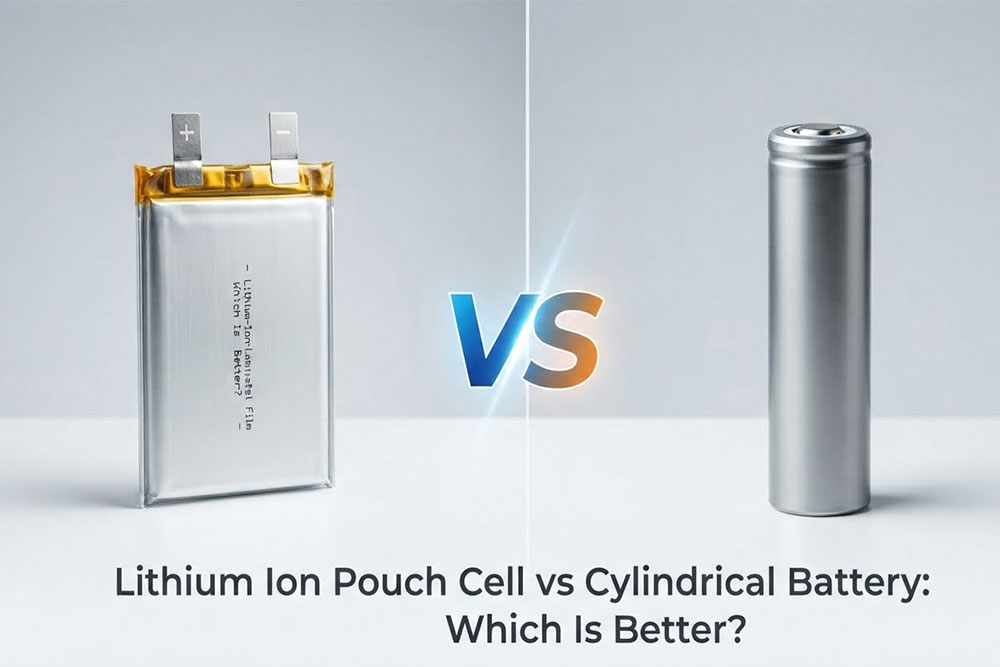
When engineers and purchasing teams start a new product, one question comes up again and again: pouch cell vs cylindrical battery — which one is the better choice? The honest answer is that neither format wins in every situation. Each has real strengths in energy density, cost, safety and manufacturing flexibility, and the right answer depends on your device’s space, current draw and budget.
In this guide, we compare lithium ion pouch cells and cylindrical batteries (such as the classic 18650) side by side, so you can match the right format to your application — and see exactly what Apsenx can supply for each one.
What Is a Lithium Ion Pouch Cell?
A pouch cell (also called a lithium polymer or Li-Po cell) is a soft-pack lithium battery sealed in laminated aluminum-plastic film instead of a rigid metal case. Inside, stacked or laminated electrodes are wrapped in the pouch material, with tab leads bringing the current out. Without a heavy steel shell, pouch cells can be made extremely thin and shaped to fit unusual spaces — which is why they dominate smartphones, tablets, wearables, drones and medical devices.
Apsenx manufactures and stocks a full range of pouch cell batteries, from small 500 mAh cells for compact electronics to high-capacity 15 Ah cells for power-hungry equipment. For example:
- 3.7V 502248 500mAh Lithium Ion Polymer Battery — ideal for ultra-thin consumer devices.
- 3.7V 1200mAh Li-Polymer Pouch Cell Battery — a versatile mid-size cell for IoT and smart hardware.
- 3.7V 15Ah 148198 Pouch Lithium Ion Battery — high capacity in a single soft pack, reducing the number of cells needed in a pack.
If your product has a custom cavity or strict thickness limit, a custom pouch cell battery pack is usually the fastest path to a fit-perfect power solution.
What Is a Cylindrical Battery?
A cylindrical battery — most famously the 18650 (18 mm diameter × 65 mm length) — rolls its electrodes into a compact “jelly roll” inside a rugged steel can. This mature format offers excellent mechanical strength, standardized dimensions and highly automated production, which keeps unit cost low and quality consistent at scale. Cylindrical cells also handle heat well: their metal shell and circular cross-section dissipate heat evenly, and packs built from them can be cooled cell-by-cell.
Apsenx supplies wholesale 18650 lithium batteries in capacities from 1500 mAh to 3500 mAh, including:
- 18650 3.7V 3300mAh Rechargeable Lithium Ion Battery — high capacity for flashlights, laptops and portable equipment.
- ICR 18650 2200mAh 3.7V Battery — a cost-effective workhorse cell for bulk purchasing.
- 18650 2600mAh Rechargeable Lithium Ion Battery — balanced capacity and discharge for everyday devices.
Need larger packs? Apsenx also assembles custom 18650 battery packs and high-power battery packs with BMS integration for power tools, drones and energy storage.

Pouch Cell vs Cylindrical Battery: Key Differences
Here is the head-to-head comparison most engineering teams care about:
| Feature | Pouch Cell | Cylindrical (e.g., 18650) |
| Shape & Flexibility | Ultra-thin, any custom shape possible | Fixed round format, standardized size |
| Energy Density (by weight) | Higher — no heavy metal shell | Slightly lower due to steel can |
| Space Utilization | Excellent — fits odd cavities | Gaps between round cells in packs |
| Mechanical Strength | Softer; needs external support in the housing | Very rugged steel shell, drop-resistant |
| Safety Behavior | Swells/punctures can vent; needs good BMS and swelling management | Safety vent built into the cap; structurally robust |
| Thermal Management | Flat surfaces stack tightly — good conduction, but heat spreads in-plane | Round shell radiates heat; easy to air-cool between cells |
| Cost at Scale | Tooling cost per custom shape; lower volume cost once scaled | Highly automated, lowest unit cost at high volume |
| Best For | Smartphones, wearables, drones, medical, ultra-thin devices | Power tools, e-bikes, flashlights, energy storage, laptop packs |
Want to go deeper on pouch cell selection? Read our related guides: Lithium Ion Pouch Cell Energy Density: Wh/kg vs Wh/L Explained, Lithium Ion Pouch Cell Discharge Rate: C Rating & Current Explained, and Pouch Cell Swelling: Causes, Risks and Prevention.

Energy Density: Where Pouch Cells Shine
Because pouch cells eliminate the rigid metal can, more of the cell’s weight and volume goes into active material. That is why a well-designed pouch cell typically delivers 5–10% higher gravimetric energy density (Wh/kg) and noticeably better volumetric efficiency than an equivalent cylindrical cell — a decisive advantage when every gram matters, as in UAV and wearable applications.
Cylindrical 18650 cells close the gap in pack-level designs: their standardized form allows dense, automated pack assembly, and the inter-cell gaps aid cooling in high-drain applications.
Safety and Reliability: Different Trade-offs
- Cylindrical cells are structurally tough. The steel can resists swelling and mechanical damage, and the cap includes a pressure safety vent. In abusive conditions they fail in a more predictable way, which is one reason they remain the default for power tools and e-mobility packs.
- Pouch cells rely on the aluminum laminate and the surrounding system design. They are more vulnerable to puncture and swelling, so they demand a proper BMS, correct charge voltage and mechanical padding in the enclosure. Managed correctly — as Apsenx does with UN38.3-certified pack designs — they are perfectly safe, and their flat geometry actually makes thermal sensing and heat-sinking easier.
Neither format is inherently “unsafe”; safety comes from matching the cell to the application and building the protection system around it.
Cost and Supply Chain Considerations
For high-volume, standardized products, cylindrical 18650 cells win on unit cost: decades of automation have driven their price to the lowest per-Wh level of any format, and multiple manufacturers guarantee supply.
For custom-shaped or thin products, pouch cells win on total design cost: one custom pouch cell can replace several cylindrical cells plus spacers and holders, simplifying assembly and freeing up interior space. Apsenx supports both routes — from off-the-shelf wholesale 18650 cells to fully customized soft-pack designs with low MOQ for OEM buyers.
Which Should You Choose?
Choose a pouch cell if your product is thin or irregularly shaped, weight-sensitive, or needs a single high-capacity cell — think drones, wearables, medical devices and premium consumer electronics.
Choose a cylindrical battery if you need ruggedness, high discharge current, proven safety behavior and the lowest cost per watt-hour at scale — think power tools, flashlights, e-bikes and energy storage systems.
And if your project sits in between? That is exactly where a custom battery manufacturer earns its keep.

Talk to Apsenx About Your Battery Project
As a Shenzhen-based lithium battery manufacturer with over 5,000 ㎡ of factory space, dedicated production lines for both pouch cells and 18650 packs, and UN38.3-compliant designs, Apsenx can build the right battery for either format — or a hybrid pack.
Browse our pouch cell battery category and 18650 lithium battery category to compare real specifications, or contact our team with your voltage, capacity and size requirements for a free quotation.
Related Products
-

11.1V 3S 850mAh li-ion Polymer Pouch Cell Battery Pack
-

134365 4500mAh 3.7V Rechargeable Lithium Polymer Battery
-

18650 2000mAh 3.7 volt Lithium-ion Battery
-

18650 2600mAh Rechargeable Lithium-Ion Battery 3.7V
-

18650 3.7V 3300mah Rechargeable Lithium ion Battery
-

18650 battery 3.7V 1500mAh Lithium-Ion Battery
-

18650 Battery 3500 mah Rechargeable Battery Cells
-

3.7V 1200mAh Li-Polymer Pouch Cell Battery
-

3.7V 15Ah 148198 Pouch Lithium Ion Battery
-

3.7V 1S2P 3000mah lithium Polymer Battery
-

3.7V 2000mAh Pouch Cell Battery
-

3.7V 502248 500mAh Lithium Ion Polymer Battery
-

3.7V 700mAh Li-Polymer Pouch Cell Battery
-

3.7V 800mAh Rechargeable Pouch Li-Polymer Battery
-

3.7V Li ion Rechargeable 3000mah 18650 Battery Cell
-

ICR 18650 Battery 2200mah 3.7V
Leave a Reply