
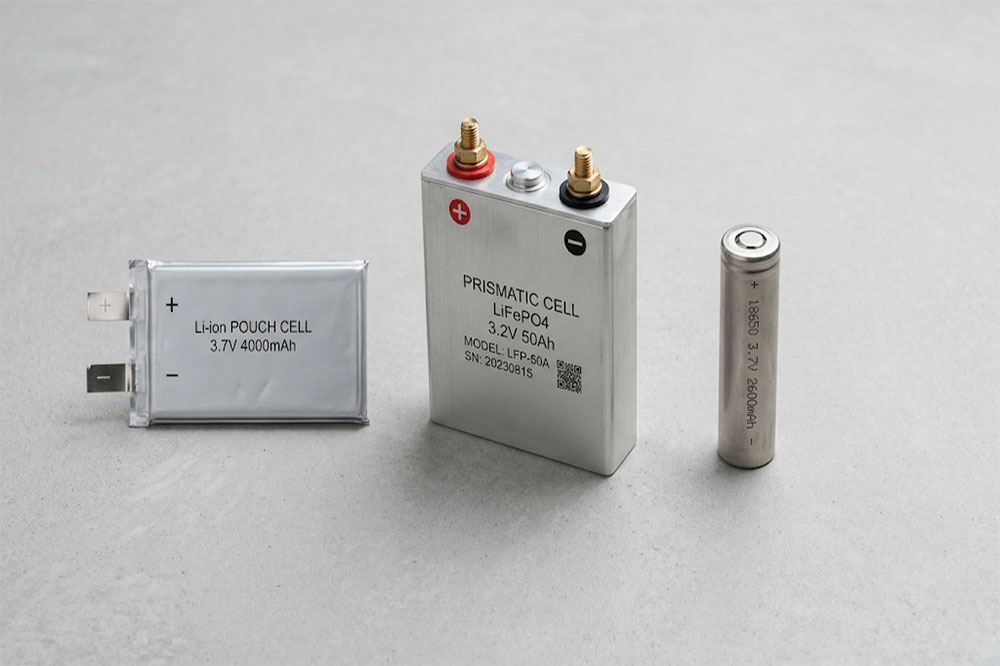
Ask three engineers which lithium ion cell format is best and you will usually get three different answers — and all three can be right. That is because the comparison between pouch, prismatic and cylindrical cells is not really a comparison of chemistry. The same NMC, LCO or LFP active materials can be wound or stacked into any of the three packages. What actually differs is the mechanical package: how the cell is enclosed, how it releases pressure, how much of its volume is active material, and how it behaves when something goes wrong.
For OEM and ODM buyers, the format decision is one of the first hard choices in a new battery project, because it shapes the enclosure design, the pack assembly method, the cost structure and even the certification path. This guide compares pouch cells, cylindrical cells and prismatic cells the way the decision actually gets made in real projects — format by format, property by property — and ends with a selection framework you can apply to your own product.
The Quick Answer
If you only need the short version:
| Format | Best at | Weakest at | Typical products |
|---|---|---|---|
| Pouch | Slim, lightweight, custom-shaped designs; high Wh/L | Mechanical rigidity; visible swelling | Wearables, phones, GPS, medical devices, slim IoT hardware |
| Cylindrical | Mechanical strength, mature automation, lowest cell cost per Wh | Wasted space in rectangular enclosures; lower Wh/L at pack level | Power tools, e-bikes, vaping, laptops, drones |
| Prismatic | Large capacity per cell, space-efficient stacking, long cycle life (esp. LFP) | Heavy housing; limited size flexibility; higher tooling cost | Energy storage systems, RV/solar packs, backup power, EVs |
Everything below explains where these rows come from, because the details are where projects get into trouble.
First, What Actually Differs: The Package
All three formats hold the same core sandwich of anode, separator, cathode and electrolyte. The difference starts at the enclosure.
Cylindrical cells roll the electrode stack into a jelly roll and seal it inside a spiral-wound steel or aluminum can. The metal housing carries all mechanical load, contains internal pressure up to a designed burst point, and ends in standardized terminals — which is why an 18650 flat-top cell from different manufacturers is dimensionally interchangeable in a way pouch cells never are.
Prismatic cells flatten the wound or stacked electrodes into a rectangular aluminum or steel case, welded shut after electrolyte filling. The housing is rigid and usually includes a vent valve. Compared with cylindrical cells, prismatic housings waste less space in a rectangular battery compartment, and a single large prismatic cell can replace dozens of cylindrical cells.
Pouch cells drop the rigid can entirely. The electrode stack is sealed in a three-layer aluminum-plastic laminate — the same structure described in detail here — with tabs crimped through heat-sealed edges. Removing the metal case is the source of almost every pouch cell advantage and every pouch cell weakness at the same time.
That single design choice — rigid can versus flexible laminate — drives the entire comparison below.
Head-to-Head Comparison
Energy Density: Pouch Wins on Paper, Format Depends on the Pack
Per cell, pouch cells usually lead. With no steel can and no vent hardware, nearly all of the cell volume holds active material, so gravimetric and volumetric density both benefit. A typical consumer pouch cell reaches 220–260 Wh/kg and 450–550 Wh/L, while an equivalent 18650 sits closer to 240–260 Wh/kg but occupies less usable volume in a rectangular enclosure after accounting for the gaps between cylinders.
That last point matters. Cylindrical cells pack into a rectangular space at roughly 90% theoretical efficiency, and realistically 80–85% once padding and cooling are added. Prismatic and pouch cells stack edge to edge with almost no wasted volume.
The full calculation — including why Wh/kg and Wh/L answer different questions — is covered in our energy density guide. For format selection, the practical summary is:
- Weight-critical products (wearables, handheld devices): pouch usually wins.
- Volume-critical rectangular products (slim enclosures): pouch or prismatic.
- Products with non-rectangular or modular spaces (tool handles, tube-shaped e-bike frames): cylindrical is often easier to lay out.
Form Factor Flexibility: Pouch’s Structural Advantage
This is the one property the other two formats cannot match. Because the laminate is flexible, pouch cells can be made in nearly any length-width-thickness combination without new metal tooling. Need a cell 4.2 mm thick that fits behind a display? A cell with a stepped profile? An L-shaped or curved cell for a wearable band? All of that is routine pouch cell work — the special-shaped and curved cells used in wearables are only possible in this format.
Prismatic cells come in a fixed catalog of industry-standard sizes. Custom dimensions are possible but require new housing tooling, which only makes sense at high volume. Cylindrical cells are the most rigid of all: 18650, 21700, 4680 — the dimensions are effectively industry law, and the product must be designed around them.
Power and Discharge Rate: Cylindrical Handles Heat Best
High-current discharge generates heat, and heat management is where the formats differ most.
Cylindrical cells have the best surface-to-volume ratio and a metal can that spreads heat. They tolerate sustained high discharge and aggressive fast charging, which is why power tools, e-bikes and drones remain dominated by cylindrical formats. If you are comparing 18650 and 21700 cells for exactly these reasons, see the 18650 vs 21700 comparison.
Pouch cells can deliver high current in short bursts — some are rated at 5C or above — but the laminate dissipates heat less effectively than steel. Sustained high-rate cycling in a pouch cell needs deliberate thermal design: larger contact area, thermal pads, or stacking with cooling plates. Discharge capability is a specification to check, not assume; C-rating and current limits vary widely between pouch cell models that look identical from the outside.
Prismatic cells are usually optimized for moderate continuous current and very long cycle life rather than peak power, which matches their typical duty in storage systems.
Mechanical Robustness and Safety: Three Different Failure Styles
None of the three formats is “safest” in an absolute sense — they fail differently, and the right question is which failure style your product can tolerate.
Cylindrical cells are the most mechanically rugged. The steel can resists crushing and bending, and the design includes a pressure relief that opens in a controlled way. A failing 18650 usually vents through its vent rather than bursting its case. The cost is that the rigid can hides early problems: internal gas builds silently until the vent operates.
Prismatic cells share similar advantages — a rigid aluminum case, a designed vent valve, good resistance to swelling forces. Failure behaviour sits between cylindrical and pouch.
Pouch cells are the most mechanically vulnerable and the most honest at the same time. The laminate cannot contain pressure, so any internal gas generation shows up immediately as visible swelling — which, as covered in depth in our swelling guide, acts as an early warning system that rigid formats do not have. The flip side: a pouch cell has no vent, so an abuse event that would make a cylindrical cell vent can rupture a pouch laminate instead. Pouch cells therefore demand more careful enclosure design (no point loads, thickness headroom, tab strain relief) and more disciplined incoming inspection.
Cycle Life and Consistency
Cycle life is mostly a function of chemistry and process quality, not format — a well-made LCO pouch cell and a well-made cylindrical cell with the same chemistry age on similar curves. Two format-related effects do exist, though:
- Pressure matters. Cylindrical and prismatic cans maintain constant stack pressure on the electrode roll, which supports cycle life. Pouch cells depend on the pack design to provide that pressure; a pouch cell clamped too rigidly, or left free with no compression at all, can age faster than the same chemistry in a can.
- Consistency depends on sourcing. Cylindrical cells from tier-one makers are dimensionally and electrically interchangeable, which simplifies cell matching in large series strings. Pouch cell matching is done per model and per batch, which makes supplier stability more important — the reason pouch cell wholesale sourcing deserves the process scrutiny described in that guide.
Cost at Volume
Per watt-hour, cylindrical cells are the cheapest cells on earth to manufacture. The process is mature, automation is universal, and volumes are enormous. Prismatic cells cost more per cell but replace many cylindrical cells in large packs, so pack-level cost can be competitive in storage applications. Pouch cells carry higher material and processing cost per Wh at small formats, but they avoid pack-level waste: no dead volume, no complex holders, no spot-welding. For a slim consumer device, the pouch cell is usually the cheapest solution that fits, which is a different statement than “cheapest cell”.

Which Format Fits Which Product?
Translating the comparison into product decisions:
| Your product | Recommended starting point | Why |
|---|---|---|
| Wearable, earbuds, smart ring, slim band | Pouch (often special-shaped) | Only format that fits thickness and curvature budgets; see curved battery sourcing |
| GPS tracker, handheld terminal, portable medical device | Pouch | Weight, thinness and runtime balance; typical cells like this 3.7V 2000mAh pouch cell |
| Power tool, e-bike, vacuum, vaping device | Cylindrical (18650/21700) | Sustained high current, thermal robustness, lowest cost |
| Long-endurance drone | Cylindrical or high-discharge pouch | Depends on flight-time vs burst-current priority; see drone battery energy density trade-offs |
| Home or commercial energy storage | Prismatic (usually LFP) | Cycle life, per-cell capacity, monitoring simplicity |
| Portable power station | Prismatic or cylindrical | Depends on weight target and discharge profile |
| Anything with a hard thickness limit | Pouch | Thickness is the one property cylindrical cells can never satisfy |
A real product often mixes motivations — a power station may use prismatic LFP cells for the main storage while the display module runs on a small pouch cell. That is normal, and it is one more reason the format question is answered per subsystem, not per company.
A Selection Framework for OEM Buyers
Five questions resolve most format decisions:
- What is the hardest spatial constraint — thickness, weight, or shape? Thickness and curved shapes point to pouch. Weight favors pouch. A modular rectangular volume with no thickness limit keeps all three formats open.
- What is the discharge profile? Sustained high current (>2C continuous) favors cylindrical. Moderate or burst current keeps pouch and prismatic in play.
- How many cycles and years must it survive? Multi-year daily cycling in storage duty favors prismatic LFP. Consumer electronics lifecycles rarely stress the format choice.
- What volume are you committing to? Low and mid volumes strongly favor pouch, because custom pouch cells are practical without new tooling. Very high volumes shift the cost balance toward cylindrical automation.
- What does your enclosure assembly line prefer? Spot-welding cylindrical cells and soldering/crimping pouch tabs are different manufacturing investments. The format decision should be made together with whoever builds your packs.
If questions 1 and 2 conflict — for example, a slim product that also needs high continuous current — that is exactly the point to talk to the manufacturer rather than the datasheet. A pack built from high-discharge pouch cells with proper thermal design can outperform a naive cylindrical pack, but only if the thermal path is engineered, not assumed. Our production process covers both routes, and the cell and pack manufacturing workflow shows what pouch-specific controls look like.

Why This Choice Is Getting Easier to Revisit
One more practical note: the formats are converging in some applications. Large-format cylindrical cells (4680-type) are moving into storage and EV duty that prismatic cells once owned, while pouch cells keep taking share in anything slim. Chemistry is also migrating across formats — LFP, once mainly prismatic, is now common in cylindrical and pouch form too.
The conclusion for buyers is reassuring: the format decision is important but not irreversible. Because all three formats use the same fundamental electrochemistry, a product can migrate formats across generations without rethinking the electronics — as long as the BMS thresholds are reviewed against the new cell’s specification. That flexibility is easier to exercise when your supplier covers more than one format under one roof; our product portfolio spans pouch, cylindrical and prismatic lines for exactly that reason.
Conclusion
Pouch vs prismatic vs cylindrical lithium ion battery cells is not a contest with a winner. It is a match between three packaging strategies and the physical reality of one product:
- Cylindrical buys mechanical strength, thermal robustness and the lowest cost per Wh — at the price of rigidity and wasted enclosure volume.
- Prismatic buys per-cell capacity, stacking efficiency and long storage-duty cycle life — at the price of size inflexibility.
- Pouch buys thinness, light weight and near-total shape freedom — at the price of mechanical vulnerability that must be managed through enclosure design and process control.
The correct format is the one whose strengths align with your product’s hardest constraint. If that constraint is thickness, weight or shape — the most common case in consumer, medical and IoT hardware — start with the pouch cell range and send us your target dimensions and discharge profile. If it is high current or large-format storage, the cylindrical and prismatic comparisons above show where to look instead.

FAQs
None is universally better. Pouch cells lead in energy density per volume, thinness and shape flexibility; cylindrical cells lead in mechanical strength, thermal handling and cost per Wh; prismatic cells lead in per-cell capacity and large-pack efficiency. The right choice depends on your product’s hardest constraint — thickness, discharge current or cycle life duty.
Per cell, usually yes — the absence of a metal can means more of the volume holds active material. At pack level the gap narrows, because cylindrical cells waste rectangular space while pouch cells do not. For a full worked example of the calculation, see our guide to pouch cell energy density in Wh/kg and Wh/L.
They fail differently. Cylindrical cells have a steel can and a vent valve that releases pressure in a controlled way; pouch cells have no vent, so severe abuse can rupture the laminate. On the other hand, pouch cells show swelling early, which acts as a visible warning before failure. With correct enclosure design and BMS protection, pouch cells meet the same international safety standards as the other formats.
Sustained high-current discharge generates heat, and the cylindrical format handles heat best through its metal can and surface geometry. Cylindrical cells are also the cheapest per watt-hour at volume and benefit from mature automated pack assembly. That combination is hard to beat for tools, e-bikes and similar duty.
Not directly as a drop-in — the mounting, terminals and thermal design are different. But across product generations it is common and practical: the BMS thresholds must be reviewed against the new cell specification, and the enclosure must provide thickness headroom and compression management for the pouch cell. Chemistry can stay the same, which keeps the electronics change manageable.
Format itself is not the main driver — chemistry and process quality are. Prismatic LFP cells commonly reach 3,000–6,000 cycles in storage duty, which is why they dominate stationary energy storage. Consumer-grade NMC/LCO cells in any format typically serve 300–800 cycles. Within the same chemistry, a well-clamped pouch cell and a well-made cylindrical cell age comparably
Related Products
-

11.1V 3S 850mAh li-ion Polymer Pouch Cell Battery Pack
-

12.8V 8Ah LiFePO4 Power Wall Battery
-

12V 100Ah LiFePO4 Solar Battery
-

134365 4500mAh 3.7V Rechargeable Lithium Polymer Battery
-

18650 2000mAh 3.7 volt Lithium-ion Battery
-

18650 2600mAh Rechargeable Lithium-Ion Battery 3.7V
-

18650 3.7V 3300mah Rechargeable Lithium ion Battery
-

18650 battery 3.7V 1500mAh Lithium-Ion Battery
-

18650 Battery 3500 mah Rechargeable Battery Cells
-

3.2V 280ah Lifepo4 Battery Cell
-

3.2V 320Ah LifePo4 Battery Cell
-

3.7V 1200mAh Li-Polymer Pouch Cell Battery
-

3.7V 15Ah 148198 Pouch Lithium Ion Battery
-

3.7V 1S2P 3000mah lithium Polymer Battery
-

3.7V 2000mAh Pouch Cell Battery
-

3.7V 502248 500mAh Lithium Ion Polymer Battery
-

3.7V 700mAh Li-Polymer Pouch Cell Battery
-

3.7V 800mAh Rechargeable Pouch Li-Polymer Battery
-

3.7V Li ion Rechargeable 3000mah 18650 Battery Cell
-

48V 200Ah LiFePO4 Battery Solar Power Wall
-

ICR 18650 Battery 2200mah 3.7V
-

IP67 48V 100Ah Solid State LiFePO4 Battery
Leave a Reply