
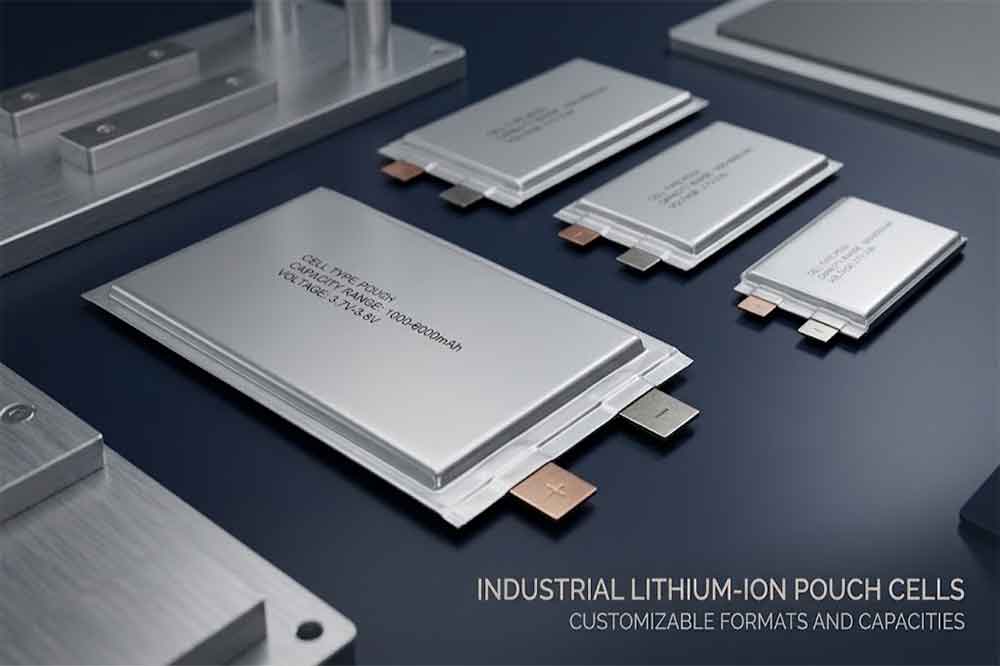
A lithium ion pouch cell is a rechargeable battery cell that uses a flexible aluminum-plastic laminated film as its outer packaging. Unlike cylindrical cells with metal cans or prismatic cells with rigid housings, pouch cells have a flat, lightweight structure that can be adapted to different product dimensions.
This design has made pouch cells a practical option for manufacturers developing compact electronics, medical equipment, portable instruments, industrial devices, and custom battery packs.
However, the flexible outer package is only one part of the design. The actual battery performance depends on the electrode materials, separator, electrolyte, cell construction, and manufacturing process.
For engineers and purchasing teams, understanding these components helps when selecting a lithium ion pouch cell for a new product or OEM battery project.
Explore our lithium ion pouch cell products to compare available capacities, dimensions, and battery configurations for your OEM or wholesale requirements.
What Is a Lithium Ion Pouch Cell?
A lithium ion pouch cell is a rechargeable electrochemical cell in which the internal electrode assembly is sealed inside a flexible multilayer aluminum-plastic film.
The cell contains a positive electrode (cathode), a negative electrode (anode), a separator, and an electrolyte. These components work together to store and release electrical energy through reversible electrochemical reactions.
The main difference between a pouch cell and other lithium-ion cell formats is its packaging.
A cylindrical battery uses a rigid metal cylinder, while a prismatic battery uses a rectangular metal case. A pouch cell uses laminated film that is heat-sealed around the internal electrode assembly.
This construction reduces the need for a heavy metal enclosure and allows manufacturers to produce thin, flat, and application-specific battery dimensions.
Pouch cells are sometimes marketed as lithium polymer batteries. However, the term does not necessarily mean that the cell uses a solid polymer electrolyte. Most commercial lithium-ion pouch cells use conventional lithium-ion chemistry with a liquid electrolyte.
For OEM manufacturers, the pouch format is particularly useful when a standard cylindrical or prismatic battery cannot fit the available space.
Structure of a Lithium Ion Pouch Cell
Although the external appearance is simple, a lithium ion pouch cell contains several carefully manufactured layers. Each component has a specific function, and the quality of these materials affects the cell’s capacity, internal resistance, cycle life, and safety.

1. Positive Electrode (Cathode)
The positive electrode is one of the main components responsible for determining the battery’s voltage and energy characteristics.
It consists of active cathode material coated onto an aluminum current collector.
Common cathode chemistries include:
- LCO (Lithium Cobalt Oxide)
- NMC (Lithium Nickel Manganese Cobalt Oxide)
- NCA (Lithium Nickel Cobalt Aluminum Oxide)
- LFP (Lithium Iron Phosphate)
Different materials offer different combinations of energy density, thermal stability, cycle life, and discharge performance.
For example, LCO is widely associated with compact electronic applications, while NMC is used in applications requiring a balance between energy density and power performance. LFP is often selected where cycle life and thermal stability are important.
The correct chemistry depends on the actual operating requirements rather than the cell format alone.
2. Negative Electrode (Anode)
The negative electrode is commonly made from graphite-based active material coated onto a copper current collector.
During charging, lithium ions move from the positive electrode through the electrolyte and separator, then enter the negative electrode structure.
During discharging, the process reverses.
The anode material, electrode loading, and manufacturing quality influence charging behavior, capacity, and long-term performance.
3. Separator and Electrolyte
The separator is a thin porous insulating membrane placed between the positive and negative electrodes.
Its main function is to prevent direct electrical contact between the electrodes while allowing lithium ions to pass through its pores.
The electrolyte provides the medium through which lithium ions move between the two electrodes.
Both components are essential to normal battery operation. Separator damage, electrolyte degradation, or contamination can affect cell performance and may create safety risks.
4. Aluminum-Plastic Film Packaging
The most recognizable feature of a lithium ion pouch cell is its outer laminated film.
This material generally contains multiple layers, including an outer protective polymer layer, an aluminum barrier layer, and an inner heat-sealable polymer layer.
The film protects the internal materials from the external environment and helps contain the electrolyte.
Unlike a metal battery case, the pouch film does not provide the same rigid mechanical support. Therefore, the battery compartment or pack enclosure must provide suitable protection against impact, sharp edges, excessive pressure, and uncontrolled expansion.
5. Positive and Negative Tabs
The electrode tabs extend from the sealed pouch and provide electrical connections to the external circuit.
The positive tab is commonly aluminum, while the negative tab is commonly nickel or copper-based, depending on the cell design and connection structure.
Tab dimensions, positions, materials, and welding requirements should be confirmed during battery pack development.
How Does a Lithium Ion Pouch Cell Work?
A lithium ion pouch cell stores energy through the movement of lithium ions between its positive and negative electrodes.
The process involves two main operating stages: charging and discharging.
Charging Process
When an external charger supplies electrical energy, lithium ions move from the positive electrode toward the negative electrode through the electrolyte.
At the same time, electrons travel through the external charging circuit.
The lithium ions are stored within the negative electrode material until the charging process reaches the specified voltage and current limits.
The charger must match the cell chemistry and manufacturer’s charging specifications. Applying an unsuitable charging voltage or current can shorten battery life or create safety problems.
Discharging Process
When the battery powers an electronic device, lithium ions move back from the negative electrode toward the positive electrode.
Electrons travel through the external load, supplying electrical energy to the connected equipment.
The voltage gradually changes as the cell releases energy.
The available capacity and discharge performance depend on several factors, including electrode materials, temperature, discharge current, cell condition, and operating voltage range.
This reversible movement of lithium ions allows the pouch cell to be recharged and used repeatedly.

Common Types of Lithium Ion Pouch Cells
Pouch cells are not a single standardized battery product. They can differ significantly in chemistry, dimensions, capacity, thickness, and electrical performance.
Different Cathode Chemistries
The most common distinctions are based on cathode materials.
LCO pouch cells: Often used in compact electronic products where high energy density and limited installation space are important.
NMC pouch cells: Suitable for applications requiring a balance of energy density, power capability, and overall performance.
LFP pouch cells: Considered for applications where long cycle life and thermal stability are priorities, although their voltage and energy density characteristics differ from other lithium-ion chemistries.
Selecting a chemistry should involve reviewing the required nominal voltage, maximum charging voltage, discharge current, temperature range, and expected service life.
Different Cell Shapes and Dimensions
Pouch cells are available in different lengths, widths, and thicknesses.
Some are designed for conventional rectangular battery compartments. Others are developed for narrow spaces, compact instruments, or products with unusual internal layouts.
However, a flexible pouch does not mean the cell can be bent or folded during installation. The finished cell must be used within its approved mechanical limits.
For OEM projects, dimensions and thickness tolerances should be confirmed before designing the battery compartment.
Main Applications of Lithium Ion Pouch Cells
The combination of low packaging weight, flat geometry, and customizable dimensions makes pouch cells suitable for many types of equipment.
Portable Electronic Devices
Portable electronics often have limited internal space. A flat pouch cell can make better use of the available battery compartment than a conventional cylindrical cell.
Typical applications include handheld devices, portable instruments, smart terminals, and compact electronic equipment.
Medical and Healthcare Equipment
Portable medical devices may require a lightweight power source with specific dimensions and capacity.
Pouch cells can be considered for selected monitoring equipment, diagnostic instruments, portable medical terminals, and other battery-powered devices.
Medical applications require careful evaluation of battery quality, electrical protection, traceability, and applicable certification requirements.
Industrial and IoT Devices
Industrial sensors, wireless communication devices, data collection terminals, and monitoring equipment may operate in locations where frequent battery replacement is inconvenient.
A properly selected pouch cell can support compact equipment designs while providing the required operating capacity.
Temperature range, standby consumption, discharge profile, and expected service life should all be considered.
Smart Wearable and Custom Electronics
Wearable products and specialized electronic devices often have unusual internal layouts.
Thin pouch cells and custom dimensions can help product designers use otherwise unavailable space.
The cell must still maintain appropriate mechanical protection, insulation, and operating conditions throughout its service life.

Advantages and Limitations of Pouch Cells
A lithium ion pouch cell offers several design advantages, but it is not automatically the best choice for every battery application.
Main advantages include:
- Lightweight packaging without a heavy rigid metal can.
- Flat geometry suitable for compact equipment.
- Efficient use of available internal space.
- Flexible options for different dimensions and capacities.
- Compatibility with different lithium-ion cathode chemistries.
There are also limitations that engineers should consider.
The flexible film provides less mechanical protection than a rigid metal case. Pouch cells can also experience thickness changes during operation and aging. The battery enclosure must account for the manufacturer’s specified expansion and mechanical requirements.
In addition, pouch cells require appropriate handling, insulation, sealing protection, and pack integration.
A good cell selection should consider the complete battery system, not just the weight or nominal capacity of an individual cell.
What Should Buyers Consider When Selecting a Pouch Cell?
For battery distributors, equipment manufacturers, and engineering teams, the following specifications are useful when comparing lithium ion pouch cells.
1. Voltage and chemistry
Confirm the cell chemistry, nominal voltage, and maximum charging voltage. Different chemistries cannot be treated as interchangeable.
2. Capacity
Determine the required capacity in Ah or mAh based on the equipment’s energy consumption and expected operating time.
3. Dimensions and thickness
Provide the available installation space, including length, width, and maximum thickness. Specify dimensional tolerances where the battery compartment is tightly fitted.
4. Charge and discharge current
Check continuous and peak current requirements. A battery with sufficient capacity may still be unsuitable if its discharge capability is too low.
5. Operating temperature
Review the permitted charging and discharging temperature ranges for the intended environment.
6. Protection and certification
For battery pack applications, consider the required BMS or PCM protection, overcharge and over-discharge control, short-circuit protection, and applicable transportation or product certifications.
7. Mechanical integration
Confirm tab positions, connection methods, insulation, enclosure support, and allowance for approved cell expansion.
These details should be reviewed before finalizing the battery design or placing a bulk order.
Custom Lithium Ion Pouch Cells for OEM Projects
Standard pouch cells are not always suitable for products with limited space or specific electrical requirements.
In OEM and ODM projects, the battery specification may need to be adjusted according to the product’s internal layout and operating conditions.
A custom pouch cell project may involve:
- Voltage and capacity requirements.
- Cell length, width, and thickness.
- Cathode chemistry selection.
- Positive and negative tab positions.
- Connector and cable requirements for the battery assembly.
- Charging and discharging current.
- Operating temperature range.
- Custom battery pack design and protection.
For purchasing teams, it is helpful to provide a product drawing or available battery compartment dimensions when requesting a quotation.
This gives the battery manufacturer a clearer starting point for checking feasibility, recommending a suitable cell, and discussing sample development.
Apsenx supplies lithium battery solutions for OEM and wholesale requirements. Buyers looking for pouch-format cells can explore the Pouch Cell Battery product category to review the available product range and discuss project specifications.
The most suitable lithium ion pouch cell is not necessarily the one with the highest capacity. It is the one that meets the product’s electrical, mechanical, thermal, and production requirements.
Frequently Asked Questions
1. What is the difference between a lithium ion pouch cell and a regular lithium-ion battery?
A pouch cell is one physical format of lithium-ion battery. Its main difference is the flexible aluminum-plastic film packaging instead of a rigid cylindrical or prismatic metal enclosure.
2. Are lithium ion pouch cells the same as lithium polymer batteries?
The terms are often used interchangeably in commercial markets. However, pouch describes the packaging format, not necessarily the electrolyte type. Most commercial pouch cells use conventional lithium-ion electrochemistry with liquid electrolyte.
3. Can lithium ion pouch cells be customized?
Yes. Depending on the manufacturer’s capabilities, cell dimensions, capacity, chemistry, thickness, and tab configuration may be selected for specific applications. Customization feasibility depends on the required specifications and production volume.
4. Do lithium ion pouch cells require a BMS?
A single cell requires a charger and operating limits appropriate to its chemistry and specifications. Multi-cell battery packs generally require suitable monitoring and protection, commonly through a BMS. The protection design should match the complete battery system.
5. What information is needed to request a pouch cell quotation?
Buyers should provide the required voltage, capacity, dimensions, maximum thickness, charge and discharge current, operating temperature, application, and estimated order quantity. Drawings or photos of the installation space can also help with technical evaluation.
1. Battery University – Pouch Cell: Small but Not Trouble Free: Learn about pouch cell construction, mechanical support requirements, and cell expansion.
2. Battery Council International – About Lithium-ion Batteries: Learn about lithium-ion battery structure and the different cell packaging formats.
Related Article
Understanding the structure of a lithium-ion pouch cell is only the first step. The manufacturing process behind its electrodes, separator assembly, aluminum-plastic packaging and electrolyte filling also plays an important role in cell quality. Explore our guide to how lithium ion pouch cells are manufactured step by step.
Understanding the basic working principle is only part of selecting a suitable battery. For a closer look at the internal construction, see our explanation of lithium ion pouch cell internal structure and materials.
Lithium Ion Pouch Cell Series
-

11.1V 3S 850mAh li-ion Polymer Pouch Cell Battery Pack
-

134365 4500mAh 3.7V Rechargeable Lithium Polymer Battery
-

3.7V 1200mAh Li-Polymer Pouch Cell Battery
-

3.7V 15Ah 148198 Pouch Lithium Ion Battery
-

3.7V 1S2P 3000mah lithium Polymer Battery
-

3.7V 2000mAh Pouch Cell Battery
-

3.7V 502248 500mAh Lithium Ion Polymer Battery
-

3.7V 700mAh Li-Polymer Pouch Cell Battery
-

3.7V 800mAh Rechargeable Pouch Li-Polymer Battery
Leave a Reply