
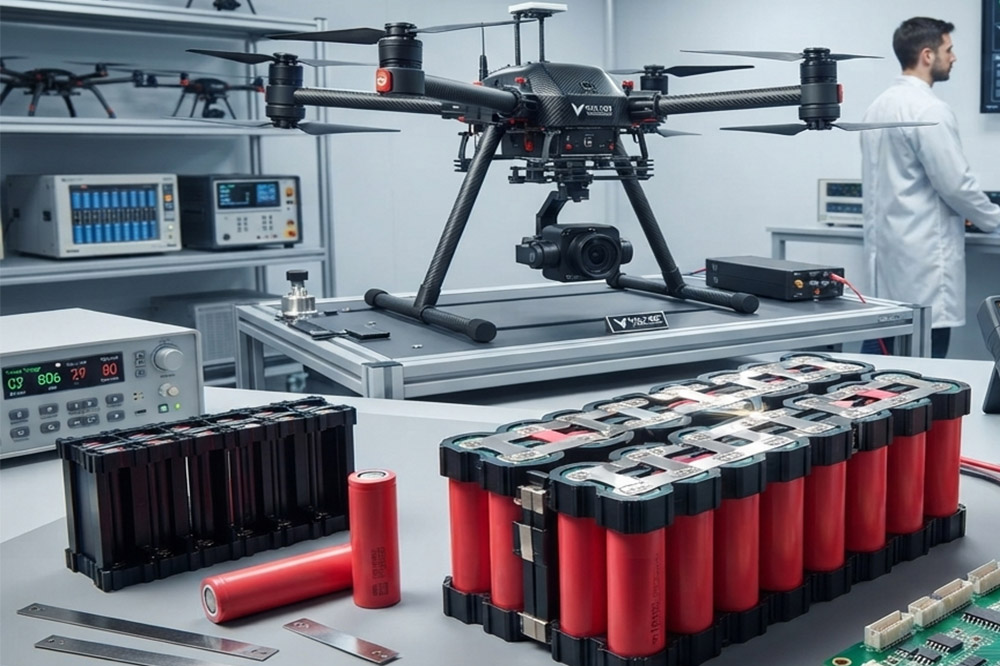
When drone manufacturer starts looking for longer flight time, one question appears quite often:
“Can we get more energy without making the battery much larger?”
This is where 21700 battery cells come into the conversation.
In recent years, 21700 lithium-ion cells have become increasingly popular in electric vehicles, energy storage systems, and commercial UAV applications.
Compared with the traditional 18650 cell, the 21700 format offers a larger size and higher capacity.
But does that automatically mean it is better for drones?
Not always.
In UAV battery design, every extra gram matters. A higher-capacity cell sounds attractive, but the final decision depends on the drone structure, motor system, payload, and flight mission.
From a battery supplier’s perspective, 21700 is not replacing every 18650 application. Instead, it gives drone manufacturers another option when longer endurance becomes a priority.
Why Are UAV Manufacturers Looking at 21700 Battery Cells?

The biggest reason is energy density.
A typical drone manufacturer is always trying to solve the same problem:
More flight time without adding too much weight.
A 21700 cell has a larger diameter and longer length compared with an 18650 cell.
Because of the increased size, it can usually store more energy per cell.
This can help reduce the number of cells needed for a battery pack.
For example, a battery pack designed with fewer high-capacity cells may have:
- Less internal connection work
- Lower pack complexity
- Better space utilization
However, the real improvement depends on the cell specification and battery design.
Simply replacing 18650 cells with 21700 cells does not always create a better UAV battery.
21700 vs 18650 Battery Cells for UAV Applications
The basic difference is size.
An 18650 cell:
- Diameter: 18mm
- Length: 65mm
A 21700 cell:
- Diameter: 21mm
- Length: 70mm
The larger physical size allows 21700 cells to achieve higher capacity.
A common comparison:
| Battery Cell | Typical Capacity Range |
|---|---|
| 18650 | Around 2000mAh-3500mAh |
| 21700 | Around 4000mAh-5000mAh or higher |
For a long endurance UAV, this difference can become meaningful.
But there is another side.
18650 cells have been produced for many years, and many manufacturers already have mature battery pack designs around them.
Some drone platforms are already optimized for 18650 dimensions.
Changing to 21700 may require:
- New battery housing
- Different wiring design
- Updated BMS settings
- Mechanical changes
So the decision is not only technical. It also involves development cost.

Where Do 21700 Batteries Fit Best in UAV Applications?
Not every drone needs a 21700 battery pack.
They are often considered for applications where flight time matters more than extreme acceleration.
Typical examples include:
Mapping Drones
Survey and mapping drones often operate on planned routes.
The goal is usually stable operation and longer flight distance.
A higher energy density battery can reduce the number of battery swaps during a working day.
Inspection Drones
Industrial inspection drones may need to stay in the air while collecting images, videos, or sensor data.
A few extra minutes of flight time can improve efficiency.
Delivery UAVs
Delivery drones carry additional weight.
The battery needs to support:
- Payload
- Motor power
- Flight distance
21700 battery packs can be an option when designers need more energy in a limited space.
Does 21700 Always Provide Longer Flight Time?
This is a common assumption, but the answer is not always yes.
Flight time depends on many factors:
- Drone weight
- Motor efficiency
- Propeller design
- Weather conditions
- Payload
- Battery management
A larger battery can increase flight time, but it also increases weight.
At some point, adding more cells creates diminishing returns.
For example, a drone designed for a lightweight camera system may perform worse with a very large battery because the motors need more energy to carry the extra weight.
The battery and aircraft need to be designed together.
Choosing the Right 21700 Cell for UAV Battery Packs
Not all 21700 cells are the same.
For UAV applications, manufacturers usually pay attention to:
Capacity
Higher capacity helps increase flight time.
Discharge Capability
The battery still needs to provide enough current during:
- Takeoff
- Acceleration
- Heavy payload operation
Internal Resistance
Lower resistance usually means better efficiency and less heat generation.
Cycle Life
Commercial drones may fly every day.
Battery lifespan directly affects operating costs.
Custom 21700 Battery Packs for UAV Manufacturers
For drone companies, buying individual cells is only the beginning.
A complete UAV battery solution usually requires:
- Cell matching
- Series and parallel design
- BMS development
- Connector customization
- Mechanical structure design
- Safety testing
For example, an agricultural drone manufacturer may need a 12S or higher voltage battery pack with high discharge capability.
A simple off-the-shelf battery may not fit the application.
This is where custom battery pack development becomes important.
What Should Buyers Ask a 21700 UAV Battery Supplier?
Before placing a bulk order, drone companies should ask:
- What cell models are available?
- What is the continuous discharge current?
- How is cell consistency controlled?
- Is BMS customization available?
- Can the battery size be adjusted?
- Are UN38.3 and other certifications available?
A battery supplier who understands UAV requirements can often help avoid problems during mass production.
21700 Battery Cells: A Better Choice for Future UAV Designs?
The popularity of 21700 cells shows an important trend in the UAV industry.
Drone manufacturers are looking for better energy efficiency, longer operating time, and more reliable battery solutions.
However, 21700 is not simply a replacement for 18650.
Some compact drones still benefit from 18650 battery packs because of size and cost advantages.
For new commercial UAV projects, 21700 cells provide another powerful option, especially when endurance is one of the main product goals.
A well-designed battery pack is usually the result of balancing capacity, weight, power output, and real working conditions.


Leave a Reply