
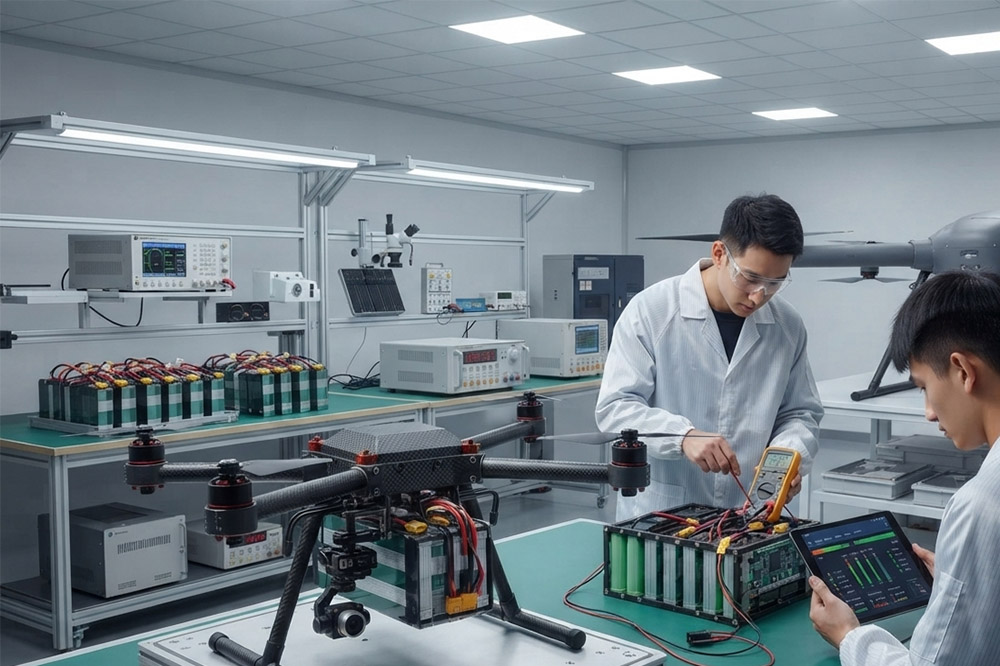
When people evaluate a drone, they often look at the camera quality, flight controller, communication range, or payload capability.
The battery usually stays behind the scenes.
But for commercial UAV manufacturers, the battery is one of the parts that can directly affect the product reputation.
A drone used for inspection, agriculture, mapping, or delivery cannot simply stop working because the battery performance is inconsistent.
Imagine a customer operating a surveying drone on a construction site. The weather is changing, the payload is heavy, and the drone needs to complete several flights every day.
A battery that performs well in a laboratory but loses capacity quickly in real operation can become a serious problem.
So, what makes a good commercial UAV battery?
It is not only about having a large capacity number on the label.
A reliable UAV battery needs to balance energy density, safety, discharge capability, lifespan, and production consistency.
Commercial UAV Batteries Are Different From Hobby Drone Batteries

A hobby drone and a commercial UAV may look similar, but their battery requirements are usually very different.
A hobby user may fly a drone occasionally for entertainment.
A commercial operator may use the drone every day for:
- Infrastructure inspection
- Agricultural spraying
- Mapping
- Security monitoring
- Delivery operations
For commercial applications, battery reliability becomes part of the business cost.
A few minutes of reduced flight time may not seem important at first, but when a company operates dozens of drones every day, small differences become significant.
This is why commercial UAV battery selection usually focuses more on long-term performance rather than only peak specifications.
1. Stable Battery Performance Matters More Than Maximum Capacity
One common mistake during battery selection is focusing only on capacity.
A higher Ah rating looks attractive.
However, commercial drone manufacturers usually care about another question:
“Will every battery perform the same after hundreds of cycles?”
Battery consistency is extremely important.
For example, a drone fleet may contain 100 battery packs.
If some batteries provide 40 minutes of flight time while others only provide 30 minutes, operation planning becomes difficult.
A good UAV battery should have:
- Consistent capacity
- Low internal resistance difference
- Stable voltage output
- Predictable performance
This is why professional battery manufacturers spend time on cell matching and quality control.
2. High Discharge Capability for Real Flight Conditions

A drone does not consume power at a constant level.
During normal flight, power demand changes constantly.
For example:
- Takeoff requires high current
- Climbing requires more power
- Carrying heavy payload increases load
- Strong wind can increase motor demand
A battery that cannot provide enough current may cause:
- Voltage drop
- Reduced motor performance
- Shorter flight time
- Excessive heat
For high-performance UAVs, battery suppliers usually evaluate:
- Continuous discharge current
- Peak discharge current
- Cell chemistry
- Internal resistance
This is especially important for agricultural drones and industrial platforms carrying heavy equipment.
3. Battery Safety Cannot Be Ignored
For commercial UAV applications, safety is not optional.
Many drones operate in environments where battery failure can create expensive consequences.
A good commercial UAV battery should include proper protection features such as:
- Overcharge protection
- Over-discharge protection
- Over-current protection
- Temperature monitoring
The battery management system (BMS) plays an important role here.
A well-designed BMS can help monitor battery conditions and improve operational safety.
However, the BMS design needs to match the battery application.
A small consumer drone and a heavy industrial UAV may require completely different protection strategies.
4. Long Cycle Life Reduces Operating Costs
A commercial drone battery is not a one-time product.
Many operators expect hundreds of charging cycles.
The battery lifespan affects:
- Maintenance cost
- Replacement frequency
- Overall project profitability
A battery with slightly higher initial cost may actually reduce expenses if it lasts longer.
For example, an inspection company flying drones every day may prefer a battery that maintains performance after many cycles instead of choosing the cheapest option.
The cheapest battery is not always the lowest-cost solution.
5. Battery Weight and Energy Density Still Matter
Commercial UAV manufacturers are always trying to increase efficiency.
The challenge is simple:
More energy usually means more weight.
More weight requires more power.
More power reduces flight efficiency.
This creates a balance problem.
Different battery types solve this problem differently.
LiPo Battery
Usually selected for:
- High power output
- Fast response
- Lightweight UAVs
18650 Lithium-ion Battery Pack
Often used for:
- Stable production
- Balanced performance
- Medium endurance applications
21700 Lithium-ion Battery Pack
Suitable for:
- Higher energy density
- Long endurance UAV projects
The right choice depends on the aircraft design.
6. Custom Battery Design Is Common in Commercial UAV Projects

Many commercial UAV companies do not use standard batteries.
The reason is simple:
Every drone design has different requirements.
A custom battery project may involve:
- Specific voltage configuration
- Custom dimensions
- Special connectors
- Customized BMS settings
- Different cell selection
For example, an agricultural drone manufacturer may need a high-voltage battery pack that fits into a limited battery compartment while supporting high current during takeoff.
A standard battery from the market may not match these requirements.
What Should Drone Manufacturers Check Before Choosing a Battery Supplier?
Before starting a bulk order, manufacturers should look beyond the quotation.
Important questions include:
What cells are used?
Different cell brands and models can affect performance.
Can the supplier customize battery packs?
OEM capability is important for commercial UAV projects.
How is quality controlled?
Check:
- Cell matching process
- Battery testing methods
- Production inspection
Are export documents available?
Depending on the market, buyers may need:
- UN38.3
- MSDS
- IEC-related reports
- Other compliance documents
Choosing Reliable UAV Battery Partner
A commercial UAV battery supplier is not simply a company that connects cells together.
The supplier should understand the relationship between:
- Drone design
- Power requirements
- Battery chemistry
- BMS protection
- Production requirements
During development, many battery problems can be avoided if the supplier joins the project early.
Sometimes a small adjustment in cell selection or pack structure can improve the final product significantly.
Final Thoughts
A good commercial UAV battery is not defined by one specification.
Capacity is important, but it is only one part of the equation.
For professional drone manufacturers, battery reliability, safety, consistency, and customization ability often determine whether a UAV project succeeds in the market.
Choosing the right battery partner during the early design stage can help reduce development risks and create a more reliable drone product.


Leave a Reply