
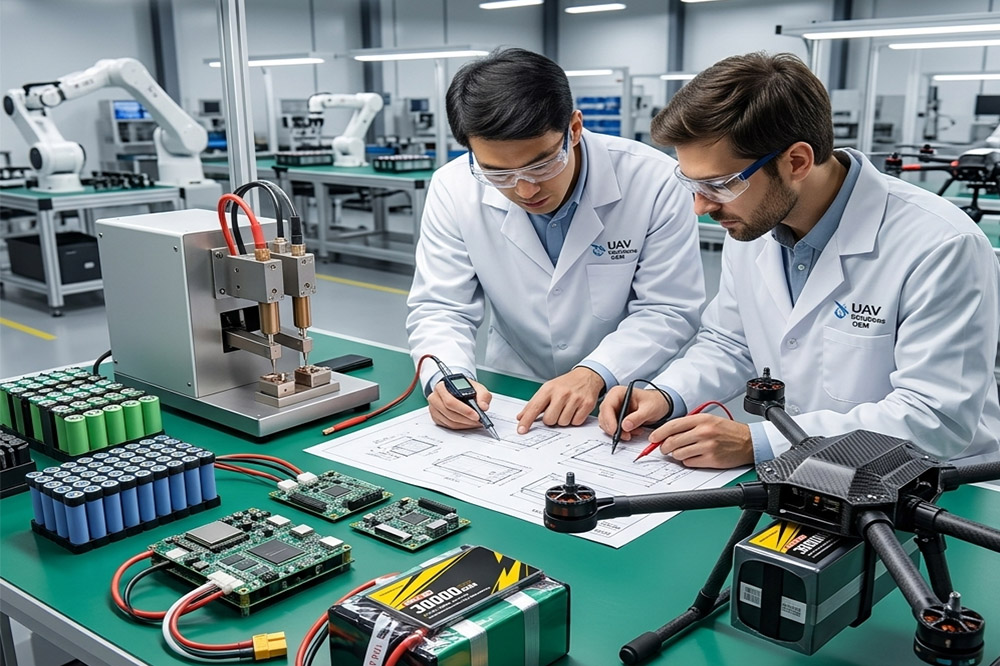
When drone company reaches the prototype stage, the battery question usually becomes more complicated.
At the beginning, many teams think:
“We just need a battery with enough voltage and capacity.”
But after the first few tests, reality often looks different.
The battery may fit the drone, but the flight time is shorter than expected.
The capacity may look good on paper, but the voltage drops too quickly during takeoff.
The battery may perform well in the laboratory but struggle when the drone carries a real payload.
This is why commercial UAV manufacturers often move toward custom battery pack development instead of simply buying standard batteries.
A custom UAV battery pack is not only about connecting lithium cells together. It is about creating a power system that matches the drone’s actual working conditions.
Why Standard Drone Batteries Often Cannot Meet Commercial Requirements

For hobby drones, standard batteries are usually enough.
A user can buy a battery, charge it, and fly.
Commercial UAV projects are different.
A company developing an agricultural drone, inspection UAV, or delivery drone usually has specific requirements:
- Exact battery dimensions
- Specific voltage output
- Higher discharge capability
- Longer operating time
- Different connector design
- Communication with BMS
A standard battery from the market may work temporarily, but it may not be suitable for long-term production.
For example, a drone manufacturer may design a compact inspection drone where the battery compartment is only 70mm high.
A normal battery pack may have enough capacity but physically cannot fit.
The battery needs to be designed around the aircraft.
The First Step: Choosing the Right Battery Cells
The cell selection is one of the most important parts of a custom UAV battery project.
Different cells create different battery characteristics.
Common choices include:
LiPo Cells
Usually selected for:
- High power output
- Fast acceleration
- Lightweight UAVs
Common applications:
- FPV drones
- Racing UAVs
- High-performance platforms
18650 Lithium-ion Cells
Often selected because of:
- Mature supply chain
- Stable production
- Balanced performance
Used in:
- Inspection drones
- Mapping UAVs
- Commercial drone platforms
21700 Lithium-ion Cells
Becoming more popular because they offer:
- Higher capacity
- Better energy density
- Longer endurance potential
Used in:
- Long-range UAVs
- Industrial drone projects
LiFePO4 Cells
Chosen when safety and cycle life are priorities.
Used for:
- Heavy-duty UAVs
- Special industrial applications
The right cell depends on the mission.
A fast racing drone and a drone flying for one-hour inspection missions are solving completely different problems.
Battery Configuration: More Than Just Voltage Numbers

A custom battery pack usually requires careful electrical design.
The battery designer needs to determine:
- Series connection (S)
- Parallel connection (P)
- Voltage
- Capacity
- Maximum current output
For example:
A 6S battery pack provides higher voltage than a 4S pack.
A 10P configuration increases capacity and current capability.
But increasing voltage or capacity also affects:
- Weight
- Size
- Heat generation
- Charging requirements
This is why battery design cannot be separated from the drone system.
The motor, ESC, flight controller, and battery all need to work together.
BMS Design: The Part Many Buyers Forget
Many customers focus on cells but underestimate the importance of the battery management system.
A BMS helps monitor and protect the battery.
A commercial UAV battery may require:
- Overcharge protection
- Over-discharge protection
- Over-current protection
- Temperature monitoring
- Cell balancing
For advanced applications, some battery packs may also require communication functions.
For example, a drone fleet operator may want battery information such as:
- Remaining capacity
- Battery health
- Cycle count
- Temperature status
The BMS becomes part of the overall drone management system.
Custom Battery Pack Structure and Mechanical Design
A battery is not only an electrical product.
The physical design matters too.
During UAV battery development, engineers usually consider:
- Battery size
- Weight distribution
- Mounting method
- Connector position
- Protection structure
A poorly designed battery can affect the drone’s balance.
For example, if a camera drone has an uneven weight distribution, flight stability can suffer.
Sometimes changing the battery structure slightly can improve the entire aircraft design.
Testing Before Mass Production
A professional UAV battery supplier should not move directly from prototype to large production.
Testing is necessary.
Typical testing includes:
Capacity Testing
Check whether the battery provides the expected energy.
Discharge Testing
Verify performance under real load conditions.
Temperature Testing
Evaluate operation in different environments.
Cycle Testing
Measure long-term battery durability.
Safety Testing
Confirm protection performance.
A battery that works once is not enough.
Commercial UAV manufacturers need consistency across hundreds or thousands of units.
Custom UAV Battery Development Process
A typical OEM battery development process may include:
1. Requirement Discussion
Understand:
- Drone model
- Flight time target
- Payload
- Operating environment
2. Cell Selection
Choose suitable:
- Battery chemistry
- Cell model
- Capacity
- Discharge rating
3. Prototype Development
Create initial samples for testing.
4. Performance Adjustment
Modify:
- Structure
- BMS settings
- Cell arrangement
5. Mass Production
After approval, move into stable production.
What Should Drone Companies Look for in a Battery Manufacturer?
Choosing a battery supplier is not only about price.
For OEM UAV projects, companies should check:
Manufacturing Experience
Has the supplier produced similar battery packs before?
Engineering Support
Can they help with battery design?
Testing Capability
Do they have proper battery testing equipment?
Quality Control
How do they manage cell consistency?
Certification Support
Can they provide documents needed for international markets?
A reliable supplier can become part of the product development team, not just a component seller.
Custom UAV Battery Packs Are Becoming More Important
As drones move into commercial industries, battery requirements continue to become more specific.
Agriculture, inspection, mapping, and delivery applications all have different power needs.
A battery designed for one drone may not work well for another.
This is why custom UAV battery packs are becoming a common choice for manufacturers who need better performance, reliability, and production control.
The right battery design usually comes from understanding the complete drone system, not just selecting the highest capacity cell.


Leave a Reply