
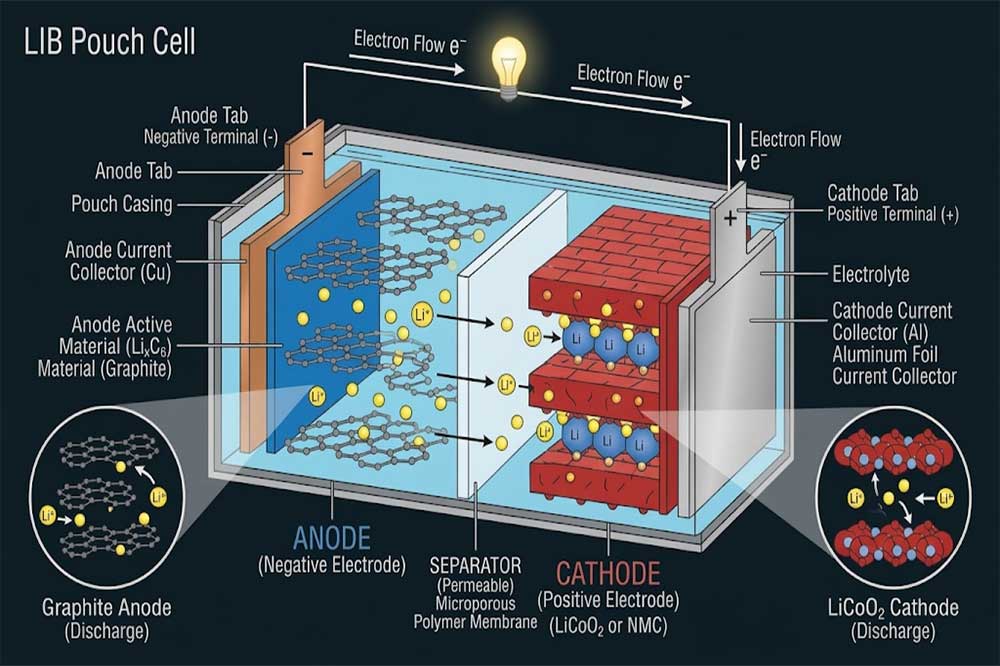
A lithium ion pouch cell may look like a simple flat battery wrapped in a flexible film, but its internal construction is much more complicated. Several materials are combined to make the cell store energy, transfer electrical current, maintain separation between electrodes, and protect the internal chemistry from the outside environment.
For battery engineers and OEM buyers, understanding these materials is useful when comparing different cell chemistries or evaluating a battery supplier. Two pouch cells with similar dimensions and rated capacities may use different electrode materials, separators, electrolytes, and packaging films. These differences can affect operating voltage, energy density, discharge performance, cycle life, and manufacturing cost.
The main materials used in lithium ion pouch cells include cathode active materials, anode materials, electrolyte, separator film, metal current collectors, and aluminum-plastic laminate packaging. Conductive additives, binders, and electrode tabs also play important roles in the finished cell.
Understanding the Basic Materials in a Lithium Ion Pouch Cell
A typical lithium ion pouch cell contains several functional layers arranged in a stacked or wound electrode assembly. The positive and negative electrodes store lithium through reversible electrochemical reactions. The electrolyte provides an ion-conducting medium, while the separator keeps the electrodes physically apart.
The materials can be divided into two general groups: electrochemically active materials and supporting materials.
Active materials directly participate in energy storage. Cathode and anode compositions largely determine the cell’s voltage, capacity, and electrochemical characteristics.
Supporting materials make the cell function reliably. These include the separator, current collectors, conductive additives, binders, and outer packaging.
| Component | Common Materials | Main Function |
|---|---|---|
| Cathode | LCO, NMC, LFP, NCA | Stores and releases lithium ions |
| Anode | Graphite, silicon-graphite | Stores lithium ions during charging |
| Electrolyte | Lithium salts and organic solvents | Transports lithium ions |
| Separator | PE, PP, ceramic-coated polymers | Prevents direct electrode contact |
| Positive current collector | Aluminum foil | Conducts electrons |
| Negative current collector | Copper foil | Conducts electrons |
| Pouch packaging | Aluminum-plastic laminate | Seals and protects the cell |
The specific material combination depends on the cell chemistry, design requirements, and intended application. altechadvancedmaterials.com+1
Cathode Materials: Determining Battery Chemistry and Performance
The cathode is one of the most important parts of a lithium ion pouch cell. Its active material influences the nominal voltage, energy density, thermal characteristics, and overall electrochemical behavior.
Different cathode chemistries are selected according to the balance required between energy storage, power output, operating conditions, and cost.
Lithium Cobalt Oxide (LCO)
Lithium cobalt oxide, commonly called LCO, is widely associated with compact lithium-ion batteries used in portable electronic products.
Its relatively high energy density makes it suitable for applications where available space and battery weight are important considerations.
LCO pouch cells are commonly considered for:
- Portable electronic devices
- Compact industrial equipment
- Small medical and monitoring devices
- Space-constrained electronic products
However, cobalt-based chemistry has cost and thermal-management considerations. Cell design, charging limits, and protection systems remain important for safe operation.
Lithium Nickel Manganese Cobalt Oxide (NMC)
NMC cathode materials combine nickel, manganese, and cobalt in different proportions.
Nickel contributes to energy capacity, while manganese and cobalt help influence structural stability and electrochemical performance. Different NMC formulations offer different performance characteristics.
NMC pouch cells are used in applications requiring a combination of energy density, power capability, and practical cycle life.
Typical applications include portable power equipment, industrial devices, electric mobility systems, and customized battery packs.
Lithium Iron Phosphate (LFP)
Lithium iron phosphate uses iron and phosphate in its cathode structure.
Compared with many nickel- and cobalt-containing cathode chemistries, LFP is known for its strong thermal stability and long cycle-life potential. Its nominal cell voltage and energy density differ from those of LCO and NMC.
LFP pouch cells may be suitable for:
- Energy storage equipment
- Backup power systems
- Industrial battery applications
- Equipment requiring extended operating life
The lower energy density compared with some high-energy-density chemistries means that the required battery dimensions and weight should be checked during product design.
Other Cathode Materials
Other lithium-ion cathode materials include lithium nickel cobalt aluminum oxide (NCA) and lithium manganese oxide (LMO).
These materials are used in particular battery designs where their electrochemical characteristics match the application.
The cathode should not be selected by chemistry name alone. Voltage range, operating temperature, discharge current, charging requirements, and available installation space all matter.

Anode Materials: Where Lithium Ions Are Stored
The anode is the negative electrode of a lithium-ion cell. In most conventional commercial designs, graphite is the main active material.
During charging, lithium ions move from the cathode through the electrolyte and separator before being stored within the graphite structure. During discharge, the movement is reversed.
Graphite is widely used because of its established manufacturing processes, suitable electrochemical performance, and relatively stable operating characteristics.
Some advanced cell designs use silicon or silicon-graphite composites. Silicon can store more lithium per unit mass than graphite, offering opportunities for higher energy density. However, silicon expands significantly during lithiation, creating challenges related to electrode stability, particle cracking, and cycle life.
Other anode materials, such as lithium titanate (LTO), are used in specialized battery systems where their particular performance characteristics justify the design trade-offs.
For OEM battery development, the anode material must be considered together with the cathode. Their capacity balance, electrode loading, and operating voltage window affect the final cell design.
Electrolyte: The Medium for Lithium Ion Movement
The electrolyte enables lithium ions to move between the positive and negative electrodes.
In many commercial lithium-ion pouch cells, the electrolyte is a liquid mixture containing a lithium salt dissolved in organic carbonate solvents.
A commonly used lithium salt is lithium hexafluorophosphate (LiPF6). Typical solvent systems may contain ethylene carbonate (EC), dimethyl carbonate (DMC), diethyl carbonate (DEC), or ethyl methyl carbonate (EMC).
Electrolyte formulations can also include additives that help improve electrode interface stability, cycling behavior, and performance under specific operating conditions.
The electrolyte is absorbed into the porous electrode coatings and separator. It is not simply a separate flat layer inside the cell.
Its composition affects several important characteristics:
- Ionic conductivity
- Low-temperature performance
- High-temperature stability
- Internal resistance
- Cycle life
- Compatibility with electrode materials
A suitable electrolyte must work with the selected cathode and anode chemistry. Changing one component without considering the rest of the cell can affect overall performance.
Separator: Preventing Internal Short Circuits
The separator is a thin, porous membrane placed between the cathode and anode.
Its primary function is to prevent direct electrical contact between the two electrodes while allowing lithium ions to pass through its microscopic pores.
Common separator materials include:
Polyethylene (PE): A widely used polymer with useful thermal shutdown characteristics in certain separator designs.
Polypropylene (PP): Offers chemical resistance and thermal properties suitable for lithium-ion cell construction.
PP/PE/PP multilayer separators: Combine different polymer layers to provide a balance of mechanical and thermal characteristics.
Some separators also have ceramic coatings. These coatings can improve dimensional stability and help maintain separator integrity under elevated temperatures, depending on the coating design.
Separator thickness, porosity, puncture resistance, and electrolyte wettability are important manufacturing considerations.
Although the separator does not directly store energy, its quality can influence internal resistance, power capability, and cell safety.
Current Collectors: Aluminum and Copper Foils
Electrode active materials are not used alone. They are coated onto thin metal foils known as current collectors.
The positive electrode generally uses aluminum foil, while the negative electrode uses copper foil.
Aluminum foil for the cathode
Aluminum provides electrical conductivity and suitable corrosion resistance under the operating conditions of the positive electrode. The cathode active material is coated onto its surface.
Copper foil for the anode
Copper is commonly used for the negative electrode because of its electrical conductivity and compatibility with the anode’s operating potential.
These metal foils collect electrons from the electrode coatings and connect the internal electrode assembly to the external terminals.
The thickness, surface quality, cleanliness, and coating adhesion of the foils influence manufacturing consistency and cell performance.
Aluminum Laminate Film: The Outer Packaging Material
One of the defining features of a lithium ion pouch cell is its flexible aluminum-plastic packaging film.
Unlike cylindrical cells with metal cans or prismatic cells with rigid housings, pouch cells use multilayer laminate film to contain the electrode assembly and electrolyte.
A typical aluminum laminate film includes three main functional layers:
- Outer polymer layer: Often made from nylon or PET-based materials, providing mechanical protection and resistance to external damage.
- Aluminum barrier layer: Helps prevent moisture and oxygen from entering the cell and reduces the transmission of gases.
- Inner heat-sealing layer: Commonly based on polypropylene or modified polypropylene, allowing the pouch edges to be heat-sealed.
The layers are bonded together to create a flexible packaging material with different mechanical, chemical, and barrier properties.
The aluminum barrier is particularly important because moisture contamination can affect electrolyte stability and cell performance.
The inner sealing layer must also remain compatible with the electrolyte and maintain reliable sealing around the cell edges and electrode tabs.
For pouch cell manufacturers, laminate quality, forming performance, sealing strength, and moisture resistance are important production considerations.

How Material Selection Affects Pouch Cell Performance
A lithium ion pouch cell is not defined by a single material. Its performance comes from the interaction between all the components.
For example, selecting a high-capacity cathode does not automatically guarantee a high-performance battery. The anode must have a suitable capacity balance, the electrolyte must support the required operating conditions, and the separator must provide reliable ionic transport and electrical insulation.
Several relationships are worth considering during battery development:
Energy density: Cathode and anode chemistry, electrode loading, and the proportion of inactive materials all influence the amount of energy stored within a given weight or volume.
Cycle life: Electrode stability, electrolyte formulation, interface chemistry, and operating temperature contribute to long-term capacity retention.
Discharge performance: Electrode resistance, conductive additives, current collectors, and electrolyte conductivity affect how well a cell delivers current.
Safety: Separator integrity, electrolyte stability, electrode chemistry, and cell manufacturing quality all contribute to overall safety.
Packaging efficiency: Aluminum laminate film allows pouch cells to use a lightweight, flexible enclosure, although additional mechanical support may be needed in the finished battery pack.
Material selection is therefore a system-level engineering decision rather than a simple comparison of individual raw materials.

Choosing the Right Materials for OEM Pouch Cell Projects
For OEM battery projects, the right material combination depends on the product’s operating requirements rather than simply choosing the cell with the highest advertised capacity.
A compact handheld device may prioritize high energy density and limited installation space. An industrial monitoring device may require stable discharge performance over a long operating period. A backup power application may place greater importance on cycle life and operating temperature.
Before selecting a pouch cell, OEM buyers should consider the following specifications:
- Cell chemistry: LCO, NMC, LFP, or another suitable lithium-ion chemistry.
- Nominal voltage: Must match the electrical requirements of the device or battery system.
- Capacity: Selected according to operating time, available space, and expected load.
- Maximum discharge current: Should support both continuous and peak current requirements.
- Operating temperature: The selected cell must work within the product’s expected temperature range.
- Dimensions and thickness: Particularly important for custom electronic devices with limited internal space.
- Protection requirements: The finished battery may require a PCM or BMS, depending on the application.
- Certification and transportation: Project-specific testing and documentation should be considered before mass production.
When comparing suppliers, buyers should also request technical datasheets and confirm that the stated chemistry, electrical specifications, and physical dimensions match the actual production cell.
For projects requiring different capacities, thicknesses, or dimensions, reviewing available lithium ion pouch cell battery products is a useful starting point. A suitable cell can then be evaluated against the device’s mechanical and electrical requirements.
A material choice that works well in one application may not be appropriate for another. It is better to evaluate the complete cell specification before finalizing the battery design.
Frequently Asked Questions
1. What are the main materials used in lithium ion pouch cells?
The main materials include cathode active materials such as LCO, NMC, and LFP; graphite-based anode materials; lithium-salt electrolyte; PE or PP separators; aluminum and copper current collectors; and aluminum-plastic laminate packaging film.
2. What material is used for the cathode of a pouch cell?
Common cathode materials include lithium cobalt oxide (LCO), lithium nickel manganese cobalt oxide (NMC), and lithium iron phosphate (LFP). The selection depends on the required voltage, energy density, thermal characteristics, and application.
3. Is aluminum used inside lithium ion pouch cells?
Yes. Aluminum is used in two different places. It serves as the positive electrode current collector and as the barrier layer in the outer aluminum-plastic laminate packaging film. These two components perform different functions.
4. What is the separator made of in a lithium ion pouch cell?
Most conventional separators use microporous polyethylene (PE), polypropylene (PP), or multilayer combinations of these polymers. Some designs also include ceramic coatings to improve thermal and dimensional stability.
5. Do all lithium ion pouch cells use the same materials?
No. Material combinations vary according to cell chemistry, design, capacity, discharge requirements, and target applications. For example, an LCO pouch cell and an LFP pouch cell use different cathode materials and have different electrical characteristics.
Related Lithium Ion Pouch Cell Articles
- What Is a Lithium Ion Pouch Cell? Structure, Working Principle & Uses
- How Are Lithium Ion Pouch Cells Made? Manufacturing Process Explained
- Lithium Ion Pouch Cell Structure: Layers, Materials and Components Explained
- Lithium Polymer vs Lithium Ion Pouch Cell: What Is the Difference?
Related Products
-

11.1V 3S 850mAh li-ion Polymer Pouch Cell Battery Pack
-

134365 4500mAh 3.7V Rechargeable Lithium Polymer Battery
-

3.7V 1200mAh Li-Polymer Pouch Cell Battery
-

3.7V 15Ah 148198 Pouch Lithium Ion Battery
-

3.7V 1S2P 3000mah lithium Polymer Battery
-

3.7V 2000mAh Pouch Cell Battery
-

3.7V 502248 500mAh Lithium Ion Polymer Battery
-

3.7V 700mAh Li-Polymer Pouch Cell Battery
-

3.7V 800mAh Rechargeable Pouch Li-Polymer Battery
Leave a Reply