
What Is ICR18650 Battery?
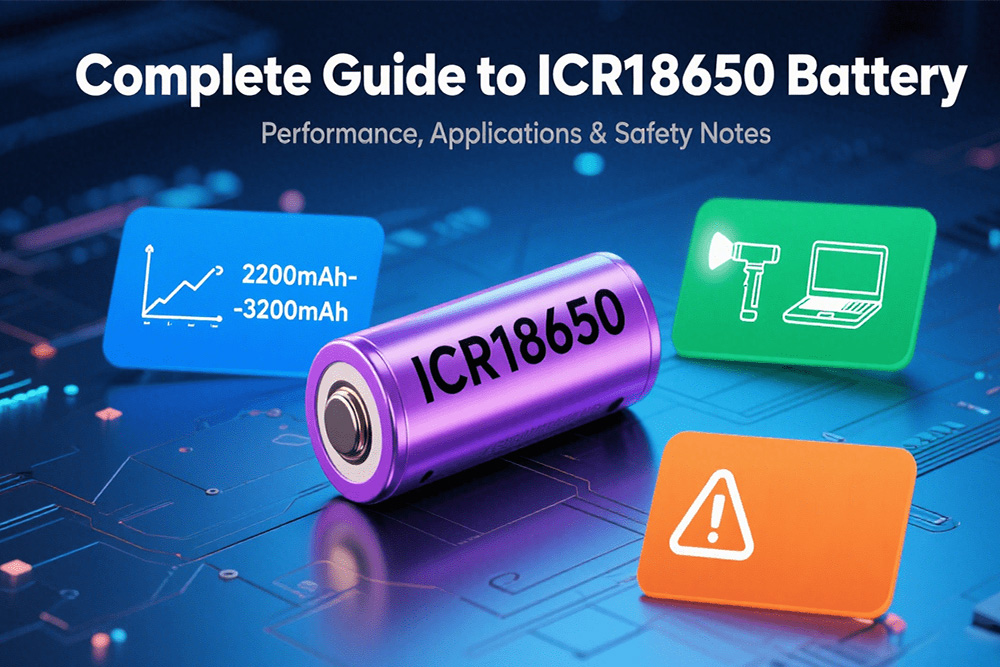
The ICR18650 battery is popular cylindrical lithium-ion cell. “ICR” stands for Lithium Cobalt Oxide (LiCoO₂) chemistry used as the cathode material. It follows the standard 18650 dimensions—18mm in diameter and 65mm in length—making it widely used in consumer electronics and compact devices.
Thanks to its high capacity, compact structure, and relatively low cost, the ICR18650 remains a go-to choice for portable electronics. However, compared to other 18650 battery types such as INR and IMR, it offers lower thermal stability and reduced discharge current capability.

Performance Specifications of the ICR18650 Battery
The ICR18650 excels in energy density, offering common capacities such as 2200mAh, 2600mAh, and 3200mAh. For example, the Samsung ICR18650-26F provides a 2600mAh capacity and performs reliably under medium loads.
However, it isn’t suitable for high-drain devices. The typical maximum continuous discharge current is around 2C (4–6A), and the chemistry is sensitive to overcharging and over-discharging. For safety, users should always pair the cell with a Protection Circuit Board (PCB).

Typical Applications of ICR18650 Batteries
Thanks to their large capacity and low cost, ICR18650 batteries work well in:
- LED flashlights
- Small household electronics and toys
- Battery packs with BMS integration
- Low-power portable medical devices
However, avoid using them in power tools, e-scooters, or drones, where high discharge current can lead to overheating and safety risks.

Pros and Cons of ICR18650 Batteries
Advantages:
- High energy density for longer runtime
- Lower cost compared to other lithium chemistries
- Industry-standard size, easy to replace and assemble
Disadvantages:
- Lower safety rating, not suitable for high-heat environments
- Not designed for high-current discharges
- Prone to thermal runaway if overcharged or short-circuited; always use with a protection board

ICR18650 vs Other 18650 Battery Types
| Type | Chemistry | Energy Density | Safety | Discharge Rate | Typical Applications |
|---|---|---|---|---|---|
| ICR | LiCoO₂ | ★★★★ | ★ | ★★ | Portable devices, low-drain gadgets |
| IMR | LiMn₂O₄ | ★★★ | ★★★★ | ★★★ | Power tools, drones |
| INR | Li(NiCoMn)O₂ | ★★★★ | ★★★ | ★★★★ | E-scooters, power batteries |
| LiFePO₄ | LiFePO₄ | ★★ | ★★★★★ | ★★★ | Energy storage, medical, EVs |
Safety Tips for Using ICR18650 Batteries
To ensure safe use of ICR18650 batteries, follow these best practices:
- Always use a protection circuit to prevent overcharging and over-discharging
- Never short-circuit, puncture, or disassemble the battery
- Keep the battery away from heat or direct sunlight
- Check regularly for swelling or leakage
- Store in a cool, dry place with voltage between 3.6V and 3.8V
Is ICR18650 the Right Choice for Your Application?
If your product demands high capacity but low current, such as LED flashlights or compact electronics, the ICR18650 offers a cost-effective and practical solution.
However, if you prioritize greater safety or high discharge performance, you should consider alternatives like INR, IMR, or LiFePO₄.
Choosing the right battery type not only affects product performance but also plays a vital role in ensuring user safety and system stability.
Leave a Reply