
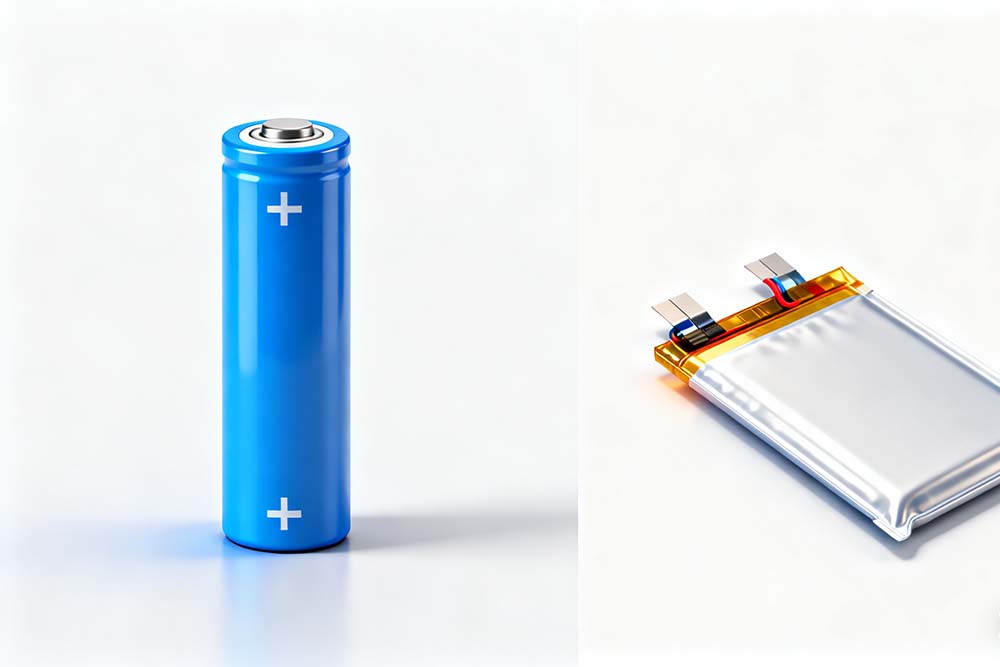
Many people still get confused about lithium ion battery vs LiPo.
To be honest, the two have been debated in the battery world for more than a decade.
Some say LiPo is a completely different chemistry.
Some say LiPo is just a variation of Li-ion.
Others insist there’s “no real difference” besides the packaging.
But the moment you actually use these batteries, test them, or tear them apart, things get clearer.
They are not identical, and they are not totally different either.
The truth sits somewhere in the middle.
This guide explains everything in simple, practical language — no textbook tone, no meaningless theory.

1. LiPo Is Not a New Chemistry — It’s Still Part of the Li-ion Family
Let’s start with the biggest misconception.
LiPo is not a brand-new chemistry.
It belongs to the same lithium-ion family.
- Li-ion = big category
- LiPo (lithium polymer) = soft-pouch structure + different electrolyte process
So yes, the chemistry is still lithium-ion.
What actually changes is:
- the structure
- the production method
- the way the cell behaves
That’s why the real difference between lithium ion and LiPo is not chemical.
It’s mostly physical and performance-related.
2. Structure Is the Biggest Real Difference
This part shapes everything else.
Li-ion: Hard Shell (Metal Case)
Examples include:
- 18650 cells
- 21700 cells
- Aluminum square cells
Key traits:
- strong
- resistant to impact
- resistant to squeezing
- stable, mature manufacturing
LiPo: Soft Pouch (Aluminum-Laminated Film)
Press the pouch and you’ll feel it flex.
Traits:
- lightweight
- thin
- fully customizable shapes
- but sensitive to pressure, bending, and piercing
In simple terms:
Li-ion feels like a metal can.
LiPo feels like a foil pouch.
This structural difference sets the tone for discharge behavior, lifespan, and safety.
3. Discharge Performance — LiPo Wins on Pure Power
When it comes to high output, LiPo takes the lead.

LiPo: Built for High Current
High discharge rates like 30C or 50C are common.
Great for:
- FPV drones
- RC cars
- devices that need instant bursts of power
- aggressive acceleration loads
Li-ion: Built for Endurance
Li-ion cells focus on stable, long-lasting output.
They don’t like high current spikes.
Best for:
- long-endurance drones
- power tools
- portable electronics
- energy storage systems
Summary:
LiPo is about power.
Li-ion is about endurance.
4. Lifespan — Li-ion Usually Lasts Longer
This is widely known in the industry.
LiPo cells degrade faster, especially under high discharge rates.
Swelling after dozens or hundreds of cycles is totally normal.
Li-ion behaves more consistently:
- longer cycle life
- fewer swelling issues
- slower aging
- stronger casing protects the structure
LiPo isn’t “bad.”
It’s just tuned for performance, not longevity.
5. Safety — Hard Shell Makes Li-ion More Robust
Safety is another area where structure matters.
Li-ion Safety Advantages
- metal casing
- higher resistance to impact
- better deformation protection
LiPo Safety Weak Points
- soft pouch
- vulnerable to puncture
- sensitive to squeezing and bending
This is why many industrial, medical, and energy storage products prefer Li-ion.
6. How to Choose? Focus on Your Application, Not the Name
Forget the idea of “which one is better.”
A better question is:
What does your device actually need?
Choose Li-ion if you need:
- longer lifespan
- stable output
- higher safety
- better endurance
Suitable for:
- long-flight drones
- tools and equipment
- power banks
- UPS and storage
- industrial devices
Li-ion is a reliable, stable, long-distance runner.
Choose LiPo if you need:
- light weight
- thin profile
- flexible size
- high burst current
Suitable for:
- FPV racers
- RC cars
- wearables
- custom industrial designs
- devices with limited or odd-shaped space
LiPo is the choice when you need power and flexibility.
Final Summary
Li-ion = stable, durable, higher energy density
LiPo = lightweight, flexible shape, powerful bursts
They’re not competitors.
They’re tools for different jobs.
Leave a Reply