
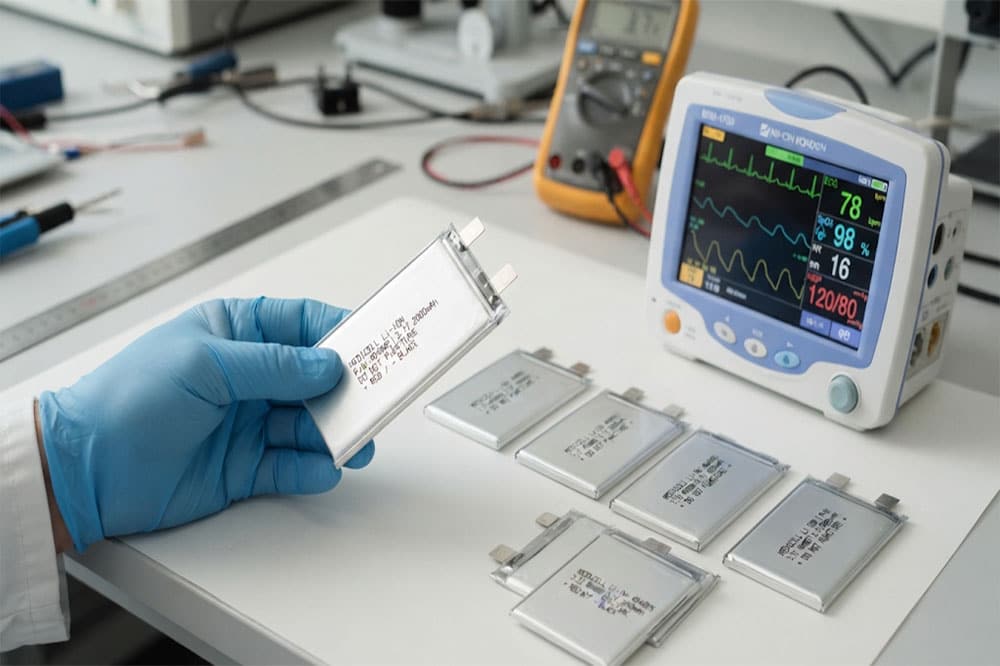
A hospital monitor that dies mid-round is an annoyance. An infusion pump that dies mid-infusion is an incident report — possibly a regulatory one. That gap is why sourcing a medical device pouch battery is not the same job as sourcing cells for a Bluetooth speaker, and why the checks you run before signing a purchase order matter more than the number on the quote.
Pouch cells earn their place in medical design for good reasons. They are thin, they can be shaped around tight enclosures, and they pack more capacity into a given footprint than cylindrical cells of the same volume. But the same soft aluminum laminate that makes them flexible also makes them the format most sensitive to manufacturing discipline. For a medical OEM, that means the supplier you choose — and the inspection plan you enforce — carries more weight than the datasheet.
This article walks through the considerations in the order a buyer actually faces them: documents first, inspection second, specification matching third, and supplier verification last.
Why Medical Devices Push Pouch Cells Harder Than Consumer Products
Three things separate a medical duty cycle from a consumer one.
Long service life with unpredictable usage. A portable patient monitor may sit on a charger for weeks and then run on battery for a full shift. Pouch cells degrade fastest when held at high state of charge for long periods, so the spec you need is not just “500 cycles” but retention under partial-state-of-charge storage — a number many datasheets do not volunteer.
Regulatory documentation. Your battery becomes part of your device’s regulatory file. When an auditor or notified body asks where the cell came from, how it was tested, and how a field failure would be traced, “the supplier said it was fine” is not an answer. Everything you buy has to be documented, and everything documented has to be reproducible.
Consequence of failure. Swelling in a wearable is a screen that pops off. Swelling inside a sealed infusion pump housing can press against a sensor or a pump mechanism. The failure modes you have to design against are stricter, which means the acceptance criteria you impose on the supplier are stricter too.
What “medical grade” actually means for a battery
There is no “medical grade” stamp for lithium cells. What exists is a stack of verifiable items: IEC 62133-2 certification for the cell chemistry and construction, UN38.3 for transport, a quality system at the factory that can support your ISO 13485 risk documentation, and test data — grading, cycle life, swelling — tied to the specific model you are buying. When a supplier says “medical grade” with nothing behind it, treat it as a slogan. When they say it with a document package behind it, treat it as a starting point and still verify.
Documents to Demand Before You Pay a Deposit
Four documents, in this order:
- UN38.3 test summary — mandatory for air and sea freight, and it must carry your exact model number.
- IEC 62133-2 report (or CB report) — the certification most markets require for cells going into medical and consumer devices.
- MSDS — needed for freight and for your own safety file.
- Capacity grading and internal resistance reports for the quoted model — not a generic sample report for a different capacity.
Match every certificate to your exact model
The mistake most buyers make is checking that certificates exist rather than checking what they certify. A UN38.3 report issued for a 3.7V 2000mAh pouch cell battery proves nothing about a 5000mAh variant quoted at the same price. Read the model number, capacity, voltage, and test lab on every page. If the shipping paperwork and the cell do not match, your shipment can sit at an airport while your production schedule burns.
Reputable manufacturers provide this package per model without being chased. The documentation included with wholesale pouch cell orders from Apsenx — UN38.3 summary, MSDS, with IEC 62133 and CB reports available per model — is listed on the pouch cell battery category page, so you can see the standard package before you inquire. For a broader walkthrough of how grading data and certificates fit together in supplier vetting, the pouch cell quality inspection guide for buyers goes deeper on each document.

A Pouch Cell Quality Inspection Plan for Medical Projects
A pouch cell quality inspection for a medical project is a sequence, not a single test. Run it in this order:
- Certificate verification (above).
- Grading and matching data for the batch you will actually receive.
- Physical inspection of sample units.
- Traceability confirmation.
- Incoming inspection on 10–50 samples in your real device.
- A written quality agreement before mass production.
Grading, internal resistance, and voltage spread
Ask the supplier for three numbers, per cell: measured capacity at 0.2C discharge, internal resistance in milliohms, and open-circuit voltage after 24 hours of storage. A factory that grades cells sorts them into tight bins — capacity within ±2–3%, matched IR. A factory that skips grading ships whatever came off the line that day.
Why it matters more for medical devices: many medical packs run 2S or 3S configurations. One weak cell in a series string drags the pack’s usable capacity down and cycles the remaining cells harder, which shortens pack life in a way that only appears months later — ideally not while the device is monitoring a patient. If you are designing a multi-cell pack, the guide on how pouch batteries are connected in series and parallel explains where mismatch hurts most.
Physical checks: seal edges, swelling, and traceability
When samples arrive, check every unit:
- Seal edges. The heat-sealed perimeter is the weak point of any pouch cell. Look for wrinkles, creases, or laminate damage along the seal line. A wrinkled edge can crack over cycles and admit moisture — a slow failure mode that is hard to diagnose in the field.
- Flatness. Lay each cell on a flat surface. A swollen cell straight out of the box is an automatic reject, not a discussion.
- Surface printing. Every cell should carry a legible date code and lot number. Mixed date codes in one box mean mixed production runs, which weakens your traceability story.
Then ask the supplier two questions in writing: Can you provide a traceability report for a given lot? And what is your swelling rate at a defined cycle count? A healthy NMC pouch cell typically stays under 4–5% thickness growth after 500 cycles; growth above 8% points to electrolyte or stack-pressure problems. The article on pouch cell safety risks and design considerations covers how these physical failure modes develop and what design margin buys you protection.
Before mass production, run the 10–50 sample units through your actual device: charge, discharge at the device’s real duty cycle, check runtime against target, and re-inspect flatness after 50 cycles. A few engineer-hours here is the cheapest risk reduction in the entire sourcing process.

Matching Cell Specs to Your Device’s Real Duty Cycle
Capacity, discharge rate, and cycle life
Start from the device, not the cell. List the peak current (motor start, wireless transmit bursts, pump actuation), the average draw, and the required runtime between charges. Then size the cell with margin — typically 20% above the calculated minimum — because capacity fade over the device’s service life is guaranteed, and a medical device usually needs to stay within its runtime spec even at 80% health.
Chemistry choice follows the duty cycle. NMC offers higher energy density for compact devices; LCO suits low-drain, slim formats; LiFePO4 trades density for cycle life and thermal stability in stationary or charging-critical equipment. If the trade-off is not obvious, the comparison of NMC vs LFP pouch cells breaks down which chemistry holds up under different discharge and storage patterns. And never accept a cycle-life claim without the underlying test curve: capacity retention versus cycles, at a stated C-rate and temperature. Two suppliers can both write “500 cycles to 80%” while one of them swells 8% by cycle 300.
Size constraints and custom form factors
Medical enclosures are tight, and the battery is usually the last component to get space. This is where pouch cells shine: standard model dimensions can often be adapted, or a custom footprint produced once volumes justify tooling. For very compact devices, the same logic that applies to wearables applies here — the pouch cell design and selection guide for wearable devices covers thickness limits, tab orientation, and enclosure pressure, all of which transfer directly to handheld medical form factors.
For multi-cell devices, pre-assembled options like the 11.1V 3S 850mAh pouch cell battery pack show how cells, protection circuitry, and wiring come integrated from the factory — worth comparing against a pack house you assemble yourself, because every hand-built connection is a field-failure point you have to qualify.

Three Questions That Separate a Factory from a Trading Company
Medical audits will eventually ask who made your cells and how their process is controlled. Three questions reveal the answer fast:
- “Can you send a traceability report for lot [X]?” A factory with in-house production answers in one message with date codes, material lots, and operator records. A middleman usually cannot.
- “What is your grading tolerance, in writing?” Factories that grade in-house state a number. Traders forward datasheet claims.
- “What is your corrective-action process when a batch fails incoming inspection?” A factory can name the step — quarantine, 8D report, re-grading. A trading company can only offer a replacement shipment, which does not fix the next batch.
Direct-from-factory sourcing also shortens the feedback loop on custom work. Apsenx, for example, controls cell supply, pack assembly, and testing in-house across its pouch cell battery range — meaning a custom dimension or a protection-board change is handled by the same team that graded the cells, not relayed through a third party. Its quality control process and battery certifications page document the systems behind that claim, which is exactly the material your audit file needs.
The Pre-Order Checklist, Assembled
Before the deposit leaves your account:
- Certificates verified against the exact model number, not just confirmed as existing
- Capacity grading and IR data requested, with grading tolerance stated in writing (±3% or tighter for pack projects)
- Sample units inspected for seal-edge integrity, flatness, and consistent date codes
- Traceability process confirmed with a real lot report
- 10–50 samples tested in the real device through 50 cycles
- Cycle-life and swelling curves reviewed — not datasheet slogans
- Quality agreement signed covering AQL level, grading tolerances, swelling limits, traceability, and claim procedure
Run the checklist in order and a weak supplier eliminates itself before it costs you a production run. Skip the checklist, and the failure surfaces in the field, where medical consequences — and regulatory attention — follow.
Frequently Asked Questions
The cell-level certificates are the same — UN38.3 for transport and IEC 62133-2 for safety — but medical applications add requirements around your quality system, not the cell itself. Your ISO 13485 file will need supplier documentation, incoming inspection records, and traceability, so the practical difference is that you need per-model test data and lot traceability that consumer projects can sometimes skip.
Ten to fifty units is a meaningful incoming inspection. Test capacity at 0.2C discharge, measure internal resistance across all units, verify open-circuit voltage after 24 hours, and inspect every seal edge visually. Then run 20–50 of them through 50 cycles in the real device and re-check for swelling. The cost is a few engineer-days; the alternative is a field failure on a regulated product.
Specify it in your quality agreement. A well-made NMC pouch cell typically stays under 4–5% thickness growth after 500 cycles at room temperature. For a rigid sealed housing, budget the enclosure cavity to accommodate 8% growth plus your safety margin, and require the supplier’s swelling curve — not just the cycle-life curve — as part of the batch documentation.
You can inspect the cells, but you cannot audit the process behind them. Trading companies rarely control grading, sealing parameters, or traceability, and their corrective actions stop at replacing shipments. For medical projects where your audit trail needs to reach the factory floor, buy direct from a manufacturer that performs cell grading and pack assembly in-house.
Five things: an AQL inspection standard (0.65 or 1.0 is common for cells), grading tolerances for capacity and internal resistance, swelling rate limits at a defined cycle count, traceability commitments per lot, and a warranty claim procedure with a defined incoming-inspection window. Without these terms signed before production, a 2% defect rate is an argument; with them, it is a procedure.
Lithium Ion Pouch Cells
-

11.1V 3S 850mAh li-ion Polymer Pouch Cell Battery Pack
-

134365 4500mAh 3.7V Rechargeable Lithium Polymer Battery
-

3.7V 1200mAh Li-Polymer Pouch Cell Battery
-

3.7V 15Ah 148198 Pouch Lithium Ion Battery
-

3.7V 1S2P 3000mah lithium Polymer Battery
-

3.7V 2000mAh Pouch Cell Battery
-

3.7V 502248 500mAh Lithium Ion Polymer Battery
-

3.7V 700mAh Li-Polymer Pouch Cell Battery
-

3.7V 800mAh Rechargeable Pouch Li-Polymer Battery
Leave a Reply