
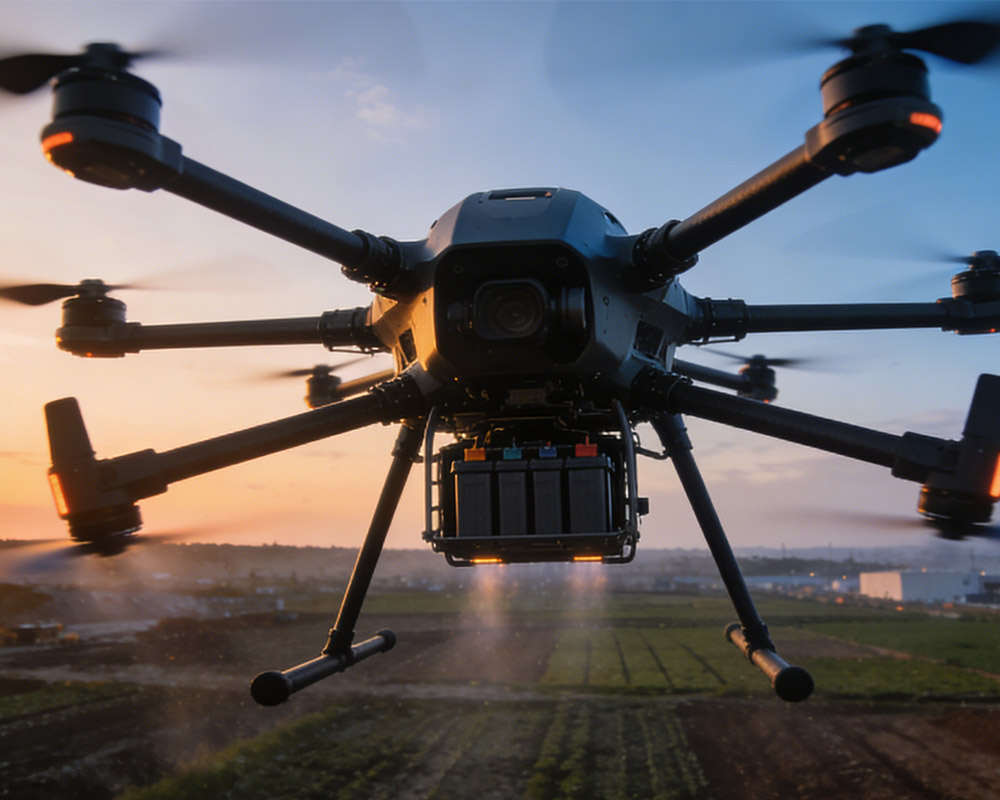
If you’ve flown drones long enough, you stop paying attention to big marketing claims.
You start paying attention to what doesn’t fail.
Because when a drone drops power mid-air, it’s rarely dramatic. It’s usually subtle — voltage sag, unstable throttle response, shortened flight time. And most of the time, the issue traces back to the battery.
That’s why choosing a reliable drone LiPo battery isn’t about picking the largest capacity number you can find. It’s about choosing a battery platform designed for sustained UAV performance.
In commercial applications, I’ve seen noticeable differences between generic RC packs and purpose-built UAV batteries — especially those engineered specifically for drone workloads, like professional-grade options found in dedicated UAV battery collections.
The difference isn’t always visible. But in the air, you feel it.

Reliability Shows Up Under Load
Anyone can print 12000mAh on a label.
The real question is: what happens when you punch throttle?
A reliable drone LiPo battery maintains voltage stability during acceleration, wind correction, or payload lift. When voltage collapses under demand, performance becomes unpredictable — and unpredictable in the air is dangerous.
This is where discharge capability matters more than capacity. A smaller pack with honest, sustained discharge performance will often outperform a larger pack built for short bursts.
In mapping and agricultural UAV operations, 6S (22.2V) systems are common for a reason. Higher voltage reduces overall current draw, which reduces heat and stress across the system. Many industrial configurations — including high-capacity 6S setups commonly available within professional UAV LiPo battery platforms — are built around this efficiency principle.
Reliability isn’t about pushing limits. It’s about reducing stress.
4S vs 6S: It’s Not Just a Spec Difference
On paper, 4S and 6S don’t look dramatically different.
In practice, they feel different.
A properly configured 6S system often runs smoother. Motors sound less strained. Power delivery feels more linear. But only if the ESC and motor KV are matched correctly.
A reliable drone LiPo battery works in harmony with the power system. It doesn’t overpower it.
That’s why UAV-specific battery lines — especially those designed around sustained load profiles rather than racing bursts — tend to offer more consistent long-duration performance.
Connectors: A Small Detail That Causes Big Failures
Most spec sheets focus on voltage and capacity.
Very few talk about connectors.
I once helped troubleshoot a survey drone experiencing random power interruptions. Cells were fine. Internal resistance was normal. The issue turned out to be a slightly worn connector that lost contact under vibration.
Switching to a higher-current XT90 connector solved it immediately.
When evaluating a reliable drone LiPo battery, look at:
- Connector type (XT60 vs XT90)
- Wire gauge thickness
- Solder quality
- Internal resistance
Many purpose-built UAV battery systems allow connector customization, which becomes critical for industrial or heavy-lift platforms.
These small hardware decisions often determine long-term reliability more than flashy performance claims.

Not All LiPo Packs Are Built for UAV Work
There’s a difference between hobby-grade RC batteries and UAV-specific battery packs.
RC batteries are often optimized for aggressive bursts. That works well for racing. It doesn’t always translate to 18-minute agricultural spray missions or extended mapping flights.
UAV-focused battery platforms typically prioritize:
- Sustained discharge stability
- Better cell matching
- Reinforced casing
- Consistent batch quality
That’s why sourcing from a structured reliable drone LiPo battery platform becomes increasingly important if you’re operating fleets rather than flying recreationally.
Consistency between packs matters. Small voltage variations across aircraft add up operationally.
Bigger Batteries Can Reduce Reliability
There’s a common instinct to maximize capacity.
But heavier batteries increase:
- Frame stress
- Motor load
- Heat buildup
- Crash impact force
Sometimes rotating two moderate-capacity packs creates better long-term reliability than constantly pushing a single oversized battery to its limits.
A reliable drone LiPo battery keeps your aircraft operating within safe margins. It supports the system instead of stressing it.
Reliability is sustainable performance, not maximum performance.

Handling Is Part of the Equation
Even the best battery won’t stay reliable if it’s mishandled.
- Storing fully charged for weeks degrades chemistry.
- Deep discharging repeatedly shortens lifespan.
- Skipping balance charging increases risk.
Commercial UAV teams that maintain storage voltage around 3.8V per cell often see significantly longer usable cycle life.
Choosing a reliable drone LiPo battery is step one. Managing it properly is step two.
Both are necessary.
What Really Defines a Reliable Drone LiPo Battery?
From real-world UAV experience, reliability comes down to:
- Stable voltage under real flight load
- Honest, sustained discharge capability
- Correct system voltage configuration
- High-quality connectors and wiring
- Consistent manufacturing standards
- Responsible storage and charging practices
When a battery is truly reliable, it disappears into the background.
It simply works.
And in professional UAV operations, that quiet reliability is exactly what keeps aircraft in the air — and projects on schedule.


Leave a Reply