
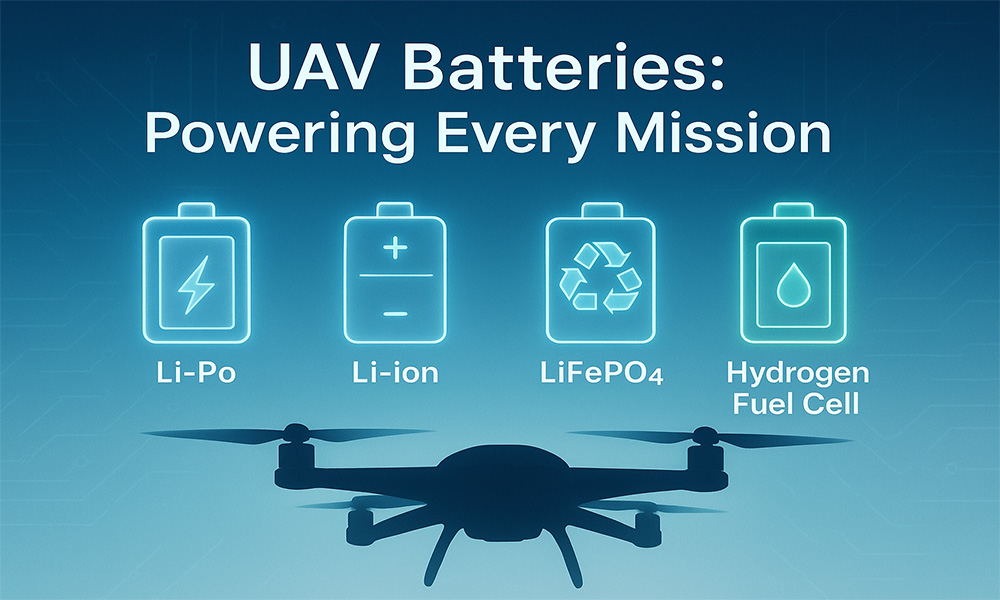
1. Basic Battery Requirements for UAVs
As UAVs expand across agriculture, logistics, security, and mapping industries, their battery systems must meet these fundamental criteria:
- High energy density: for extended flight durations
- Lightweight design: to reduce aircraft load
- High discharge rate: to support takeoff and heavy payloads
- Safety and stability: to ensure secure operation
- Fast charging and long lifespan: to improve work efficiency
Each battery type excels in different aspects to meet the power demands of various UAV missions.

2. Lithium Polymer Battery (Li-Po): Lightweight and High-Discharge Favorite
Li-Po batteries offer lightweight design and high discharge rates, making them the top choice for FPV racing drones and consumer-level aerial drones.
- Pros: Light, compact, customizable shapes, high discharge capability
- Cons: Lower safety, prone to swelling or fire if misused
- Applications: Aerial photography, stunt flying, FPV racing drones

3. Lithium-Ion Battery (Li-ion): Balanced for Endurance and Safety
Li-ion batteries feature high energy density and stability, making them ideal for long-endurance drones.
- Pros: High energy density, long cycle life, stable structure
- Cons: Moderate discharge rate, not suitable for fast-response applications
- Applications: Mapping drones, long-range delivery drones, power line inspection UAVs

4. Lithium Iron Phosphate Battery (LiFePO4): Safe and Long-Lasting
LiFePO4 batteries deliver exceptional safety and cycle durability, widely used in agricultural and industrial drones.
- Pros: High safety, non-flammable, over 2000 charge cycles
- Cons: Lower energy density, heavier weight
- Applications: Agricultural spraying drones, power grid inspection, security patrol UAVs

5. Hydrogen Fuel Cell: The Future of Long-Endurance UAVs
Hydrogen fuel cells offer ultra-long flight endurance and zero emissions, ideal for logistics and reconnaissance drones.
- Pros: Extended flight time, eco-friendly, multi-hour endurance
- Cons: High cost, immature technology, complex hydrogen storage
- Applications: Fixed-wing surveillance drones, emergency reconnaissance UAVs

6. Comparison Table of UAV Battery Types
| Battery Type | Energy Density | Discharge Rate | Safety | Weight | Applications |
|---|---|---|---|---|---|
| Li-Po | ★★★★☆ | ★★★★★ | ★★☆☆☆ | ★★★★★ | FPV racing drones, aerial photography drones |
| Li-ion | ★★★★★ | ★★★☆☆ | ★★★★☆ | ★★★★☆ | Mapping, inspection, logistics UAVs |
| LiFePO4 | ★★★☆☆ | ★★☆☆☆ | ★★★★★ | ★★☆☆☆ | Agricultural, power inspection, patrol drones |
| Hydrogen Fuel Cell | ★★★★★+ | ★★★☆☆ | ★★★☆☆ | ★★☆☆☆ | Long-range logistics, reconnaissance drones |
Conclusion
As UAV technology continues to evolve, battery solutions are becoming increasingly mission-specific. Knowing what types of batteries are used in UAVs helps engineers design better power systems and enables users to choose the right power source based on their flight needs. In the future, smart Battery Management Systems (BMS) and advanced materials will make drone batteries even safer, smarter, and more efficient.


Leave a Reply