
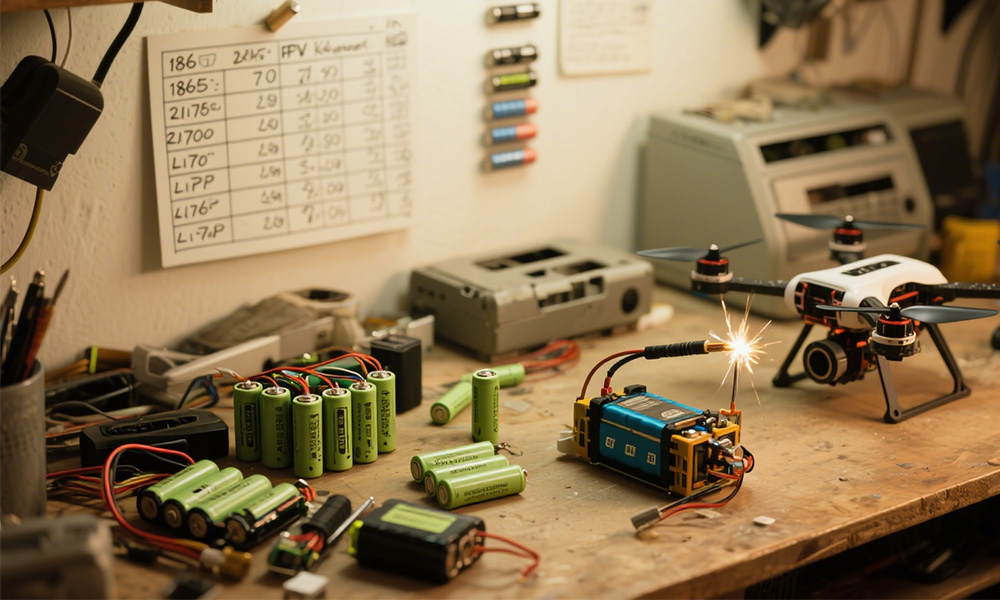
“Who says ‘do it yourself’ means peace of mind? Ever had that moment when you built your own pack, took it for a flight, and nearly started questioning your whole existence?” — I still remember my first pack failure at the field: the cells hissed like a ticking bomb, and before my brain caught up, I was already clutching my 7-inch long-range quad and sprinting for safety.
1. Why Even Build Your Own Battery Pack?
Aren’t there enough batteries on the market? Why take the risk and make your own?
If you’ve ever hung out on r/fpv, you’d know — DIY battery packs aren’t just about saving money. They’re FPV’s version of “adult LEGO,” letting you bake your flying style into every single cell.
But seasoned pilots have been saying it for years:
“Pick only one: long flight time or high power. Real-world physics doesn’t let you have both.”
I first saw this line on a Reddit thread and thought, yeah, right. Six months later, lugging an 8.4Ah 6S2P pack that had me shaking mid-flight, I had to admit — this was physics talking, not conspiracy theory.

2. Electrochemistry Basics: Don’t Fall for the Marketing Hype
We’ve all heard “high C-rating,” “high energy density,” “RC-special” thrown around — but the real differences only show in the air.
LiPo (Lithium Polymer)
Pros: Light, high discharge rate, instant punch
Cons: Fragile, puffs if pushed too hard, the most common “dead soldier” at the field
My take: Once flew a 6S 1500mAh LiPo on a 35°C summer day — 5 minutes later it puffed up like a steamed bun.
Li-ion (18650 / 21700)
Pros: High energy density, good durability, long cycle life
Cons: Lower discharge rate, not great for aggressive freestyle
3. Spec Sheet Traps: Lab Numbers Don’t Live in the Field
Open a cell manufacturer’s datasheet and everything looks great — but those numbers only live in lab conditions.
Big capacity ≠ long flight: That giant pack you think will give you insane flight time might end up killing it with weight before you get halfway.
High C-rating ≠ endless punch: Sure, it’ll rip hard, but voltage sag will hit you like an elevator drop.
Series/Parallel setups:
4S2P → Stable, beginner-friendly
6S2P → Balance of range and punch
6S3P → Range monster, but without a reinforced frame you’re asking for snapped arms.
I once grabbed some “perfect spec” 21700 P50Bs at an electronics market. Looked flawless on paper. In the air? Massive sag. Found out later they were refurbs. That’s what skipping internal resistance testing gets you.

4. Safety: Don’t Turn the Flying Field into a Fireworks Show
LiPo explosion clips are all over YouTube, but the real thing is quieter — at first. It starts with a puff, then a nasty chemical smell, then a flash of runaway flames.
I’ve seen a guy’s LiPo start smoking 10 seconds after landing — the extinguisher didn’t even make it over before he was already sprinting away.
Thermal runaway threshold: 3.2V per cell is a red line. Don’t be the hero who drains to 2.8V — you’re basically making a slow-cooking time bomb for the next charge.
My safety kit:
3kg ABC fire extinguisher
Fireproof charging bag (never charge bare)
Voltage alarm (live in-flight alerts)
5. Field Tests: Data Only Counts When You’ve Burned Packs for It
I don’t trust manufacturer claims — I run my own tests.
35°C uphill wind: 6S 7Ah Li-ion, theoretical 20 min — cut off at 8 min due to heat throttling.
Back mountain ridge: 6S2P 8.4Ah P42A, 19 min flight, cells at 68°C, just shy of triggering cutoff.
Winter night flight: LiPo 1500mAh at 4°C, lasted 2 min before sagging to 3.4V. Cold is the silent killer.

6. The Eternal Trade-Off: Fly Longer vs. Fly Harder
You want range? Stack cells, and your frame turns into a bricklayer’s loadout.
You want to rip trees? Go light, and 4 minutes of flight time is all you’ll get.
Some folks chase the mythical “one pack for everything” — but in the real world, that’s a joke. The pros pack different batteries for different jobs, like a photographer swapping lenses for weddings vs. wildlife.
7. My Build Process (New Pilots Can Copy-Paste)
Pick cells: Buy from reliable sources (yes, the good electronics market stalls count).
Welding: 0.15mm nickel strip, spot welder set around 400A — strong joints without cooking the cell.
Protection: Add a 5A BMS, shrink wrap, foam padding on the edges.
Testing: Let the pack sit for 12h, watch for leakage or abnormal self-discharge.
Flight trials: Hover test under light load, then full-send at the field — check temps and sag behavior.
8. Final Words: The Romance of Flight Isn’t in the Datasheet
“Flight isn’t the thrill of numbers on paper — it’s when you haul your cells up a mountain, into the wind, into the wild, and see if they’re truly alive.”
Every cell you weld is just a cold number — until you stand on a mountaintop, watch it take your quad 2km out and back, steady and sure. That’s when it has a heartbeat.

Leave a Reply