
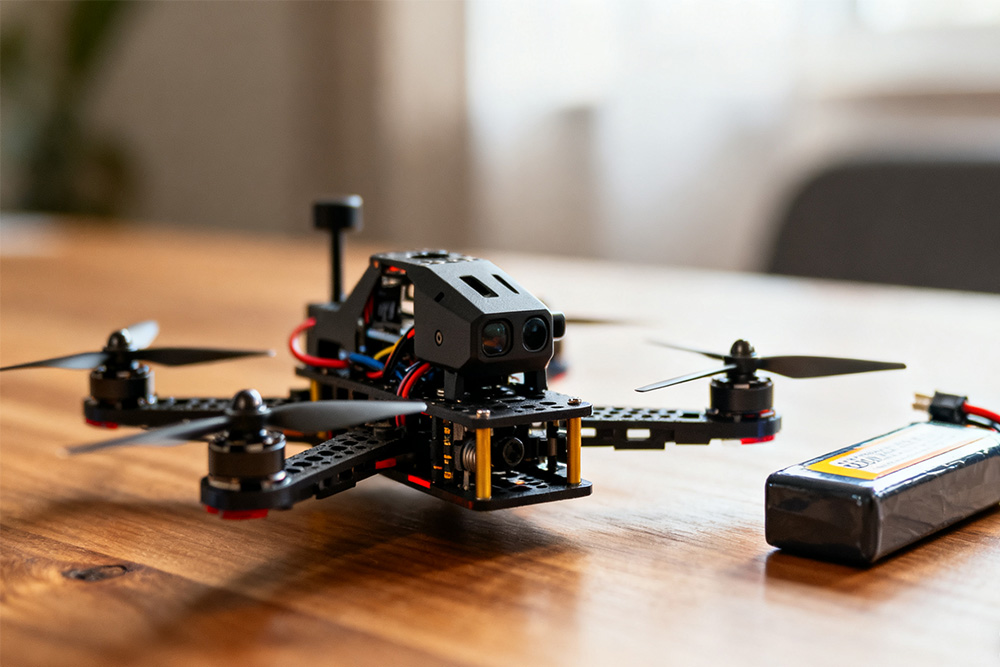
When I first got into FPV (First Person View) flying, I honestly didn’t pay much attention to the battery. I thought—hey, as long as it flies, it’s fine. But later I realized, the FPV battery is literally the heart of the drone. If your quad feels sluggish, unstable, or cuts out mid-air, nine times out of ten—it’s your battery’s fault.
I Was Totally Lost at First
Back when I started, I used a 4S 1300mAh LiPo battery and assumed it could last a solid ten minutes. Guess what? It barely made it past six before the voltage sagged. Motors lost punch, the video feed stuttered—it was a mess. That’s when I learned FPV batteries aren’t about “bigger capacity,” they’re about discharge rate (C rating) and balance with your setup.

Bigger capacity doesn’t always mean better performance. A 2200mAh pack with low C rating will feel way worse than a smaller, higher-rated one. And that “S number”? Took me a while to realize 4S means 14.8V, 6S means 22.2V. Sure, 6S gives you more power and smoother throttle, but not every quad can handle it—burned an ESC once because of that mistake.
What I Eventually Learned
After a few months (and a few too many crashes), I switched to a 6S 1100mAh pack for my 5-inch drone—and man, the difference was huge. The throttle response was clean, punchy, and the flight felt… alive. You’ll notice that crisp acceleration only when voltage and discharge match your motor setup.
But here’s the catch: don’t fall for those “150C” or “200C” labels. Most of the time, those numbers are inflated. If the pack can actually sustain half of that, you’re lucky. I stick with 75C to 100C; reliable, predictable, no nonsense.
And weight—oh, that’s another rabbit hole. Two batteries, same capacity, 30 grams apart—completely different flight feel. Too heavy, and you lose agility. Too light, and it drains fast. There’s no formula here—you just have to fly and feel it.

Battery Types: It’s Not All LiPo
Most FPV pilots deal with three kinds of batteries:
- LiPo (Lithium Polymer): High power, light, but prone to puffing up.
- LiHV (High Voltage LiPo): Slightly higher voltage, a few more seconds of punch.
- Li-ion (Lithium-ion): Longer flight time, less power—better for long-range or cinematic shots.
I once built a pack with four 18650 Li-ion cells. It flew for 15 minutes straight—but the throttle felt soft, like the drone was half-asleep. Great for cruising, terrible for freestyle.
The Everyday Stuff No One Tells You
Nowadays, I have this ritual: as soon as I’m done flying, I balance-charge everything and store them at 3.7V per cell. If you leave them full for days, puffing is just a matter of time.
And don’t skip the balance lead when charging—it keeps the cells even and healthy. I used to charge only through the main lead for convenience; big mistake. Uneven cells kill batteries faster than crashes.
I even switched from XT60 to XT30 connectors for smaller builds. Saves about 10–15 grams—not much, but it makes the drone feel snappier in the air. FPV is a game of small margins, trust me.
The Traps You’ll Probably Fall Into
Here’s a classic one: buying a huge 2200mAh battery hoping for longer flight time, only to end up with a sluggish quad that handles like a brick. Heavier battery = more inertia = less fun. Sometimes “more” really is less.
Another thing—don’t overcharge your LiPo. Even though 4.2V is standard, I stop at 4.18V. That tiny difference barely affects flight time but noticeably extends battery life. I learned the hard way—used to charge aggressively, and within months my packs looked like balloons.
FPV Battery Is All About Trade-Offs
You’ll never find a perfect one. There’s no such thing as a battery that’s lightweight, powerful, and long-lasting all at once. Something’s always gotta give.

Now I match batteries by purpose:
- For racing: 6S 1100mAh 100C
- For casual flying: 4S 1500mAh 75C
- For aerial filming: 4S 3000mAh Li-ion
Each has its own “personality,” just like cars.
After a While, You Just Feel It
Fly long enough, and you’ll develop a weird sixth sense for batteries. You can tell if a pack’s “off” just by picking it up. A few laps in, and you’ll know if it’s time to retire it.
These things can’t be taught—they’re learned through puffed packs, burnt connectors, and a few too many crashes.
Honestly, nowadays I don’t even obsess over specs. I pick up a new pack, look at it, and think, “yeah, this one feels right.” And somehow, that instinct’s rarely wrong.
Leave a Reply