
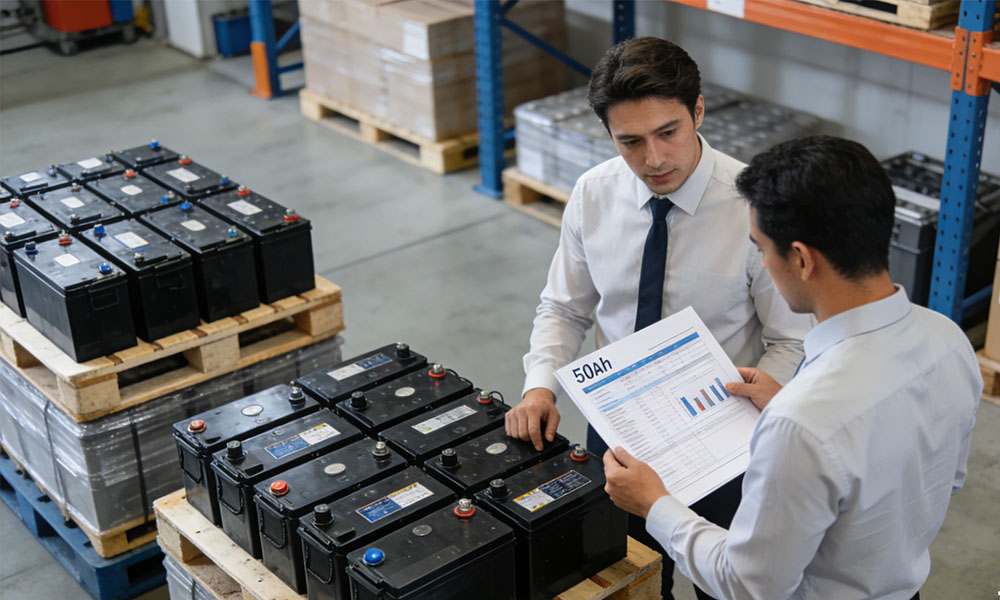
If you’re sourcing 50Ah or 100Ah LiFePO4 cells for energy storage systems, battery packs, or long-term project supply, you’ve probably noticed one thing very quickly:
Spec sheets look similar, but pricing can vary by 20–40%.
That price gap is rarely about chemistry.
Most of the time, it comes down to how the specs are tested, defined, or quietly stretched.
Below are the parameters that cause the most trouble for buyers in bulk procurement—and where problems usually show up later, not at the quotation stage.
1. Rated Capacity (Ah) — The Most Misleading Number for Buyers
For procurement, capacity is not about what’s written, but how it was measured.
What buyers commonly run into
- “100Ah” measured at 0.1C discharge
- Capacity tested under elevated temperature
- Best-performing cells used to represent the whole batch
Spec sheets usually just say:
Capacity ≥100Ah
—but skip the conditions.

What buyers should confirm
- Discharge rate: 0.5C or 1C
- Cut-off voltage: 2.5V or 2.0V
- 100% cell testing vs. sample testing
Practical rule of thumb:
A true 100Ah LiFePO4 cell has a minimum weight and volume.
If a batch looks unusually light, consistency issues usually follow.
2. Cycle Life — Where Lab Numbers Don’t Match Field Reality
A common buyer mistake is trusting the cycle number without checking test methodology.
Typical red flags
- Cycle life tested at 0.2C
- End-of-life defined at 70% capacity
- DOD and temperature conditions unclear or missing
What matters for procurement decisions
- Test rate: ≥0.5C
- End-of-life defined at 80% capacity
- Ambient temperature conditions (~25°C)
For 50Ah / 100Ah LiFePO4 cells:
3,000–5,000 cycles is a realistic, engineering-grade expectation.
Anything significantly higher is usually lab data, not long-term supply data.
3. Internal Resistance (mΩ) — The Consistency Killer Buyers Overlook
Many buyers focus on capacity and ignore internal resistance.
That’s often where downstream problems start.

Why buyers should care
- Resistance variation = uneven heat
- Uneven heat = uneven aging
- Uneven aging = warranty and service issues
Common procurement blind spots
- Only a “typical value” provided
- AC resistance listed instead of DC resistance
- No batch min / max range disclosed
Buyer-side requirements
- DC internal resistance range
- Batch max / min values
- Confirmation of cell grading (sorting)
An industry reality:
If a supplier won’t share resistance ranges, consistency is usually the issue.
4. Discharge Rate (C-Rate) — Specs That Look Strong on Paper
Datasheets often advertise:
- Continuous 2C / 3C
- Peak 5C / 10C
In real projects, those numbers are rarely sustainable.
What buyers see in practice
- “2C continuous” only holds briefly before heat rises
- Peak ratings limited to a few seconds
- Significant capacity drop at high C-rates
What buyers should clarify
- Continuous discharge duration
- Temperature rise test data
- Impact on cycle life
For most procurement scenarios:
1C continuous is the safe operating zone for 50Ah / 100Ah LiFePO4 cells.
Anything higher depends heavily on design and application.
5. Voltage Range — Wide Numbers Don’t Mean Long Life
Buyers often see voltage ranges like:
- 2.0–3.9V
- 2.5–4.0V
These are absolute limits, not recommended operating ranges.
What matters for long-term use
- Discharge cut-off: 2.5V
- Charge cut-off: 3.65V
Below 2.5V, usable capacity drops fast while degradation accelerates.
Above 3.65V, you’re already in overcharge territory.
If a supplier only emphasizes wide limits without recommended ranges, buyers should slow down.

6. Grade A / Grade B — The Hardest Claim for Buyers to Verify
“Grade A” is not a strictly regulated term in bulk cell sourcing.
Market reality
- Some “Grade A” cells are actually B+ or mixed batches
- Re-sorted or repackaged cells do exist
What buyers can reasonably check
- Same production batch
- Factory test records or serial tracking
- Support for third-party inspection or incoming QC
A shared understanding among experienced buyers:
True Grade A consistency is never the cheapest option.
Buyer Takeaway: The 3 Specs That Matter Most
In 50Ah / 100Ah LiFePO4 bulk procurement, buyers should prioritize:
- Capacity test conditions
- Cycle life definition
- Internal resistance consistency
These three directly affect:
- Project reliability
- After-sales cost
- Long-term supplier viability
Questions Buyers Can Ask Directly (and Safely)
These work well in RFQs or technical reviews:
- At what C-rate and cut-off voltage is capacity tested?
- Is every cell tested or only samples?
- What is the DC internal resistance range per batch?
- Is cycle life defined at 80% or 70% capacity? At what C-rate?
- Can incoming inspection or third-party testing be supported?
Suppliers who answer clearly are usually worth continuing with.
Those who avoid these questions often introduce risk later.
Leave a Reply