
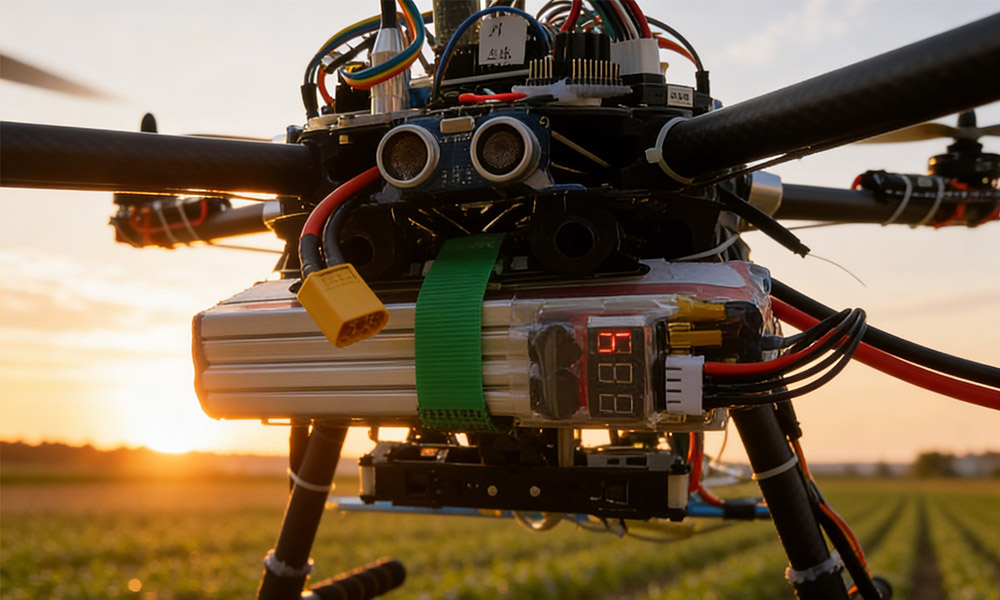
If you’ve been sourcing drone LiPo batteries for a while, you’ll probably notice something interesting: on paper, many batteries look almost identical. Similar voltage, similar capacity, similar specifications.
But once they are actually used on drones, the difference becomes obvious very quickly.
Some batteries perform reliably for hundreds of cycles. Others start showing issues after only a few months. For UAV manufacturers and distributors, these problems don’t just affect flight time — they can delay projects or increase maintenance costs.
Battery Swelling Happens More Often Than People Expect
One of the most common complaints we hear from drone operators is battery swelling.
At first it’s subtle. The battery still works, maybe the flight time drops slightly. But after repeated high-load flights, the pack starts expanding. Once that happens, the battery usually needs to be replaced.
In most cases the problem comes down to cell quality or heat buildup during heavy discharge.
Agricultural drones and industrial UAVs often push batteries close to their limits, especially when carrying spraying systems or camera payloads. Using high-quality LiPo battery packs designed for UAV workloads can reduce this risk significantly.
For example, packs like the 6S 22.2V 12000mAh LiPo Drone Battery are designed for demanding drone applications such as agricultural UAVs and aerial photography platforms, offering stable power output and large capacity for longer flight endurance.
Short Flight Time Isn’t Always a Capacity Problem
When drone pilots complain about short flight time, the first instinct is usually to look for a bigger battery.
But it doesn’t always work that way.
A heavier battery increases capacity, yes — but it also increases total aircraft weight. In some cases, the motors end up working harder and the actual flight time barely improves.
Another overlooked factor is discharge capability.
If the battery cannot deliver enough current during takeoff or aggressive maneuvers, voltage drops quickly. The flight controller may trigger a low-voltage warning even though the battery still has energy left.
This is exactly why many industrial drone operators prefer high-capacity 6S LiPo batteries, which provide higher voltage stability and stronger power output for multi-rotor UAVs.
Overheating During Heavy Operations
Industrial drones rarely fly in ideal conditions.
Agricultural spraying drones often operate continuously during peak seasons. Inspection UAVs might hover for long periods while carrying thermal cameras or sensors.
In these scenarios, the battery is under constant stress.
If the battery pack is not designed for high-current output, heat builds up quickly. Over time, this accelerates battery degradation and reduces cycle life.
Well-designed UAV batteries usually include:
- better internal cell matching
- low-resistance wiring
- stable high-rate discharge capability
These design details rarely appear in a spec sheet, but they make a noticeable difference in real-world drone operations.
Rapid Capacity Loss After Limited Cycles
Another issue that surprises many UAV buyers is how quickly some batteries lose capacity.
In theory, LiPo batteries can last hundreds of cycles with proper handling. But in practice, performance depends heavily on build quality and thermal management.
If cells inside the pack are not well matched, some will degrade faster than others. Once that imbalance appears, the entire battery pack starts losing efficiency.
Experienced drone manufacturers usually run several flight tests before adopting a new battery model. It takes more effort upfront, but it helps avoid reliability issues later.
Choosing the Right Drone LiPo Batteries Matters More Than It Seems
For commercial UAV platforms, the battery is not just another component — it directly affects flight stability, payload capability, and operational efficiency.
From what we’ve seen in the UAV industry, buyers who focus only on price often end up replacing batteries far more frequently.
On the other hand, working with a reliable battery manufacturer — and choosing well-designed drone LiPo batteries built for industrial UAV use — tends to deliver much better long-term performance.
Final Thoughts
Drone technology keeps evolving, but batteries are still one of the biggest factors that determine how well a UAV performs in real-world environments.
Reliable drone LiPo batteries can help improve:
- flight time
- system stability
- payload capacity
- overall operational efficiency
For UAV manufacturers, distributors, and integrators, choosing the right battery solution early in the project often saves a lot of trouble later.


Leave a Reply