
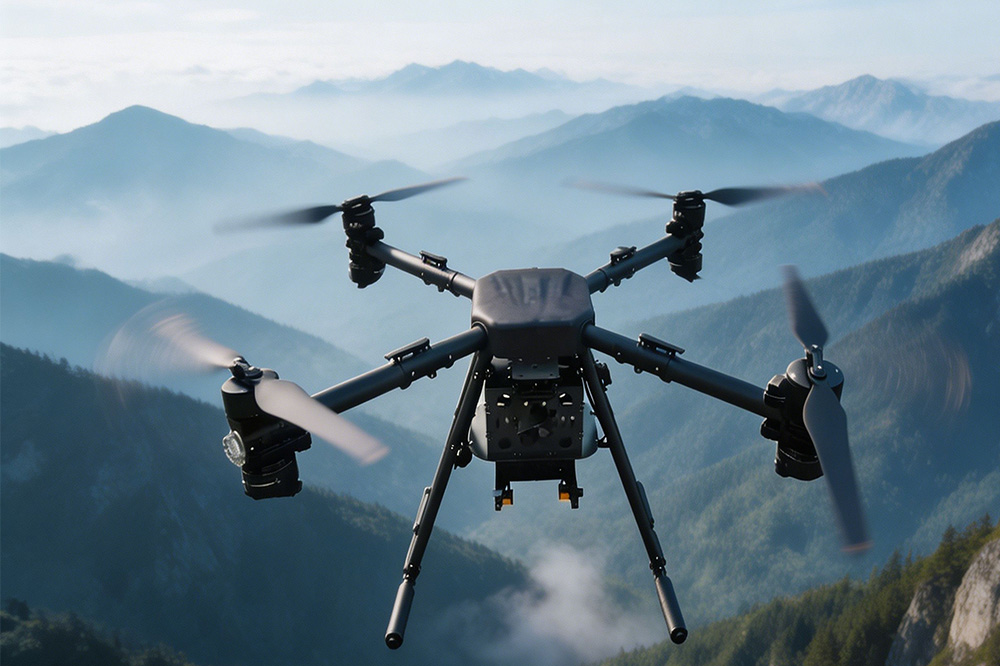
Long-endurance drones are becoming more common across industrial UAV projects.
You see them in:
- Powerline inspection
- Pipeline monitoring
- Agricultural surveying
- Coastal patrol
- Mapping missions
- Emergency response work
Some platforms stay airborne for hours instead of minutes.
But behind almost every long-flight UAV project, there’s one problem engineers spend a lot of time trying to solve: battery efficiency.
Because once flight time increases, battery performance starts affecting almost every part of the aircraft.
Flight Time Is About More Than Just Bigger Batteries
A lot of people assume long-endurance drones simply use larger battery packs.
In reality, it’s more complicated than that.
As battery size increases, weight also increases. And once the aircraft becomes too heavy, the motors consume more energy just to keep the drone in the air.
At that point, adding more battery capacity stops helping as much as expected.
That’s why long-endurance UAV design usually focuses on energy efficiency instead of only increasing battery size.
The battery has to balance:
- Capacity
- Weight
- Discharge stability
- Thermal performance
- Aircraft aerodynamics
Several industrial UAV battery systems are now designed specifically around endurance-focused aircraft platforms rather than general drone applications.
Energy Density Matters More on Long-Range UAVs
For short flights, battery weight may not seem like a major issue.
But on long-range UAVs, every extra gram affects efficiency.
Higher energy density batteries allow drones to:
- Stay airborne longer
- Carry more payload
- Reduce motor strain
- Improve flight efficiency
This becomes especially important on:
- Fixed-wing UAVs
- VTOL platforms
- Hybrid industrial drones
Long-endurance aircraft usually prioritize efficient cruising rather than aggressive acceleration, so battery structure becomes a major part of the overall flight strategy.

Stable Voltage Output Helps Aircraft Fly More Efficiently
Long-duration flights put continuous stress on the battery system.
If voltage drops too quickly during operation, the aircraft may experience:
- Reduced flight stability
- Lower propulsion efficiency
- Inconsistent motor response
- Earlier forced landing
Industrial UAV operators care a lot about discharge stability because long inspection routes or mapping missions leave less room for power fluctuations.
That’s one reason commercial UAV manufacturers pay close attention to:
- Cell matching
- Internal resistance
- BMS tuning
- Thermal control
instead of focusing only on maximum capacity numbers.
Heat Becomes a Bigger Problem During Long Flights
Battery heat increases naturally during long-duration operation.
And unlike short hobby flights, industrial endurance drones may remain in the air for several hours continuously.
Poor heat management can lead to:
- Faster battery aging
- Voltage instability
- Swelling
- Reduced cycle life
This becomes more noticeable in:
- Desert operations
- Summer agricultural work
- Coastal environments
- Heavy payload missions
Many commercial drone battery manufacturers now design endurance-focused battery systems with improved cooling structures and thermal protection features.
Payload and Battery Design Need to Work Together
Industrial UAVs rarely fly empty.
Many endurance platforms carry:
- Thermal cameras
- Mapping sensors
- LiDAR systems
- Communication equipment
- Inspection cameras
Every additional payload changes the aircraft’s power demand.
That’s why battery selection usually happens together with payload planning.
A battery that works perfectly on one aircraft setup may become inefficient once heavier equipment is added.
Experienced UAV engineers often optimize:
- Battery placement
- Payload layout
- Airframe balance
- Voltage configuration
as a complete system rather than treating them separately.

VTOL Drones Create Unique Battery Demands
VTOL UAVs are becoming increasingly popular because they combine:
- Vertical takeoff capability
- Long-range fixed-wing flight
But they also create a difficult battery challenge.
During takeoff and landing, the drone requires high discharge power similar to a multirotor aircraft.
During cruise flight, efficiency becomes more important.
That means the battery system has to handle both:
- High power output
- Long endurance operation
at the same time.
This is one reason custom battery systems are becoming common in industrial VTOL platforms.
Smart Battery Systems Help Reduce Operational Risk
Long-range UAV operations often take place far from operators.
If battery problems occur mid-flight, recovery may be difficult or impossible.
That’s why modern industrial drones increasingly rely on smart battery systems with:
- Real-time monitoring
- Temperature tracking
- Remaining power estimation
- Fault detection
- Communication with flight controllers
Several high capacity UAV battery platforms now integrate intelligent BMS systems designed specifically for commercial fleet operations.
For endurance drones, accurate battery data can be just as important as the battery itself.
Charging Strategy Also Affects Operational Efficiency
Long-endurance UAV operations often involve large operating areas and repeated missions.
Battery charging workflow becomes part of the overall system.
Commercial operators usually focus on:
- Fast charging capability
- Portable charging systems
- Field charging stations
- Battery rotation management
because downtime between flights directly affects productivity.
In some industrial operations, charging efficiency becomes almost as important as flight time itself.
Reliability Usually Matters More Than Maximum Flight Time
A drone capable of flying four hours on paper may not perform well in real industrial conditions if the battery becomes unstable over time.
Most commercial UAV operators would rather have:
- Consistent performance
- Predictable flight duration
- Stable battery lifespan
than extreme flight times with unreliable results.
That’s why industrial battery sourcing often focuses more on:
- Cell consistency
- Thermal reliability
- Long-term stability
- Quality control
instead of only headline specifications.
The Battery Is Becoming Part of the Aircraft Design
A few years ago, drone batteries were treated more like replaceable accessories.
That’s changing quickly in industrial UAV development.
Today, battery systems directly affect:
- Airframe layout
- Payload strategy
- Cooling design
- Flight control tuning
- Operational workflow
For long-endurance UAVs especially, the battery is no longer just a power source. It has become a core part of overall aircraft performance.
Final Thoughts
Long-endurance UAV performance depends heavily on battery design, not just battery size.
Industrial drone manufacturers are paying much closer attention to:
- Energy density
- Thermal management
- Voltage stability
- Smart battery systems
- Weight optimization
- Charging efficiency
because flight endurance affects both operational capability and project economics.
As commercial UAV missions continue becoming longer and more demanding, battery systems will likely play an even bigger role in future aircraft development.


Leave a Reply