
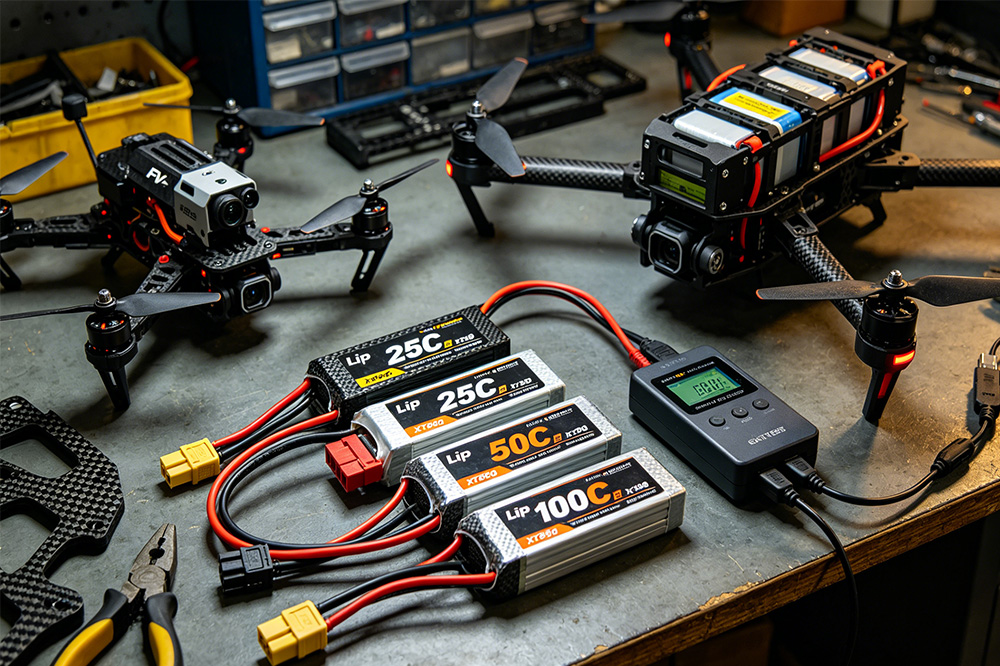
If you’ve ever looked at a drone battery label, you’ve probably seen numbers like:
- 25C
- 50C
- 100C
For a lot of people, those numbers are confusing at first.
Some assume higher always means better. Others buy the highest C rating they can find without really knowing whether the drone actually needs it.
In reality, C rating is just a way to describe how much current a battery can deliver safely.
And depending on the type of UAV, that can make a huge difference.
A freestyle FPV quad pulls power very differently from a mapping drone flying a steady route over farmland. The battery requirements are not the same, even if both aircraft use lithium batteries.
That’s why many manufacturers building professional drone battery packs offer different discharge configurations for different UAV applications.
ANPS Global UAV Battery
What the “C” Actually Means
C rating is connected to discharge speed.
Put simply, it tells you how fast the battery can release stored energy.
The calculation itself is straightforward:
Maximum Current=Battery Capacity×C Rating
For example, a 5000mAh battery equals 5Ah.
If the pack is rated at 20C:
5Ah×20=100A
That means the battery can theoretically provide 100 amps continuously.
The higher the C rating, the easier it is for the battery to handle heavy current demand.
Why Discharge Rate Matters in Drones
Drone motors can draw a surprising amount of power, especially during:
- Rapid climbs
- Hard acceleration
- Sharp direction changes
- Heavy payload takeoff
When the battery cannot keep up, the aircraft starts showing it immediately.
Throttle response becomes weaker. Voltage drops faster. The drone may even feel unstable in the air.
That’s why discharge performance matters more in some UAVs than others.
FPV drones are a good example. They constantly move between low throttle and full power in seconds. The battery needs to react instantly.
Without enough discharge capability, the drone feels sluggish.

Why FPV Pilots Care So Much About C Rating
Spend enough time around FPV pilots and you’ll hear people talking about voltage sag all the time.
That usually happens when the battery struggles under load.
During aggressive flying, current demand spikes very quickly. A weak battery can’t maintain stable voltage, so power delivery starts feeling inconsistent.
Pilots notice things like:
- Slower punch-outs
- Softer throttle feel
- Reduced recovery after dives
- Early low-voltage warnings
This is why FPV setups often use high discharge drone batteries with higher C ratings.
Not because the number looks impressive, but because the aircraft genuinely needs fast current delivery to fly properly.
Industrial Drones Usually Have Different Priorities
Commercial UAVs don’t always need extremely high discharge rates.
A mapping drone flying a stable automated route behaves very differently from an FPV racing quad.
Many industrial UAVs spend most of the flight:
- Cruising steadily
- Maintaining altitude
- Carrying moderate payloads
- Following pre-programmed routes
In those situations, energy efficiency may matter more than aggressive power output.
That’s one reason long-endurance UAV platforms often use lower-discharge Li-ion battery systems instead of ultra-high-C LiPo packs.
The goal is different.
Bigger C Numbers Don’t Always Mean Better Batteries
This is where marketing sometimes confuses people.
A battery advertised as 120C is not automatically better than one labeled 60C.
Real performance depends on much more than the printed number.
Things like:
- Cell quality
- Internal resistance
- Heat management
- Voltage stability
- Manufacturing consistency
matter just as much.
Experienced drone pilots usually judge batteries based on how they perform in actual flights, not just the label on the pack.
Some batteries with lower advertised ratings perform more consistently than packs claiming much bigger numbers.

Heat Is One of the Biggest Battery Problems
High current creates heat.
The harder a battery works, the hotter it gets.
Excessive heat shortens battery lifespan and increases internal resistance over time. In serious cases, overheating can damage the pack completely.
This becomes especially important in:
- Heavy-lift drones
- Agricultural UAVs
- Hot weather operations
- Repeated aggressive flights
Professional operators often check battery temperature after flights because heat tells you a lot about whether the setup is working efficiently.
A battery that comes down excessively hot is usually being pushed too hard.
Matching the Battery to the Aircraft
There’s no perfect C rating for every drone.
The right choice depends on how the aircraft is actually used.
Higher C Ratings Usually Make Sense For:
- FPV racing drones
- Freestyle quads
- Heavy-lift multirotors
- Spraying drones
Moderate C Ratings Often Work Fine For:
- Mapping UAVs
- Inspection drones
- Survey aircraft
- Long-range VTOL systems
The important thing is balance.
A battery should match the drone’s power demands instead of simply having the highest specification on paper.
Conclusion
C rating is only one part of battery performance, but it’s an important one.
A good UAV battery needs to deliver stable power without excessive heat, voltage drop, or unnecessary weight.
For FPV pilots, discharge performance has a direct impact on how the drone feels in the air. For industrial UAV operators, efficiency and reliability may matter more than extreme current output.
Understanding what C rating actually means makes it easier to choose a battery based on real flight requirements instead of marketing numbers.


Leave a Reply