
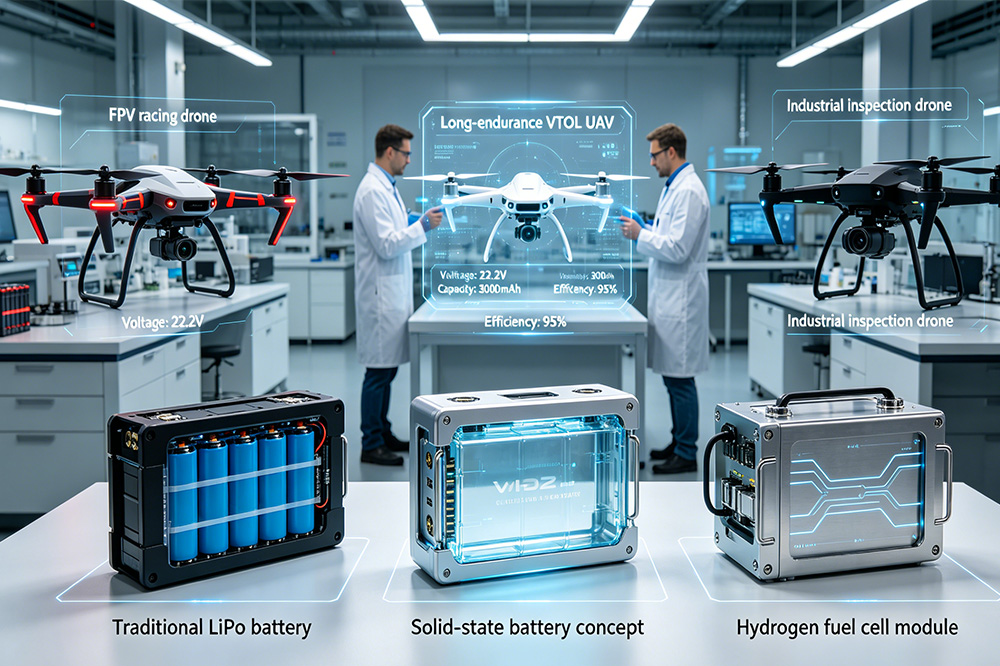
LiPo batteries still power most drones flying today.
From FPV racing quads to industrial agricultural UAVs, lithium polymer technology remains the standard because it offers a balance of:
- Power output
- Weight efficiency
- Compact size
- Fast response under load
But as drones take on bigger roles in logistics, inspection, mapping, and autonomous operations, battery limitations are becoming harder to ignore.
Most UAV operators eventually run into the same problem:
Flight time.
No matter how advanced the drone becomes, endurance is still limited by energy storage.
That’s why battery technology has become one of the biggest areas of development in the UAV industry.
Manufacturers working on next-generation UAV power systems are now exploring everything from solid-state batteries to hydrogen-assisted flight platforms.UAV Battery
LiPo Batteries Still Dominate for a Reason
Even with newer technologies being developed, LiPo batteries remain difficult to replace.
They still provide:
- Strong discharge capability
- Lightweight construction
- Reliable high-current performance
- Good compatibility with existing UAV systems
That matters especially in:
- FPV racing drones
- Freestyle quads
- Heavy-lift multirotors
- Agricultural UAVs
These aircraft need fast throttle response and stable current delivery more than extreme endurance.
That’s one reason LiPo technology continues evolving instead of disappearing.
Modern packs are becoming:
- Safer
- More energy efficient
- Better thermally managed
- More durable under load
The Biggest Industry Challenge Is Energy Density
Most battery development now focuses on one goal:
Store more energy without adding more weight.
In drone design, weight affects everything:
- Flight time
- Payload capacity
- Efficiency
- Stability
- Motor load
A heavier battery may contain more energy, but eventually the extra weight cancels out the endurance gain.
That’s why researchers continue pushing for higher energy density instead of simply increasing battery size.
Solid-State Batteries Get a Lot of Attention
Solid-state batteries are probably the most talked-about future battery technology right now.
Unlike traditional lithium batteries that use liquid electrolytes, solid-state systems use solid conductive materials internally.
The potential advantages are significant:
- Higher energy density
- Improved safety
- Lower fire risk
- Better thermal stability
- Longer cycle life
For UAV applications, that could eventually mean:
- Longer flight times
- Reduced battery weight
- More stable operation in difficult environments
But there’s still a gap between laboratory development and large-scale commercial drone use.
Right now, cost and manufacturing complexity remain major obstacles.

Hydrogen UAV Systems Are Growing Slowly
Hydrogen-powered UAVs are another technology attracting attention, especially for long-endurance missions.
Hydrogen fuel cell systems can keep drones airborne much longer than traditional lithium batteries in some applications.
That makes them interesting for:
- Long-range inspection
- Border surveillance
- Mapping large territories
- Maritime monitoring
Some hydrogen UAV platforms can already achieve flight times measured in hours instead of minutes.
But hydrogen systems also introduce new challenges:
- Larger infrastructure requirements
- Higher system cost
- More complicated maintenance
- Storage and transport concerns
For now, hydrogen remains more practical for specialized industrial UAVs rather than mainstream drone use.
Hybrid Power Systems May Become More Common
Instead of replacing lithium batteries completely, many companies are exploring hybrid UAV power systems.
These setups combine:
- Lithium batteries
- Fuel cells
- Generators
- Solar assistance in some cases
The idea is to balance:
- Peak power demand
- Long-duration efficiency
- Weight management
For example:
A drone may still use LiPo batteries for takeoff and rapid maneuvering while relying on another energy source during steady cruising flight.
Hybrid systems are more complex, but they may become increasingly useful in large industrial UAV operations.
Battery Management Is Becoming Smarter
Future UAV batteries are not only about chemistry.
Battery intelligence is improving too.
Modern commercial drone batteries increasingly include:
- Real-time health monitoring
- Thermal protection
- Cell balancing systems
- Predictive maintenance tracking
- Smart charging management
Large UAV fleets already rely heavily on battery diagnostics because battery reliability directly affects operational cost and safety.
In the future, software may become just as important as the battery cells themselves.
Fast Charging Will Continue Improving
Charging speed remains a major issue for drone operations.
Commercial UAV fleets often lose time waiting for batteries to recharge between missions.
Battery companies are now working on:
- Faster charging systems
- Lower heat generation during charging
- Improved cycle stability under rapid charging conditions
But extremely fast charging still creates thermal stress.
That means future development will likely focus on balancing:
- Charging speed
- Safety
- Long-term battery lifespan
instead of simply pushing maximum charging rates higher.

Li-ion and LiPo Will Still Be Around for Years
Even as new technologies develop, lithium batteries are not disappearing anytime soon.
The current UAV industry is already built around LiPo and Li-ion infrastructure:
- Chargers
- ESC systems
- Flight controllers
- Battery connectors
- Power management designs
That ecosystem is hard to replace quickly.
Most likely, future drone power systems will evolve gradually rather than switching overnight to entirely new technologies.
Recommended Reading
- Best LiPo Battery for Drone: How to Pick One That Actually Works
- Explore Long Endurance Drones: Which Drone Has the Longest Battery Life?
- UAV Battery Product Category
- LiPo Battery for Drone: The Heart of UAV Power
- UAV Battery Types: Types and Applications for Drones
- Reliable Drone LiPo Battery: What Actually Makes It Reliable?
Final Thoughts
The future of UAV batteries will probably not be defined by a single breakthrough.
Instead, the industry is moving toward gradual improvements in:
- Energy density
- Thermal stability
- Smart battery management
- Charging efficiency
- Long-endurance power systems
LiPo batteries still make the most sense for many high-performance drone applications today. But endurance-focused UAV operations are already pushing the industry toward new technologies.
The next generation of drone batteries will likely focus less on raw power alone and more on balancing endurance, safety, reliability, and operational efficiency.


Leave a Reply