
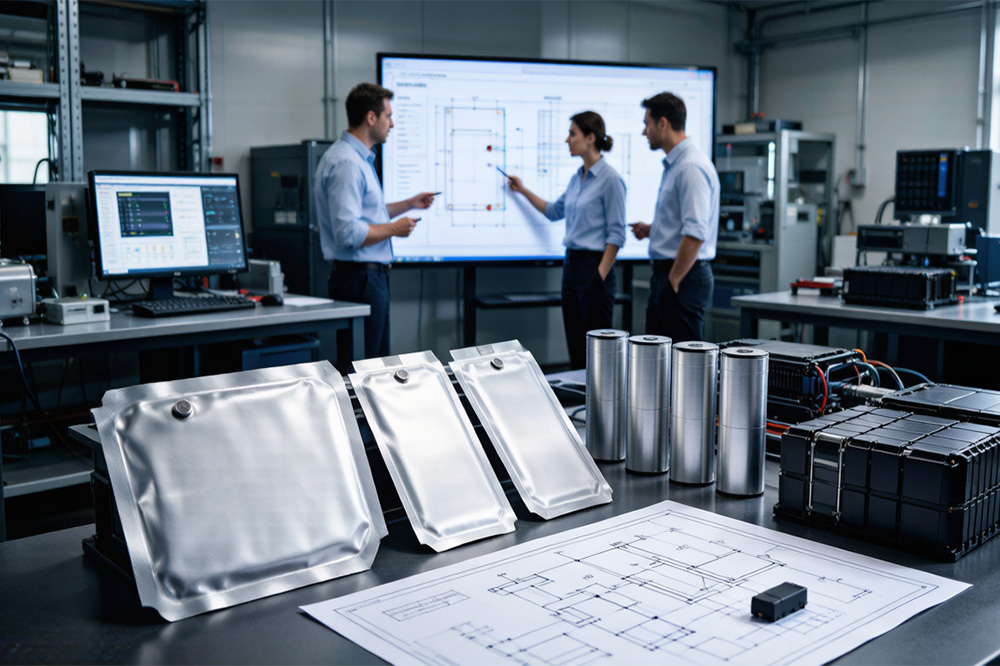
Walk into a battery factory today and you’ll probably notice something interesting.
For years, cylindrical batteries dominated conversations.
Then prismatic cells started appearing everywhere.
But behind the scenes, many engineers working on electric vehicles, drones, robotics, medical equipment, and energy storage systems have been quietly moving toward another format: pouch batteries.
Not because they’re perfect.
Actually, most engineers will tell you they create their own headaches.
Yet despite those challenges, pouch cells continue gaining attention for one simple reason.
They make better use of space.
And in battery design, every millimeter matters.
What Exactly Is Pouch Battery?
A pouch battery is a lithium-ion battery cell packaged inside a flexible laminated aluminum-polymer film instead of a rigid metal casing.
At first glance, it almost looks fragile compared to a cylindrical cell.
No steel can.
No aluminum housing.
Just a sealed flexible pouch.
That sounds risky until you understand why manufacturers use it.
Removing the heavy metal casing means more room for active materials.
More active material generally means more energy storage within the same volume.
That’s where pouch batteries start becoming interesting.

The Space Problem Most Battery Designers Face
Battery design is rarely about finding the “best” cell.
It’s usually about finding the least compromised solution.
Imagine you’re designing:
- An electric motorcycle
- A drone
- A portable medical device
- A robotic platform
- An autonomous inspection system
The available space rarely matches standard battery dimensions.
Cylindrical cells create unavoidable gaps between cells.
Those gaps seem insignificant until multiplied across hundreds or thousands of batteries.
Suddenly a considerable amount of pack volume disappears.
Pouch batteries solve part of that problem.
Because they are flat and flexible in size, designers can build battery packs that utilize available space much more efficiently.
I’ve seen battery engineers describe this as “recovering dead volume.”
That phrase captures the idea perfectly.
Why Energy Density Gets So Much Attention
One recurring topic in battery development is energy density.
Put simply:
How much energy can fit into a given space?
Since pouch cells eliminate much of the structural metal found in cylindrical batteries, they can dedicate a larger percentage of their volume to energy storage materials.
The result is often:
- Higher gravimetric energy density
- Better volumetric energy density
- Lower overall pack weight
This explains why pouch batteries appear frequently in:
- Electric vehicles
- Aerospace systems
- Racing applications
- Performance drones
When every kilogram affects performance, reducing unnecessary packaging becomes valuable.

A Formula Student Team’s Perspective
One discussion among Formula Student and Formula SAE teams revealed an interesting divide.
Some teams preferred cylindrical cells because sourcing and replacement were easier.
Others chose pouch cells because they could build lighter battery packs with better packaging efficiency.
Neither side was completely wrong.
The choice often depended on project priorities.
If rapid assembly and standardized manufacturing matter most, cylindrical cells offer advantages.
If maximizing performance and minimizing weight become critical, pouch cells start looking attractive.
Real engineering decisions are rarely black and white.
Pouch vs Cylindrical vs Prismatic
People often ask which battery format is best.
That’s usually the wrong question.
A better question is:
Best for what?
Cylindrical Cells
Strengths:
- Mechanically robust
- Mature manufacturing process
- Excellent consistency
- Easier thermal management
Challenges:
- Wasted space between cells
- Additional pack weight
- Limited form factor flexibility
Prismatic Cells
Strengths:
- Better space utilization
- Strong structural housing
- Suitable for large battery packs
Challenges:
- Higher manufacturing complexity
- Internal stress concentration
- More difficult repair scenarios
Pouch Cells
Strengths:
- Highest packaging efficiency
- Lightweight design
- Flexible dimensions
- Excellent energy density potential
Challenges:
- Swelling management required
- Additional mechanical support needed
- Greater sensitivity to abuse conditions
The trade-offs become obvious once viewed this way.
Every format solves one problem while introducing another.
The Swelling Issue Nobody Should Ignore
Ask battery engineers about pouch cells and sooner or later the conversation turns toward swelling.
This is probably the most discussed challenge associated with pouch batteries.
During charging, discharging, and aging, gases can form inside the cell.
Unlike cylindrical batteries with rigid housings, pouch cells have flexible packaging.
As gas accumulates, the cell can expand.
Small amounts of expansion may be manageable.
Excessive swelling, however, can create:
- Mechanical stress
- Cooling difficulties
- Reduced pack lifespan
- Safety concerns
This is why professional pouch battery packs typically include compression systems.
Compression isn’t an optional feature.
It’s often a critical design requirement.
Why Modern EV Designers Still Like Pouch Cells
Given the swelling issue, some people wonder why automotive engineers continue using pouch technology.
The answer comes back to efficiency.
A well-designed pouch battery system can deliver:
- Higher usable energy per pack volume
- Lower weight
- Better customization opportunities
- Improved integration flexibility
When designing vehicles where range matters, even small efficiency gains become valuable.
One extra percent of energy density may not sound important.
Across thousands of battery cells, it absolutely is.
Thermal Management Is More Complicated Than It Looks
Battery articles often mention thermal management without explaining what that means.
For pouch batteries, heat management becomes particularly important.
The large flat surface area offers some advantages.
Heat can spread more evenly across the cell surface.
At the same time, cell stacking introduces challenges.
If cooling channels are poorly designed, hotspots may develop inside densely packed modules.
This is one reason battery pack architecture often matters more than the cell itself.
A premium cell inside a poorly cooled pack can still fail prematurely.
Applications Growing Faster Than Many People Realize
Pouch batteries are no longer limited to consumer electronics.
Today they appear in:
Electric Vehicles
Large-scale traction battery systems.
UAVs and Drones
Weight-sensitive flight platforms.
Robotics
Mobile robots requiring compact energy storage.
Medical Devices
Portable equipment demanding lightweight power solutions.
Defense and Aerospace
Applications where energy density directly affects mission duration.
Industrial Equipment
Inspection systems, communication devices, monitoring platforms, and portable automation equipment.
As battery-powered equipment becomes smaller and more capable, pouch cell demand continues expanding.

What OEM Buyers Usually Ask First
End users often focus on capacity.
OEM buyers typically focus elsewhere.
Questions frequently include:
- Can dimensions be customized?
- Is the cell available with different chemistries?
- What cycle life can be verified?
- How stable is production consistency?
- What certifications are available?
- Can the supplier support long-term production?
These questions may seem less exciting than energy density discussions.
But they’re often what determine whether a project succeeds commercially.
Not Every Project Needs the Highest Energy Density
This might sound surprising.
Some applications deliberately avoid the most energy-dense cell available.
Why?
Because battery selection involves balancing:
- Cost
- Safety
- Service life
- Thermal performance
- Mechanical integration
- Supply chain stability
The “best” battery frequently turns out to be the one that best matches the application rather than the one with the highest specification sheet numbers.
That’s something experienced battery engineers learn quickly.
Looking Ahead
The push toward lighter vehicles, longer-lasting portable devices, and more compact energy storage systems keeps driving pouch battery development.
Manufacturing processes continue improving.
Materials continue evolving.
Cell designs continue becoming more sophisticated.
Yet the fundamental reason pouch batteries remain attractive hasn’t changed.
They allow engineers to store more energy in less space.
And in many modern products, that’s still one of the most valuable advantages a battery can offer.
Need Custom Pouch Batteries for Your Project?
Whether you’re developing electric vehicles, drones, robotics systems, industrial devices, or energy storage products, selecting the right pouch battery supplier is just as important as selecting the right cell chemistry.
We support:
- Custom Pouch Cell Development
- OEM & Private Label Manufacturing
- Battery Pack Assembly
- Low MOQ Prototype Projects
- High-Volume Production Programs
- Global Compliance Support
Contact our engineering team to discuss your battery requirements, request samples, and evaluate custom pouch battery solutions for your application.
-

11.1V 3S 850mAh li-ion Polymer Pouch Cell Battery Pack
-

134365 4500mAh 3.7V Rechargeable Lithium Polymer Battery
-

3.7V 1200mAh Li-Polymer Pouch Cell Battery
-

3.7V 15Ah 148198 Pouch Lithium Ion Battery
-

3.7V 1S2P 3000mah lithium Polymer Battery
-

3.7V 2000mAh Pouch Cell Battery
-

3.7V 502248 500mAh Lithium Ion Polymer Battery
-

3.7V 700mAh Li-Polymer Pouch Cell Battery
-

3.7V 800mAh Rechargeable Pouch Li-Polymer Battery
Leave a Reply