
I’ve noticed something over the years — people don’t really ask for “20V drill batteries” in a clean technical way.
At least not the serious buyers.
They usually start with something like:
“Do you have something compatible with DeWalt-style tools?”
or
“Can this run longer than the last batch we bought?”
Specs come later. Sometimes much later.
And honestly, that already tells you how this market works.
When 20V becomes “standard”… but not really standard
On paper, 20V looks like a fixed category. Same voltage, same idea.
But in real sourcing conversations, it doesn’t behave like a standard product.
One buyer once told me — not in a formal meeting, just casually during testing —
“Two batteries with the same 20V label can feel completely different in hand.”
That stuck with me a bit.
Because he was right, just not in a technical sense.
Inside factories, you’ll see differences:
- some packs feel heavier (usually better cell density… or sometimes just cheaper casing, hard to tell at first glance)
- some discharge smoother under load
- some overheat earlier than expected
You only really notice this when tools are actually running on a job site, not on a test bench.
The part buyers care about but don’t always say directly
Most wholesale buyers don’t lead with “capacity” or “cycle life”.
They care about things like:
- Will this come back as a complaint batch?
- Can I reorder the same spec six months later?
- Will it fit multiple tool platforms without redesign?
Compatibility is where a lot of deals either expand… or fall apart quietly.
Some suppliers promise “universal fit” — but in practice, even slight differences in connector shape or casing tolerance can create friction at scale.
That’s why OEM buyers usually start asking for samples early, sometimes earlier than expected.

Inside the pack
If we strip the branding away, a 20V drill battery is usually just a 5S lithium-ion pack.
But what matters more is not the structure — it’s what goes inside:
- 18650 cells (more stable supply, often cheaper)
- 21700 cells (higher energy density, but pricing swings more)
- BMS design (some are overly conservative, others push performance harder)
- welding consistency (this sounds minor, but it affects failure rate more than people expect)
I’ve seen batches where everything looked identical on paper, but runtime difference was noticeable enough that distributors started splitting them into “premium” and “standard” lines internally.
Not officially, just… practically.
OEM buyers usually don’t want “battery”
This part is important if you’re looking at wholesale seriously.
Most OEM buyers aren’t actually buying a battery.
They’re trying to build a repeatable supply chain.
So the conversation shifts toward:
- consistent casing design
- branding flexibility
- MOQ that doesn’t trap inventory
- stable cell sourcing
And sometimes they’ll ask something very simple like:
“If I reorder next year, will it still look the same?”
That question says more than any spec sheet.
Example product
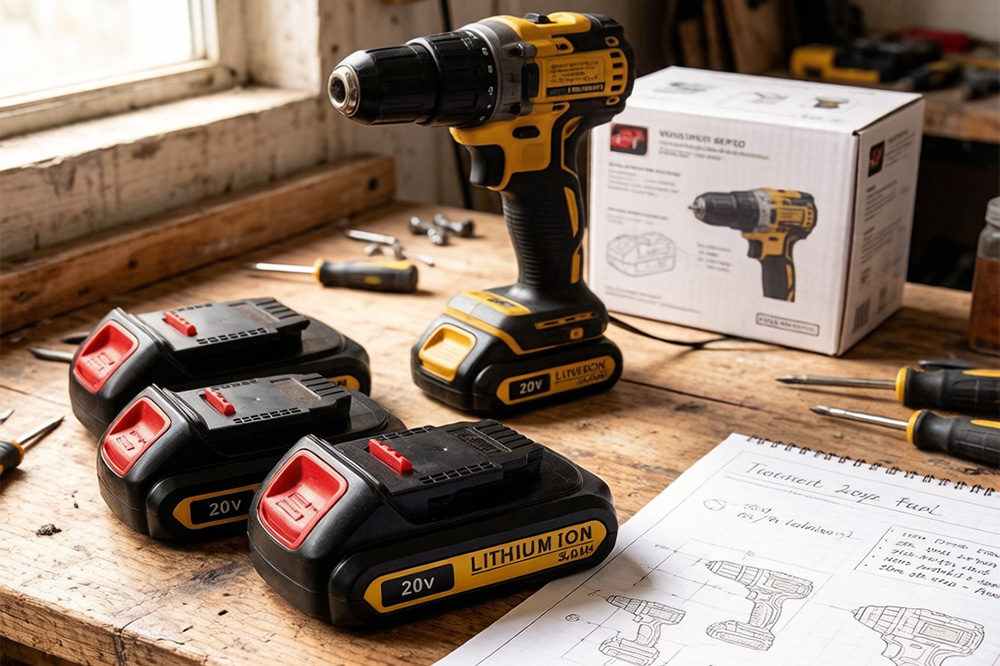
For reference, here is one configuration commonly requested in OEM projects:20V 18650-based 3.0Ah cordless drill battery
Where most sourcing discussions actually happen
Interestingly, most serious discussions don’t happen around specs anymore.
They happen around small details like:
- packaging tolerance
- label durability (especially in humid shipping routes)
- connector wear after repeated cycles
- how the battery behaves after long storage
One distributor once said:
“I don’t care how it performs on day one. I care how it performs on day 60 in a warehouse.”
That kind of thinking is very typical in this category.

A small reality check for buyers
If you’re comparing suppliers, it’s easy to get stuck in spec sheets.
But in 20V drill batteries, real differences often show up later:
- after repeated charging
- after shipping stress
- after inconsistent tool usage
That’s where OEM experience matters more than just listed capacity.
Not every factory will tell you this directly, but it’s usually obvious once you’ve handled a few batches.
Closing thought
20V drill batteries look simple from the outside.
But in bulk sourcing, they behave more like a system than a product.
And maybe that’s why repeat buyers tend to stick with fewer suppliers than expected — not because of price alone, but because inconsistency is more expensive than it looks on paper.
Leave a Reply