
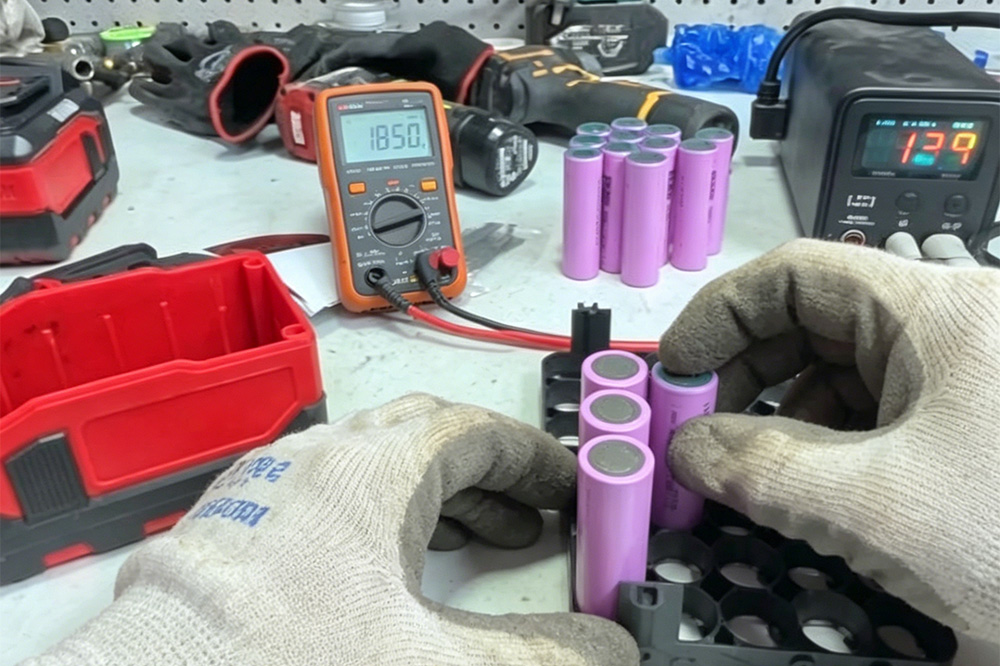
When people first come across the 18650 li-ion rechargeable battery, there’s often a quiet assumption:
“It’s just a standard cylindrical battery.”
But once you actually start using it in real applications—electric devices, portable power systems, or energy storage packs—you quickly realize the behavior is far from simple.
Two batteries that look identical on paper can perform very differently in real life. Some last years in stable condition, while others start degrading within months. The difference is usually not visible from the outside.
Voltage is more sensitive than most people expect
In discussions around the 18650 li-ion rechargeable battery, voltage is often mentioned, but not always fully understood.
Typical reference points:
- Fully charged: around 4.2V
- Nominal range: 3.6V–3.7V
- Cut-off range: 2.5V–3.0V (varies by design)
However, real-world usage doesn’t follow clean laboratory numbers.
Many devices begin to behave differently long before reaching “official” limits. For example, some outdoor or portable equipment already shows unstable performance once the voltage drops below 3.6V.
So even if the battery is still technically “usable,” the system may not feel stable anymore.
Higher capacity doesn’t always mean better performance
One common request in bulk purchasing is:
“Do you have higher capacity 18650 cells?”
On paper, higher capacity sounds like an upgrade. But in real applications, it often comes with trade-offs:
- Higher internal resistance
- Lower discharge rate capability
- More heat under load
- Faster degradation under high stress
In high-power systems, this becomes more noticeable. Some projects initially prioritize maximum capacity, but later shift toward a more balanced configuration—moderate capacity with more stable output. The result is often better long-term reliability.

A real-world case: when “battery drain” is misunderstood
There are many troubleshooting cases where users report:
“The battery drops very fast after full charge.”
But after testing, the situation is different:
- Voltage still appears normal
- Yet under load, voltage drops sharply
This usually points to internal resistance increase rather than actual capacity loss.
In simple terms: the battery isn’t necessarily “too small,” it just cannot handle sudden load demands effectively anymore.
Hidden issues when multiple 18650 cells are used together
When 18650 li-ion rechargeable batteries are assembled into packs, complexity increases significantly.
People often focus only on total voltage, but in practice, several factors matter more:
- Cell consistency within the pack
- Different aging rates between cells
- Uneven temperature distribution
- Long-term voltage drift
Even a single weak cell can affect the overall performance of the entire pack. That’s why industrial applications often prioritize cell matching instead of only looking at specifications.
Voltage readings don’t always reflect true battery health
One misleading assumption is that voltage equals battery condition.
In reality, many 18650 cells still show normal voltage even when performance has already declined.
This happens because:
- Voltage curves are relatively flat
- Aging affects internal resistance more than voltage
- Capacity fade is not directly visible through voltage readings
So relying only on voltage is not enough to evaluate battery health.
What really matters in bulk purchasing decisions
A common question is:
“Which 18650 battery is the best?”
But in real engineering or sourcing decisions, a better question might be:
- What device is it used for?
- Is the load continuous or intermittent?
- What is the operating temperature range?
- Is high discharge current required?
The same 18650 specification can behave very differently depending on the application.
A more realistic engineering approach
In long-term industrial use, the goal is rarely “maximum specs.”
Instead, the focus is usually:
- Balanced capacity and internal resistance
- Stable discharge performance
- Consistency across batches
This approach is common in energy storage systems, electric mobility, and industrial devices, where reliability matters more than peak numbers.

18650 battery wholesale and customization
For project development, OEM production, or bulk sourcing, different configurations can be explored:
18650 li-ion rechargeable battery product range:18650 Lithium Battery Products
Available options include:
- Different capacity grades
- Custom battery pack design (series/parallel configurations)
- OEM/ODM structural customization
- Industrial application matching solutions
-

12V 4400 mah Lithium ion 3S2P 18650 Battery Pack
-

18650 2000mAh 3.7 volt Lithium-ion Battery
-

18650 20V 3.0Ah Cordless Drill battery
-

18650 22.2V 7.8Ah 2600Mah 6S3P Rechargeable Battery Pack
-

18650 2600mAh Rechargeable Lithium-Ion Battery 3.7V
-

18650 3.7V 10Ah Li-Ion Power Battery Pack
-

18650 3.7V 3300mah Rechargeable Lithium ion Battery
-

18650 7S7P 24V 14Ah Lithium ion Electric Scooter Battery Pack
-

18650 battery 3.7V 1500mAh Lithium-Ion Battery
-

18650 Battery 3500 mah Rechargeable Battery Cells
-

18650 Electric Scooter 48V 13000mAh Lithium Battery
-

2600mAh 3S1P 11.1V 18650 Battery Packs
-

3.7V Li ion Rechargeable 3000mah 18650 Battery Cell
-

36V 5200mAh 10S2P 18650 Battery Pack
-

48v 4400mah 13S2P 18650 Rechargeable Battery Pack
-

7S2P 24V 18650 Lithium Battery Pack
-

Electric Scooter 36V 4400mAH 10S2P 18650 Battery Pack
-

ICR 18650 Battery 2200mah 3.7V
Leave a Reply