
A few months ago, customer building a power line inspection drone asked us a question that sounded surprisingly simple:
“Which battery should we use for our UAV?”
At first, it seemed like a straightforward request. But after twenty minutes of discussion, it became obvious that there wasn’t a single correct answer.
The drone needed to fly for nearly an hour.
It also had to carry a camera payload.
The operating environment could reach 45°C during summer.
Suddenly, the battery decision became much more complicated than choosing the highest-capacity pack on the market.
That’s actually what happens in many UAV projects.
People often assume drone batteries are all basically the same. In reality, the battery inside a racing FPV drone can be completely different from the one powering an agricultural spraying platform or a fixed-wing mapping UAV.
Walk Around Any Drone Exhibition and You’ll Notice Something Interesting
At drone trade shows, you’ll see hundreds of aircraft.
Different shapes.
Different missions.
Different price tags.
Yet most of them rely on only a handful of battery technologies.
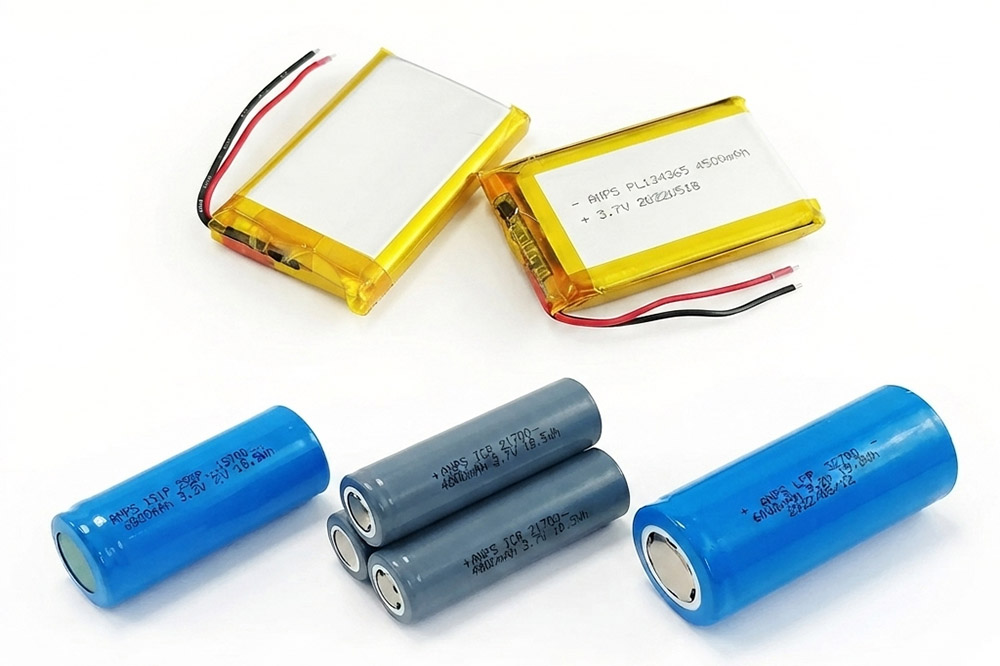
The industry has gradually settled around three mainstream options:
- Lithium Polymer (LiPo)
- Lithium-Ion
- Lithium Iron Phosphate (LiFePO4)
You may occasionally spot NiMH batteries, but honestly, they’re becoming harder to find in new UAV designs.

LiPo Batteries: Still The Favorite For High-Power Drones
If you’ve ever watched an FPV racing drone shoot into the sky like a rocket, chances are it was powered by a LiPo battery.
There’s a reason pilots keep choosing them.
LiPo batteries can deliver huge bursts of current almost instantly.
That’s exactly what aggressive flying requires.
One FPV builder told me he tried replacing his LiPo pack with a lithium-ion pack to gain more flight time. The result was disappointing. Flight duration improved, but throttle response felt sluggish and the drone simply didn’t feel the same.
That’s the trade-off.
You get power.
You give up some endurance.
For applications like:
- Racing drones
- Cinematic FPV
- Heavy-lift multicopters
- Agricultural spraying drones
LiPo remains extremely common.
The downside is something many new users discover the hard way.
LiPo batteries don’t particularly like abuse.
Overcharge them.
Store them fully charged for weeks.
Leave them inside a hot vehicle.
Sooner or later, they’ll let you know.
Lithium-Ion Batteries Quietly Took Over Long-Endurance UAVs
This shift has become more obvious over the last five years.
When manufacturers started building inspection drones capable of flying 40, 50, even 90 minutes, lithium-ion batteries suddenly became much more attractive.
Especially 18650 and 21700 cells.
The reason is fairly simple.
They store more energy relative to their weight.
That extra energy translates into longer missions.
And for a mapping company surveying hundreds of acres, an additional 15 minutes of flight time can mean one less battery swap during the day.
Many industrial UAV manufacturers now prefer high-quality 21700 cells.
Not because they’re trendy.
Mostly because they provide a practical balance between capacity, weight, and pack design flexibility.
If you open some modern long-range UAV battery packs, there’s a good chance you’ll find 21700 cells inside.
LiFePO4 Batteries Don’t Get Much Attention, But They Solve Certain Problems
Whenever people discuss UAV batteries online, LiPo and lithium-ion dominate the conversation.
LiFePO4 usually sits in the background.
That’s a bit unfair.
In some industrial environments, LiFePO4 offers advantages that are difficult to ignore.
For example:
A security drone stationed at a remote facility may perform several short patrol flights every day for years.
In that situation, maximum flight time isn’t always the priority.
Battery lifespan becomes more important.
A LiFePO4 pack can often survive thousands of charge cycles.
Some operators are willing to accept extra weight in exchange for that longevity.
It’s not the perfect solution for every aircraft.
But it solves a problem that other chemistries sometimes struggle with.

What About NiMH Batteries?
You still see them mentioned occasionally.
Mostly in older drone forums.
Or in educational projects.
Ten years ago, NiMH batteries were far more common.
Today, they’re largely a legacy technology in the UAV sector.
The energy density simply can’t compete with modern lithium batteries.
Most commercial manufacturers have already moved on.
Here’s Where Many UAV Buyers Make A Mistake
A surprising number of purchasing teams start by comparing capacity.
10,000mAh.
20,000mAh.
30,000mAh.
The assumption is obvious:
Higher capacity equals better battery.
Sometimes that’s true.
Sometimes it isn’t.
What really matters is the complete picture.
Questions worth asking include:
- How much continuous current does the UAV require?
- What is the payload weight?
- How much installation space is available?
- Does the drone operate in extreme temperatures?
- How many cycles are expected annually?
- Is fast charging necessary?
I’ve seen projects fail because buyers focused entirely on capacity and ignored discharge performance.
On paper, the battery looked perfect.
In actual flight tests, it struggled.
More UAV Manufacturers Are Choosing Custom Battery Packs
This trend has accelerated recently.
Off-the-shelf batteries work well for hobby aircraft.
Commercial UAVs often need something more specialized.
Custom packs may include:
- Smart BMS systems
- CAN Bus communication
- Battery health monitoring
- GPS-linked battery management
- Waterproof housing
- Rapid charging support
Some military and industrial projects even require heating systems inside the battery pack for cold-weather operation.
These details rarely appear in marketing brochures, but they matter once the drone leaves the testing lab and starts working in real-world conditions.

Final Thought Before Choosing A UAV Battery
If someone asks, “What types of batteries are used in UAVs?” the technical answer is easy:
LiPo, lithium-ion, LiFePO4, and occasionally NiMH.
The practical answer is different.
The best battery depends on what the drone is expected to do.
A battery that’s ideal for an FPV pilot may be completely wrong for a mapping company.
And the battery that delivers the longest flight time isn’t necessarily the battery that creates the most reliable UAV platform over the next three years.
That’s usually where experienced drone manufacturers start the conversation—not with capacity, but with the mission itself.


Leave a Reply