
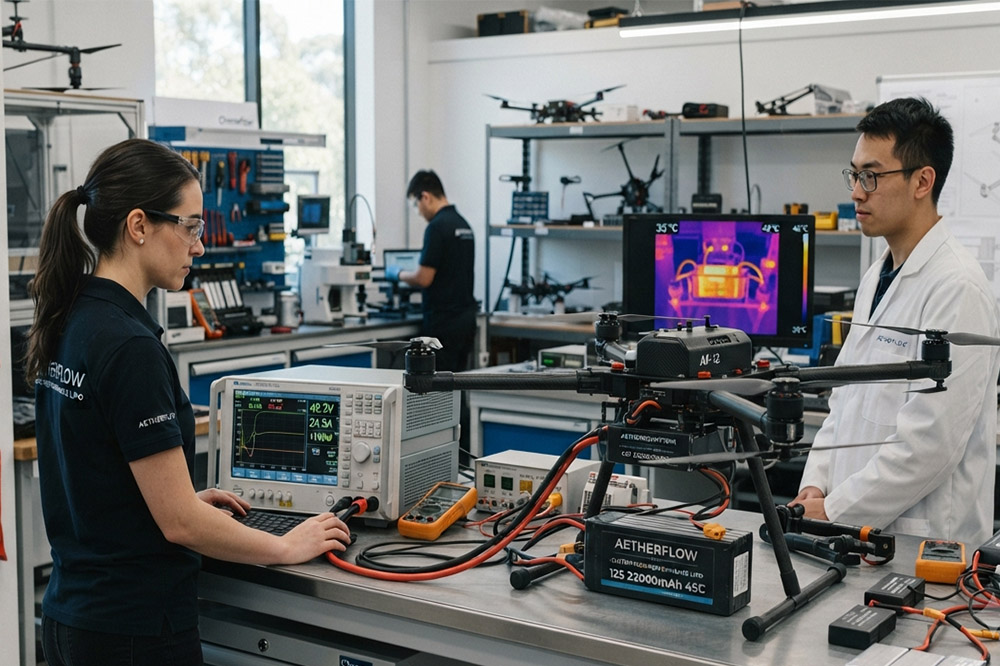
Why Do Drones Use LiPo Batteries?
When people talk about drone performance, they usually focus on the camera, flight controller, motors or communication system. But after working with battery applications, one thing becomes clear: the battery often decides what the drone can actually do.
A powerful motor is useless if the battery cannot provide enough current. A lightweight drone design also becomes difficult if the battery is too heavy.
This is the main reason why LiPo batteries have become the common choice for many drones, especially FPV drones, racing drones and professional UAV systems.
LiPo batteries are not perfect. They need proper charging, protection and handling. But when engineers need a battery that is light, powerful and flexible in design, LiPo technology is still one of the first options they consider.
Lightweight Design Helps Drones Stay in the Air Longer
For drones, every gram matters.
Unlike electric vehicles or stationary equipment, drones have to lift their entire power system into the air. Adding extra battery weight can increase flight time, but it also increases motor load. Finding the right balance is always a challenge for drone designers.
LiPo batteries offer a high energy-to-weight ratio compared with many traditional battery types.
For example, a small camera drone may need a battery that provides enough energy for stable flight while keeping the total weight low. A heavier battery could technically store more energy, but the drone may consume more power just carrying it.
This is why drone manufacturers often choose LiPo pouch cells. The flexible structure allows battery designers to create packs that fit limited spaces inside different drone frames.
High Discharge Capability Is the Key Reason Drones Use LiPo Batteries
One of the biggest differences between normal lithium batteries and drone LiPo batteries is discharge performance.
When a drone takes off, climbs quickly or changes direction suddenly, the motors can demand a large amount of current in a very short time.
A battery with low discharge capability may cause:
- slower response
- voltage drop
- reduced motor performance
- shorter effective flight time
LiPo batteries are popular because they can provide high current output. This is especially important for FPV racing drones, where pilots need instant acceleration and fast movement.
For example, a 2200mAh LiPo battery with a high C rating can deliver much higher current than a standard battery of the same capacity.
From a battery supplier’s perspective, this is often one of the first questions from drone companies: not only “how many mAh does the battery have?” but also “how much current can it safely provide?”

Different Drones Need Different LiPo Battery Designs
There is no single “best” drone battery.
A small consumer drone, an agricultural UAV and an FPV racing drone usually have completely different requirements.
A racing drone may need:
- extremely high discharge rate
- lightweight structure
- fast response
An industrial UAV may focus more on:
- longer operation time
- stable output
- safety
- custom battery shape
This is where custom LiPo battery packs become important.
Many drone companies do not simply buy a standard battery from the market. They need a battery manufacturer that can adjust:
- voltage configuration
- capacity
- battery dimensions
- connector type
- BMS design
A battery that works well for one drone platform may not perform well in another design.
Why Not Use Regular Lithium-Ion Batteries in Drones?
This is a question we often hear.
Lithium-ion batteries, including 18650 cells, also have excellent energy density and are widely used in many applications. They are not a bad choice.
The difference is mainly about application requirements.
18650 lithium-ion battery packs are often suitable for drones that prioritize longer endurance and moderate power output.
LiPo batteries are usually preferred when the drone needs:
- high current output
- lightweight structure
- compact design
For example, an FPV racing drone that frequently accelerates and changes direction puts very different demands on the battery compared with a mapping drone flying at a steady speed.
The battery selection depends on the actual mission.

Important LiPo Battery Specifications for Drone Manufacturers
When selecting a LiPo battery supplier, drone companies usually look beyond capacity.
Voltage
Drone batteries commonly use configurations such as:
- 2S
- 3S
- 4S
- 6S
The voltage affects motor speed, ESC compatibility and overall system design.
Capacity
Battery capacity directly affects flight time.
A higher capacity battery can provide longer operation, but it also increases weight.
The right choice depends on:
- drone size
- payload
- motor efficiency
- flight purpose
C Rating
The C rating indicates how quickly the battery can release energy.
High C rating batteries are usually preferred for:
- racing drones
- heavy payload drones
- high-power UAV systems
However, choosing the highest C rating is not always necessary. In some applications, balancing capacity, weight and battery life is more important.
Common Problems When Using LiPo Batteries for Drones
Although LiPo batteries perform very well, they require correct management.
Battery swelling is one common issue.
Possible reasons include:
- overcharging
- excessive heat
- poor charging habits
- low-quality cells
Another problem is reduced flight time.
Sometimes the battery is not the only reason. A heavier payload, aging motors or inefficient flight settings can also increase power consumption.
For professional UAV projects, battery quality control becomes very important. Consistent cells, reliable BMS protection and proper testing can make a big difference.
Choosing the Right LiPo Battery Manufacturer for UAV Projects
For drone manufacturers, finding a battery supplier is not only about buying cells.
A reliable partner should understand the complete battery system.
Important factors include:
- stable cell sourcing
- battery pack design experience
- customization ability
- quality certifications
- production testing
During the early stage of drone development, battery design should be considered together with the motor, ESC and flight requirements.
Changing the battery design after the drone structure is finished can create unnecessary cost and delays.

Custom LiPo Battery Solutions for Drone Applications
The reason drones use LiPo batteries is simple: they provide a combination that is difficult to replace.
Lightweight design, strong discharge capability and flexible customization make LiPo batteries suitable for many UAV applications.
For drone manufacturers, the challenge is not just finding a battery with enough capacity. The real challenge is finding the battery configuration that matches the entire aircraft system.
A custom LiPo battery supplier can help optimize:
- energy output
- battery size
- discharge performance
- safety protection
- production scalability
If you are developing a new UAV project and looking for a customized LiPo battery solution, selecting the battery design at the early engineering stage can help improve flight performance and reduce future redesign costs.


Leave a Reply