
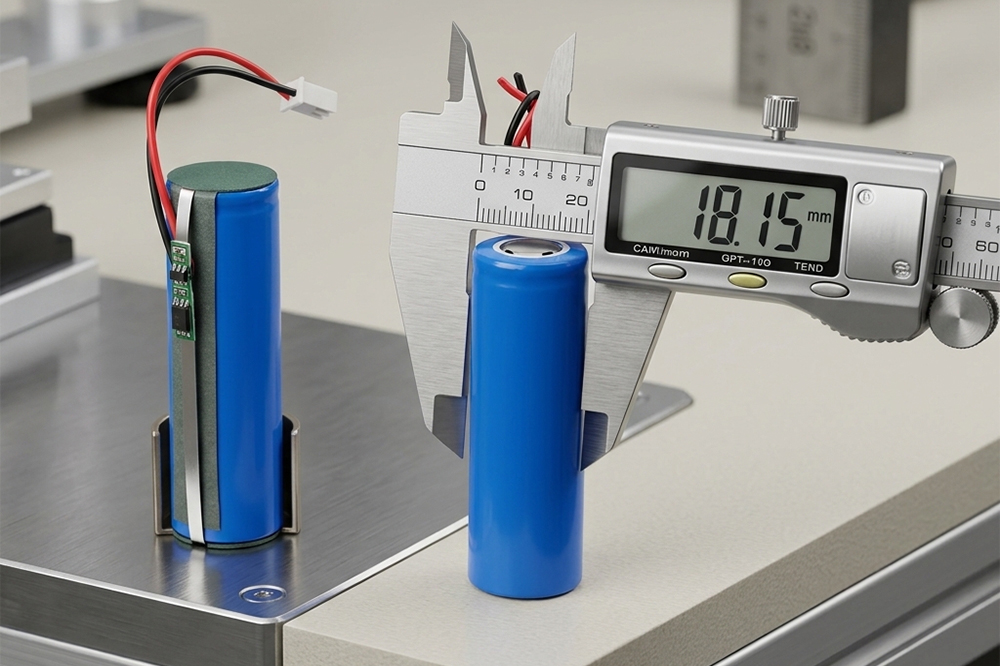
The name 18650 refers to the approximate size of a cylindrical lithium-ion cell, but real-world dimensions can vary. This guide explains 18650 battery diameter, length, terminal types, protection circuits, size tolerances, holders, and OEM battery pack design considerations.
The term 18650 describes a common cylindrical lithium-ion battery format. It is widely used in portable electronics, flashlights, power tools, industrial equipment, energy storage systems, and custom battery packs.
Many buyers assume that every 18650 battery has exactly the same dimensions. In practice, the basic cell format is standardized, but the final size can change depending on the cell construction, terminal design, protection circuit, wrapping, and other mechanical features.
For a battery pack designer, a difference of only a few millimeters can affect:
- Whether the cell fits inside the enclosure
- The design of the battery holder
- The position of nickel strips or busbars
- The total pack length and width
- The space available for a BMS
- The installation of insulation and protective materials
- The final assembly process
Understanding 18650 battery dimensions before ordering samples or bulk quantities can prevent costly mechanical changes later.
What Does “18650” Mean?
The name 18650 is based on the approximate physical dimensions of the cylindrical cell:
- 18: approximately 18mm in diameter
- 65: approximately 65mm in length
- 0: cylindrical cell format
A standard unprotected 18650 cell is often close to:
- Diameter: approximately 18mm
- Length: approximately 65mm
However, these numbers describe the general cell format rather than a guarantee that every product will measure exactly 18.00mm × 65.00mm.
The actual dimensions may vary slightly between manufacturers and models.
For a basic explanation of the cell format, voltage, and capacity, see our guide to what a standard 18650 battery is.

Typical Standard 18650 Battery Dimensions
A common bare 18650 cell has dimensions similar to the following:
| Dimension | Typical Value |
|---|---|
| Cell diameter | Approximately 18mm |
| Cell length | Approximately 65mm |
| Shape | Cylindrical |
| Nominal voltage | Usually 3.6V or 3.7V |
| Full-charge voltage | Usually 4.2V for standard lithium-ion cells |
| Terminal type | Flat top or button top |
The exact measurements should always be confirmed with the supplier’s technical drawing or a physical sample.
A cell listed as “18650” may have a slightly different length because of:
- Positive terminal design
- Safety vent structure
- Insulating ring
- PVC shrink wrap
- Protection circuit
- Additional welding tabs
- External wires or connectors
For general product selection, the 18mm × 65mm format is a useful starting point. For mechanical design, it is not enough.
Diameter: Why 18mm Is Not Always Exactly 18mm
The diameter of a standard 18650 cell is usually close to 18mm. Depending on the model, the measured diameter may be slightly below or above this value.
Several factors can influence the diameter:
Cell Can
The metal casing forms the main cylindrical body. Manufacturing tolerances may cause small dimensional differences.
Insulation and PVC Wrap
The cell is normally covered with an insulating sleeve. The thickness of the sleeve can slightly increase the outside diameter.
Protection Components
Protected 18650 batteries may include a protection circuit attached to the cell. This can change the external shape and may create a small raised area.
Manufacturing Tolerance
Different factories may use different dimensional tolerances. Even cells with the same nominal format can require slightly different clearances.
For a battery holder or enclosure, avoid designing the internal diameter exactly at 18mm. A suitable clearance should be considered based on the supplier’s confirmed dimensions and the assembly method.
Length: Bare Cell vs Finished Battery
The length of an 18650 battery is often more variable than buyers expect.
A bare cell may be close to 65mm long, but the finished product can be longer because of additional components.
Bare or Unprotected Cell
A bare unprotected 18650 cell commonly measures approximately 65mm in length, although the exact value depends on the model.
Button-Top Cell
A button-top cell has a raised positive terminal. This may add a small amount to the overall length compared with a flat-top cell.
Protected 18650 Cell
A protected 18650 battery usually includes a protection circuit and an additional outer wrap. Some protected versions may be several millimeters longer than a bare cell.
Cells with Tabs or Wires
Cells prepared for battery pack assembly may include:
- Nickel tabs
- Solder tabs
- Wires
- Connectors
- Custom insulation
- Special terminal structures
These features can significantly affect the final length and installation space.
For this reason, a product described as a “65mm 18650 battery” should not be assumed to fit every 18650 holder.
Flat-Top vs Button-Top Dimensions
The positive terminal is another important mechanical detail.
Flat-Top 18650 Battery
A flat-top cell has a relatively flat positive terminal. It is commonly used in:
- Custom battery packs
- Battery holders designed for flat-top cells
- Industrial equipment
- High-current applications
- Pack assembly with nickel strip welding
Flat-top cells are often preferred for custom pack manufacturing because they can be arranged closely and welded more easily, depending on the pack design.
Button-Top 18650 Battery
A button-top cell has a raised positive terminal. It is often used in:
- Flashlights
- Consumer battery holders
- Devices with spring contacts
- Equipment designed for raised terminals
The raised terminal may improve contact in some devices, but it can also increase the total cell length.
A holder designed for a 65mm flat-top cell may not have enough space for a longer button-top or protected cell.
For a detailed comparison, see our guide to flat-top vs button-top 18650 batteries.

Protected vs Unprotected 18650 Battery Size
Protection circuits are useful in applications that require additional protection against:
- Overcharge
- Over-discharge
- Overcurrent
- Short circuit
However, the protection circuit usually changes the external dimensions.
A protected 18650 battery may include:
- A protection PCB
- Additional nickel connections
- An extended outer wrap
- A longer positive terminal
- A button-top structure
As a result, a protected cell may be longer than a standard bare cell. Some versions may also have a slightly different diameter or an uneven surface.
The choice between protected and unprotected cells depends on the equipment and battery pack design. A protected cell is not automatically the best option for every application.
For more information, read our guide to protected vs unprotected 18650 batteries.
Why Dimensional Tolerance Matters
A supplier may provide a nominal size, but mechanical engineers should also ask for the tolerance.
For example, a specification might state:
- Diameter: 18.2mm maximum
- Length: 65.3mm maximum
Another model may be listed as:
- Diameter: 18.5mm maximum
- Length: 69mm maximum
Both may be marketed as 18650 batteries, but they are not mechanically interchangeable.
Dimensional tolerance matters when:
- Cells are installed in a tight enclosure
- A plastic battery holder is used
- Several cells are arranged in a compact pack
- The pack includes insulation between cells
- A BMS is placed inside the enclosure
- The battery is installed in a molded product
- The pack uses a sliding or snap-fit structure
For production, it is safer to design around the maximum confirmed dimensions rather than the nominal average.
18650 Battery Dimensions in Battery Holders
Battery holders are often designed around a specific cell format, but the holder’s actual usable space may be limited.
Before selecting a holder, check:
- Maximum supported cell length
- Internal diameter
- Positive and negative contact design
- Spring travel
- Contact pressure
- Flat-top or button-top compatibility
- Protected-cell compatibility
- Heat resistance
- Current rating
- Mounting dimensions
A holder that fits a bare 18650 cell may not fit a protected version. A holder designed for a button-top cell may also have different contact geometry from one designed for a flat-top cell.
For low-current testing, a standard holder may be suitable. For high-current battery packs, welded connections are often preferred because spring contacts can introduce additional resistance and heat.

Dimensions and Battery Pack Design
The dimensions of individual cells directly affect the final battery pack.
For example, a battery pack using 18650 cells may need to include space for:
- Cells
- Cell holders or spacers
- Nickel strips or busbars
- BMS
- Insulation paper
- Fish paper rings
- PVC shrink film
- Foam padding
- Wires
- Connectors
- Fuse
- Enclosure walls
The final pack size is therefore larger than the simple sum of the cell dimensions.
Example: 4S2P Battery Pack
A 4S2P pack uses eight cells:
- Four cell groups connected in series
- Two cells connected in parallel within each group
The exact pack dimensions depend on the cell arrangement. A straight arrangement, staggered arrangement, or custom enclosure can produce different results.
The pack designer should consider:
- Cell orientation
- Spacing between cells
- Welding clearance
- Insulation thickness
- BMS location
- Wire routing
- Thermal expansion
- Assembly access
A theoretical layout based only on 18mm × 65mm cells may be too small for real production.
How Dimensions Affect Battery Pack Capacity and Energy
The available enclosure space often influences the choice between different 18650 cells.
A higher-capacity cell may provide more energy without changing the basic format, but its actual dimensions, weight, and discharge performance still need to be checked.
For example, two cells may both be sold as 18650 batteries, but one may have:
- Higher capacity
- Lower maximum discharge current
- Slightly different length
- Different terminal design
- Different internal resistance
The battery designer must balance:
- Capacity
- Discharge current
- Cell dimensions
- Weight
- Thermal performance
- Cost
- Availability
For a comparison of capacity choices, read 18650 battery capacity and discharge performance.
Energy can be estimated using voltage and capacity, as explained in our guide to 18650 battery energy and runtime.
Dimensions and Discharge Performance
Physical size does not directly determine the discharge current of an 18650 cell.
Two cells with similar dimensions may have very different:
- Capacity
- Chemistry
- Internal resistance
- Continuous discharge current
- Peak discharge current
- Cycle life
- Thermal behavior
Likewise, a high-discharge cell may not have the highest capacity.
When selecting cells for power tools, motors, or industrial equipment, buyers should evaluate both mechanical dimensions and electrical performance. More information is available in our guide to 18650 battery discharge current.
What Wholesale Buyers Should Request
Before purchasing 18650 cells in bulk, request a complete technical specification rather than only a product name.
Important information includes:
- Nominal diameter
- Maximum diameter
- Nominal length
- Maximum length
- Cell weight
- Flat-top or button-top terminal
- Protected or unprotected construction
- PVC wrap thickness
- Terminal dimensions
- Capacity tolerance
- Discharge current rating
- Internal resistance
- Operating temperature
- Product drawing
- Sample measurement confirmation
For a custom battery pack, ask the supplier to provide a dimensioned drawing showing:
- Cell body diameter
- Total cell length
- Positive terminal height
- Negative terminal shape
- Tab or wire position
- Connector location
- Protection board size, if applicable
A physical sample should be measured before mass production, especially when the enclosure has limited clearance.
A Practical Measurement Checklist
When receiving an 18650 sample, use a digital caliper to measure:
Cell Diameter
Measure the widest part of the cylindrical body. Do not measure only the metal can if the PVC wrap is part of the finished product.
Overall Length
Measure from the bottom of the negative terminal to the highest point of the positive terminal.
Terminal Height
For button-top cells, record how far the positive terminal extends above the cell surface.
Protection Circuit Length
For protected cells, measure the complete finished length, including the protection board and outer wrap.
Wire and Connector Extension
If the cell includes wires or a connector, record their direction and required installation space.
Dimensional Consistency
Measure several samples from the same batch. A single sample may not represent the full production tolerance.
Common Mistakes When Selecting 18650 Battery Dimensions
Mistake 1: Assuming Every 18650 Cell Is 18mm × 65mm
The name indicates a general format, not an exact finished-product measurement.
Mistake 2: Ignoring Protection Components
Protected cells may be longer and may not fit standard holders.
Mistake 3: Designing the Enclosure Without Clearance
A tight enclosure can create pressure, damage the wrap, or make assembly difficult.
Mistake 4: Checking Only One Sample
Production batches may have dimensional variation. Several samples should be measured.
Mistake 5: Forgetting Insulation and Welding Space
The finished pack needs room for protective materials, connections, and assembly tools.
Mistake 6: Choosing a Cell Only by Size
Electrical performance, discharge current, capacity, safety, and availability are equally important.
Final Thoughts
The 18650 format provides a useful starting point for battery design, but the name alone does not define the exact dimensions of the finished cell. Diameter, length, terminal structure, protection circuit, insulation, and manufacturing tolerance can all affect the final size.
For consumer replacement batteries, a small dimensional difference may determine whether the cell fits the holder. For OEM battery packs, the impact is larger because the cell dimensions influence the enclosure, BMS position, wiring, insulation, welding process, and production yield.
Before ordering in bulk, request the supplier’s technical drawing, confirm maximum dimensions, and test a physical sample inside the intended product or enclosure.
For wholesale and OEM applications, explore our 18650 lithium battery cells for different capacity, voltage, and custom battery pack requirements.
-

12V 4400 mah Lithium ion 3S2P 18650 Battery Pack
-

18650 2000mAh 3.7 volt Lithium-ion Battery
-

18650 20V 3.0Ah Cordless Drill battery
-

18650 22.2V 7.8Ah 2600Mah 6S3P Rechargeable Battery Pack
-

18650 2600mAh Rechargeable Lithium-Ion Battery 3.7V
-

18650 3.7V 10Ah Li-Ion Power Battery Pack
-

18650 3.7V 3300mah Rechargeable Lithium ion Battery
-

18650 7S7P 24V 14Ah Lithium ion Electric Scooter Battery Pack
-

18650 battery 3.7V 1500mAh Lithium-Ion Battery
-

18650 Battery 3500 mah Rechargeable Battery Cells
-

18650 Electric Scooter 48V 13000mAh Lithium Battery
-

2600mAh 3S1P 11.1V 18650 Battery Packs
-

3.7V Li ion Rechargeable 3000mah 18650 Battery Cell
-

36V 5200mAh 10S2P 18650 Battery Pack
-

48v 4400mah 13S2P 18650 Rechargeable Battery Pack
-

7S2P 24V 18650 Lithium Battery Pack
-

Electric Scooter 36V 4400mAH 10S2P 18650 Battery Pack
-

ICR 18650 Battery 2200mah 3.7V
Leave a Reply