
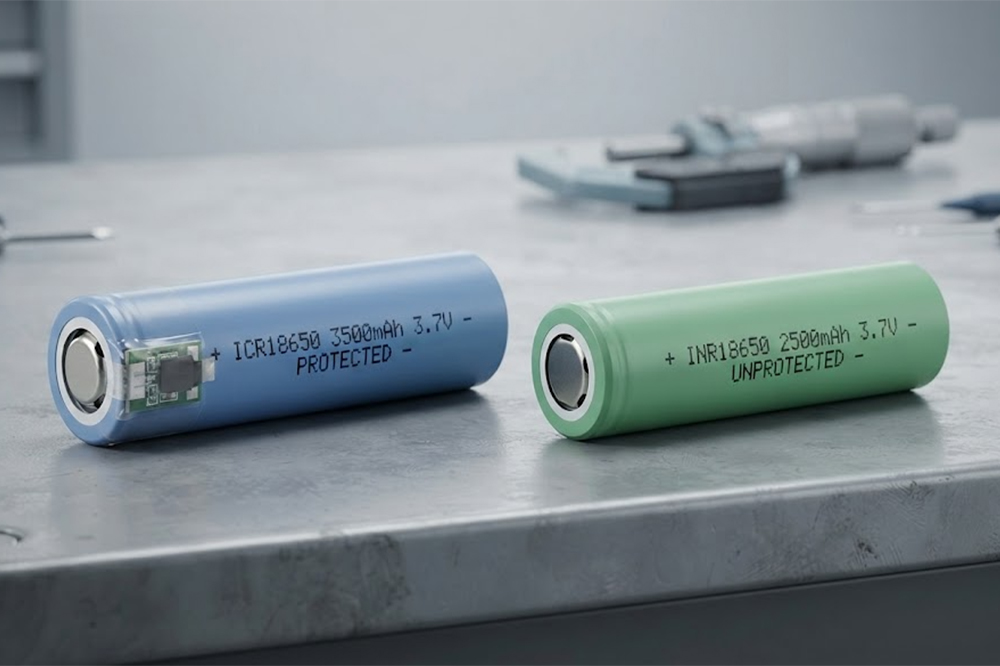
Protected and unprotected 18650 batteries are both widely used in portable electronics, flashlights, industrial equipment, power tools, and custom battery packs. They may look similar from the outside, but their internal construction and application requirements can be quite different.
The main difference is simple:
- A protected 18650 battery includes an additional protection circuit.
- An unprotected 18650 battery normally consists of the cell without an attached protection PCB.
This difference affects more than safety. It can also change the battery’s length, discharge performance, cost, installation method, and compatibility with the equipment.
For a replacement battery, the correct choice depends on the device’s design. For OEM battery pack, the decision must also consider the BMS, charger, cell arrangement, current demand, enclosure, and protection strategy.
What Is Protected 18650 Battery?
A protected 18650 battery contains a small protection circuit, often called a PCB, attached to the cell.
The circuit is usually designed to help protect against conditions such as:
- Overcharge
- Over-discharge
- Overcurrent
- Short circuit
The protection circuit monitors the cell voltage and current. When a specified abnormal condition occurs, it may disconnect the battery from the load or charger.
A protected battery may include:
- The 18650 cell
- A protection PCB
- Nickel connections
- An insulating layer
- PVC shrink wrap
- A raised positive terminal
- Sometimes a button-top structure
The protection circuit does not turn the battery into a completely risk-free product. It is one part of the battery’s safety system. Correct charging, suitable equipment, proper handling, and appropriate mechanical design are still necessary.
What Is Unprotected 18650 Battery?
An unprotected 18650 battery is generally a bare cell without an attached protection PCB.
It may still have:
- A metal casing
- An insulating ring
- PVC shrink wrap
- A flat-top or button-top terminal
- Internal safety features designed by the cell manufacturer
However, it normally does not include an external circuit that actively disconnects the cell during overcharge, over-discharge, or overcurrent conditions.
Unprotected cells are common in:
- Custom battery packs
- Battery packs using a separate BMS
- Power tools
- Industrial equipment
- High-current applications
- Products with an integrated protection system
An unprotected cell should not be treated as a complete standalone battery solution unless the equipment has the required protection and charging controls.

Protected vs Unprotected 18650 Batteries: Main Differences
| Feature | Protected 18650 Battery | Unprotected 18650 Battery |
|---|---|---|
| Protection PCB | Usually included | Usually not included |
| Overcharge protection | Provided by the protection circuit | Requires external protection |
| Over-discharge protection | Provided by the protection circuit | Requires external protection |
| Overcurrent protection | Usually included, depending on design | Requires external protection |
| Overall length | Often longer | Usually shorter |
| Discharge current | May be limited by the PCB | Depends mainly on the cell and external system |
| Cost | Usually higher | Usually lower |
| Pack integration | May be more difficult in compact packs | Often easier for custom pack assembly |
| Typical use | Standalone devices | Packs with a separate BMS |
| Mechanical compatibility | Must check length and terminal design | Must check cell and holder compatibility |
The exact features depend on the specific product. Some protected batteries have different protection thresholds, current limits, and physical dimensions.
How Does the Protection Circuit Work?
A protection PCB usually monitors the cell through a control circuit and switching components.
Depending on the design, it may disconnect the battery when:
Overcharge Occurs
The battery voltage rises above the permitted charging threshold. The protection circuit may stop the charging current.
Over-Discharge Occurs
The cell voltage falls below the permitted discharge threshold. The circuit may disconnect the load to reduce the risk of excessive discharge.
Overcurrent Occurs
The connected device draws more current than the protection circuit allows. The PCB may interrupt the current path.
A Short Circuit Occurs
A short circuit causes a rapid current increase. The protection circuit may disconnect the cell to limit the fault current.
The protection thresholds are not identical across all products. A protected battery designed for a flashlight may not be suitable for a high-current industrial application.

Does Protection Reduce Discharge Current?
It can.
The cell itself may be capable of delivering a certain current, but the attached protection PCB may have a lower current limit. The final battery rating is therefore affected by both the cell and the protection circuit.
For example, a cell may be designed for high-current use, while the protection board is designed for a lower current range. In that case, the protected battery cannot necessarily deliver the full current capability of the bare cell.
Buyers should check:
- Cell continuous discharge current
- Protection PCB continuous current
- Protection PCB peak current
- Overcurrent cutoff threshold
- Recovery method after protection activation
- Temperature conditions
- Wiring and contact resistance
For high-power applications, the protection circuit must be selected as carefully as the cell.
More information about current capability is available in our guide to 18650 battery discharge current.
Protected Battery Dimensions Can Be Different
One of the most common mechanical differences is length.
A bare 18650 cell is often close to 65mm long. A protected version may be longer because it includes:
- Protection PCB
- Additional nickel strip
- Extra insulation
- A button-top terminal
- Additional wrapping
The final length may vary between manufacturers and models. A protected 18650 battery may not fit a holder designed for a short flat-top cell.
Diameter can also change slightly because of the outer wrap and protection construction.
Before ordering, confirm:
- Overall length
- Maximum diameter
- Terminal type
- Protection PCB position
- Wrap thickness
- Wire or tab extension
- Holder compatibility
For more information, see our article about 18650 battery dimensions.

Flat-Top and Button-Top Protection Designs
Protected batteries are available in different terminal configurations.
Protected Flat-Top 18650 Battery
A protected flat-top battery may be used in certain custom devices or holders. The protection PCB can be integrated into the cell structure while maintaining a relatively flat positive terminal.
Protected Button-Top 18650 Battery
A protected button-top battery has a raised positive terminal. It is common in flashlights and devices that require a raised contact.
The raised terminal may improve contact in some equipment, but it also increases the overall length.
A battery holder designed for a flat-top cell may not work correctly with a protected button-top version. The reverse can also be true if the holder relies on a raised terminal for reliable contact.
Review our guide to flat-top vs button-top 18650 batteries before selecting a replacement or holder.
When Is Protected 18650 Battery Useful?
Protected batteries may be useful when the device does not include a suitable battery management system.
Typical examples include:
- Some flashlights
- Portable electronic devices
- Certain low-current instruments
- Standalone battery holders
- Equipment designed specifically for protected cells
In these applications, the protection circuit may provide additional layer of control against abnormal charging or discharging conditions.
However, the device must still use a compatible charger and charging method. A protection PCB cannot correct an unsuitable charger or defective equipment.
When Is an Unprotected 18650 Battery More Suitable?
Unprotected cells are often selected for battery packs that already include a dedicated BMS or another suitable protection system.
Common applications include:
- E-bike battery packs
- Power tool battery packs
- Industrial battery systems
- Portable power stations
- Robotics equipment
- Custom OEM battery packs
- High-current battery assemblies
Using unprotected cells can make pack design more flexible because the engineer can select:
- A separate BMS
- A specific continuous current rating
- A suitable balance function
- A custom protection threshold
- A suitable physical arrangement
- A high-current connection system
The BMS must be designed for the number of series cells, the battery chemistry, the charging voltage, the continuous current, and the expected peak current.
Protected Cell vs Pack-Level BMS
A protected single cell and a battery pack with a BMS are not the same thing.
Protection on an Individual Cell
A protected 18650 battery normally has a small protection circuit attached to one cell. It may be suitable for a standalone application.
BMS on a Battery Pack
A pack-level BMS may monitor multiple cells and manage:
- Overcharge
- Over-discharge
- Overcurrent
- Short circuit
- Cell balancing
- Temperature
- Pack-level voltage
A multi-cell battery pack generally requires a protection and monitoring system designed for the complete series configuration.
Using several individually protected cells does not automatically replace a properly designed multi-cell BMS. The protection circuits may not coordinate correctly, and the final pack may have unwanted dimensional, electrical, or thermal issues.

Protected Batteries and Series Connections
When cells are connected in series, their voltages add together. The protection strategy must account for every cell in the series group.
For example, a 4S pack contains four cells or cell groups connected in series. A suitable pack-level BMS should monitor the individual series groups rather than only the total pack voltage.
Potential concerns include:
- Uneven cell voltage
- Different protection activation points
- Unbalanced charging
- Unexpected cutoff
- Inconsistent recovery behavior
- Additional resistance from individual protection boards
For custom battery pack manufacturing, it is generally better to define the protection architecture at the pack level rather than combining unrelated protected cells without engineering validation.
How Protection Affects Capacity and Energy
The protection PCB does not normally increase the cell’s actual capacity. The cell capacity remains determined by the cell’s electrochemical design and test conditions.
However, protection may affect usable energy in practical operation.
For example:
- The PCB may disconnect the load before the cell reaches the supplier’s laboratory cutoff.
- The PCB may limit current during a high-load event.
- Additional resistance may increase voltage drop.
- A longer protected cell may require a different pack arrangement.
For a better understanding of capacity, review 18650 battery capacity and discharge performance.
For energy calculations, see 18650 battery energy and runtime.
Safety Considerations
Both protected and unprotected 18650 batteries require correct handling.
Do Not Use an Unprotected Cell Without Suitable Protection
An unprotected cell should be used only in equipment or battery packs designed to manage charging, discharging, and fault conditions.
Do Not Assume Every Protected Battery Is Suitable
Protection boards have different current ratings and cutoff thresholds. A protected cell designed for a low-current device may not work correctly in a high-current application.
Avoid Mixing Different Cell Types
Do not casually mix:
- Protected and unprotected cells
- Different capacities
- Different chemistries
- Different ages
- Different internal resistance levels
- Cells from unrelated production batches
Check Charger Compatibility
The charger must match the battery chemistry, series configuration, charging voltage, and charging current.
Protect the Cell Wrap
Damage to the outer insulation can create a short-circuit risk. Cells should be inspected before installation.
Avoid Excessive Heat
High temperature can affect both the cell and the protection PCB. The complete battery system should be evaluated under realistic operating conditions.
How Buyers Should Select Between Protected and Unprotected Cells
The selection process should start with the equipment rather than the battery label.
Choose a Protected Cell When:
- The device is designed for a protected cell
- There is no suitable external protection system
- The required current is within the PCB rating
- The available space supports the longer cell
- The charger and device are compatible
- The terminal type matches the holder
Consider an Unprotected Cell When:
- The battery pack includes a suitable BMS
- The application requires higher current
- The pack needs a compact cell arrangement
- The protection system is designed at the pack level
- The OEM design requires custom voltage, capacity, and current
- The cell must be welded into a custom assembly
The final decision should be based on electrical, mechanical, and safety requirements together.
What OEM and Wholesale Buyers Should Ask Suppliers
Before placing a bulk order, request the following information.
Cell Information
- Cell chemistry
- Nominal capacity
- Nominal voltage
- Full-charge voltage
- Continuous discharge current
- Peak discharge current
- Internal resistance
- Operating temperature
- Cell weight
Protection PCB Information
- Overcharge protection voltage
- Over-discharge protection voltage
- Overcurrent protection threshold
- Short-circuit protection response
- Continuous current rating
- Peak current rating
- PCB dimensions
- Recovery method
- Operating temperature
Mechanical Information
- Overall length
- Maximum diameter
- Terminal type
- Flat-top or button-top structure
- PVC wrap dimensions
- Wire or tab position
- Protection board location
- Product drawing
Quality and Documentation
- Capacity test data
- Internal resistance test data
- Protection function test results
- Batch consistency
- Safety documentation
- Sample approval process
- Packaging and shipping requirements
For OEM projects, the supplier should confirm whether the cell is intended for standalone use or integration into a custom battery pack.

Common Mistakes
Mistake 1: Assuming Protected Means Higher Quality
Protection and cell quality are different factors. A protected cell can still have poor capacity, high internal resistance, or unsuitable discharge performance.
Mistake 2: Ignoring the Protection PCB Current Limit
The cell may have a high current rating, but the protection circuit may limit the final output.
Mistake 3: Assuming All Protected Cells Have the Same Size
Different PCB structures, terminal designs, and wraps can produce different dimensions.
Mistake 4: Using Protected Cells in a Pack Without Checking the Design
A multi-cell pack requires coordinated protection and monitoring. Individual protection boards may not replace a suitable BMS.
Mistake 5: Selecting by Capacity Alone
Capacity, discharge current, dimensions, protection, and application requirements must be considered together.
Mistake 6: Forgetting the Charger
A suitable battery still requires a charger designed for the correct chemistry and voltage configuration.
Final Thoughts
Protected and unprotected 18650 batteries serve different purposes.
A protected 18650 battery includes an additional circuit that can help control overcharge, over-discharge, overcurrent, and short-circuit conditions. It may be useful in certain standalone devices, but the protection PCB can increase the battery’s length and limit its current capability.
An unprotected 18650 cell is often preferred for custom battery packs that use a properly designed BMS. It can offer more flexibility for high-current applications, compact layouts, and OEM battery manufacturing, but it must be integrated into a suitable protection and charging system.
Before purchasing, compare the cell specifications, protection design, dimensions, current rating, charger compatibility, and intended application. For wholesale and OEM requirements, explore our 18650 lithium battery cells for different capacity, voltage, discharge-current, and custom battery pack applications.
-

12V 4400 mah Lithium ion 3S2P 18650 Battery Pack
-

18650 2000mAh 3.7 volt Lithium-ion Battery
-

18650 20V 3.0Ah Cordless Drill battery
-

18650 22.2V 7.8Ah 2600Mah 6S3P Rechargeable Battery Pack
-

18650 2600mAh Rechargeable Lithium-Ion Battery 3.7V
-

18650 3.7V 10Ah Li-Ion Power Battery Pack
-

18650 3.7V 3300mah Rechargeable Lithium ion Battery
-

18650 7S7P 24V 14Ah Lithium ion Electric Scooter Battery Pack
-

18650 battery 3.7V 1500mAh Lithium-Ion Battery
-

18650 Battery 3500 mah Rechargeable Battery Cells
-

18650 Electric Scooter 48V 13000mAh Lithium Battery
-

2600mAh 3S1P 11.1V 18650 Battery Packs
-

3.7V Li ion Rechargeable 3000mah 18650 Battery Cell
-

36V 5200mAh 10S2P 18650 Battery Pack
-

48v 4400mah 13S2P 18650 Rechargeable Battery Pack
-

7S2P 24V 18650 Lithium Battery Pack
-

Electric Scooter 36V 4400mAH 10S2P 18650 Battery Pack
-

ICR 18650 Battery 2200mah 3.7V
Leave a Reply