
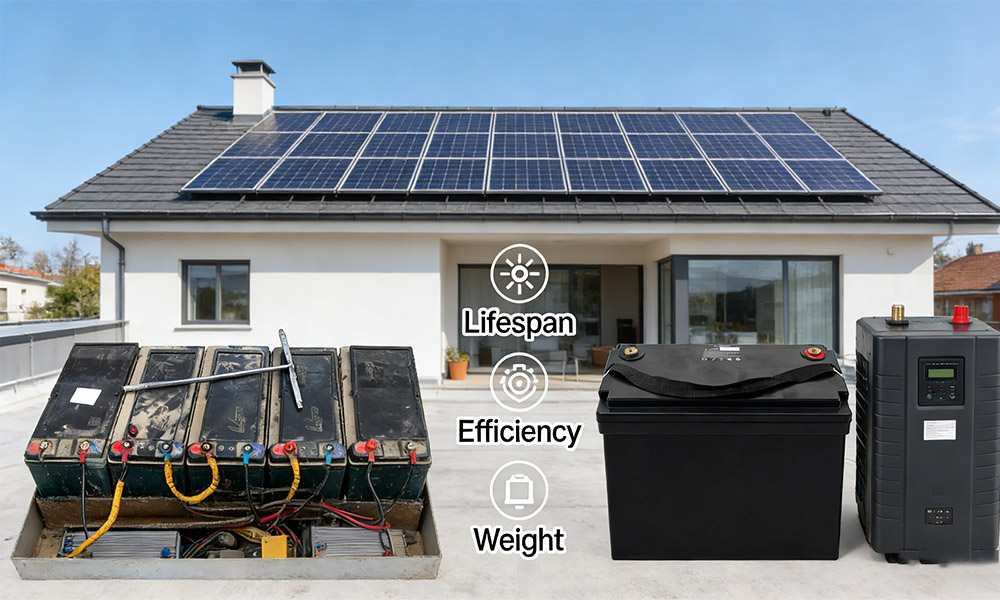
Anyone planning a home energy storage system eventually lands on the same question: stick with traditional lead-acid, or move to lithium batteries?
Both still exist in the market for a reason. Lead-acid has been around forever and feels familiar. Lithium, especially LiFePO4, has become the default choice in modern solar storage. But when you look at real home use — daily cycling, backup power, and long-term reliability — the difference becomes pretty clear.

Why Lead-Acid Still Shows Up in Solar Setups
Lead-acid batteries earned their reputation decades ago. They’re cheap upfront, easy to find, and most installers understand them well. For small off-grid cabins or very occasional backup use, they can still work.
But home energy storage isn’t just about storing power anymore. Most systems now charge and discharge daily. That’s where lead-acid starts to show its age.
Cycle life is limited. Even good deep-cycle lead-acid batteries may only last a few hundred to around 800 cycles before capacity drops sharply. They’re also heavy, require ventilation, and need careful charging to avoid damage. Over-discharge once or twice, and lifespan shortens fast.
In real household use, many homeowners find themselves replacing lead-acid banks every few years. What looks cheaper at the start often costs more over time.
Why Lithium Batteries Are Taking Over Home Storage
Lithium batteries — especially LiFePO4 — weren’t always the obvious choice. A few years ago, cost kept them out of reach for many homeowners. That has changed quickly.
Modern LiFePO4 batteries are designed for daily cycling. They handle deep discharge without damage, recharge faster, and maintain stable voltage throughout use. In practical terms, that means lights stay bright, inverters run smoothly, and stored solar energy is actually usable.
Cycle life is the biggest shift. A quality LiFePO4 home storage battery can easily deliver 4000–6000 cycles. For a household running daily solar charge and nightly discharge, that can translate into 8–12 years or more of service.
Maintenance is another difference people notice immediately. No water refilling, no acid corrosion, no ventilation requirements. Once installed, lithium systems are largely hands-off.

Efficiency Matters More Than Most People Expect
One detail often overlooked is efficiency.
Lead-acid batteries typically deliver around 70–80% usable energy after charge and discharge losses. Lithium batteries often reach 95% or higher. Over months and years, that gap adds up. More of the solar energy generated during the day actually gets used at night.
For grid-tied homes trying to reduce electricity bills or increase energy independence, higher efficiency directly affects savings.
A Practical Example: 12V 100Ah LiFePO4 Solar Battery
For homeowners or installers looking for a straightforward upgrade from lead-acid, a 12V 100Ah LiFePO4 battery is often the starting point.
The 12V 100Ah LiFePO4 solar battery is built specifically for residential solar storage and backup systems. It delivers stable output for inverters, supports deep cycling, and fits easily into existing 12V or 24V setups that previously used lead-acid.
Compared with a typical 12V 100Ah lead-acid battery, the usable capacity is significantly higher. Lead-acid users often only access about 50% of rated capacity to protect lifespan. LiFePO4 allows 80–90% usable energy without shortening battery life. In real use, one lithium battery can replace multiple lead-acid units.
Weight and installation are easier as well. A LiFePO4 battery of this size is far lighter than an equivalent lead-acid bank, making wall or rack installation simpler for home systems, RV solar setups, and small off-grid storage rooms.

Long-Term Cost vs Upfront Cost
It’s true that lithium batteries still cost more at the beginning. But home energy storage isn’t a short-term purchase.
When calculating total cost over five to ten years, lithium usually comes out ahead. Fewer replacements, higher usable capacity, better efficiency, and minimal maintenance all contribute to lower long-term cost per kWh stored.
That’s why most new residential solar installations — and nearly all system upgrades — are moving toward LiFePO4 instead of expanding lead-acid banks.
So Which Is Better for Home Energy Storage?
If the goal is the lowest upfront cost and very occasional use, lead-acid can still work. For cabins, emergency backup used once or twice a year, or extremely tight budgets, it remains a viable option.
But for real home energy storage — daily solar use, backup reliability, and long service life — lithium batteries have become the clear choice. They store more usable energy, last far longer, and require almost no maintenance.
For homeowners planning a system that will run for years without constant battery replacement, LiFePO4 has quietly become the new standard.


Leave a Reply