
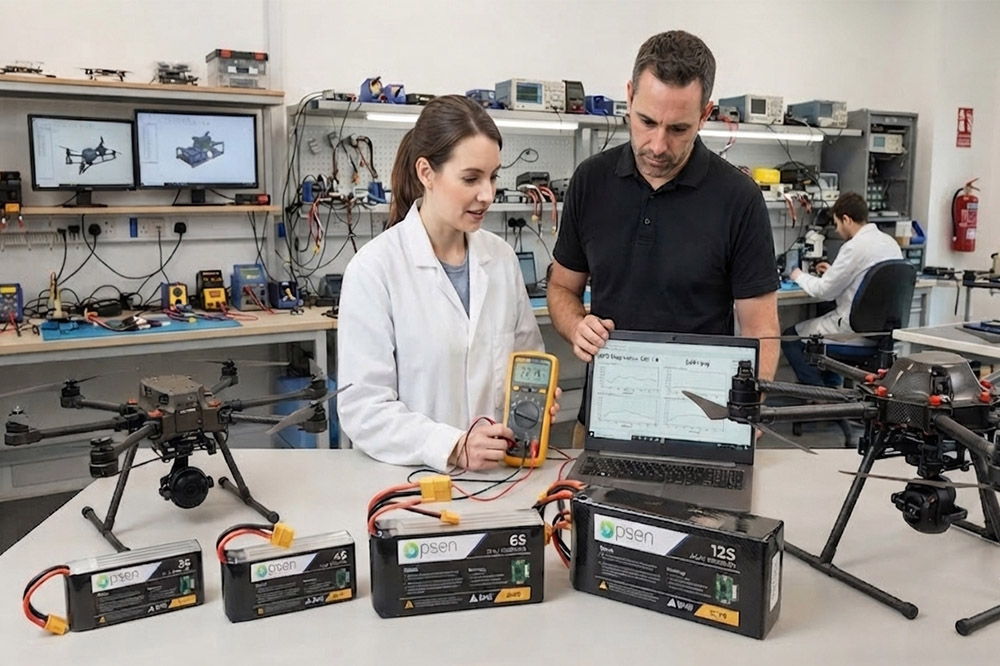
How to Choose the Right Voltage and Capacity for a UAV Battery?
When drone manufacturer starts designing a new UAV, battery selection is usually not as simple as choosing the largest capacity available.
A common question from buyers is:
“Can we just use a bigger battery to get longer flight time?”
Sometimes yes, but sometimes the result is the opposite.
A larger battery means more energy, but it also means more weight. The motors need more power to carry that weight, and the efficiency balance can change.
This is something we often see during battery development projects. A customer initially focuses on capacity numbers, but after testing the prototype, they realize voltage, current output, and battery weight are equally important.
For UAV applications, choosing the right battery is more like matching the battery with the entire aircraft system.
Why UAV Battery Voltage Matters More Than Many Buyers Expect

Voltage determines how much electrical power the battery system can deliver to the drone.
In simple terms:
Higher voltage can help the motor system achieve better efficiency and support larger UAV platforms.
This is why small drones and industrial drones often use different battery configurations.
Common UAV battery configurations include:
3S Battery Pack
Nominal voltage: around 11.1V
Often used for:
- Small drones
- Hobby UAVs
- Lightweight applications
4S Battery Pack
Nominal voltage: around 14.8V
Common for:
- FPV drones
- Medium-size UAVs
- High-performance applications
6S Battery Pack
Nominal voltage: around 22.2V
Often selected for:
- Professional drones
- Higher power motors
- Larger payload systems
12S and Higher Voltage Packs
Used in:
- Agricultural drones
- Industrial UAVs
- Heavy payload platforms
For commercial UAV manufacturers, selecting voltage early in the design stage is important because it affects:
- Motor selection
- ESC compatibility
- Wiring design
- Battery structure
Battery Capacity: More mAh Does Not Always Mean Better
Battery capacity is usually measured in mAh or Ah.
Many customers compare batteries by looking at this number first.
For example:
“Battery A is 10,000mAh. Battery B is 15,000mAh. So B must be better.”
Not necessarily.
The actual flight performance depends on the whole system.
A higher-capacity battery can provide longer operation time, but it also increases:
- Battery weight
- Drone load
- Motor workload
A practical UAV battery design needs a balance.
For example:
A small inspection drone may perform better with a lightweight battery that provides 35 minutes of flight.
A larger agricultural drone carrying liquid payload may need a much bigger battery because the mission requirement is different.
How Do UAV Manufacturers Estimate Required Battery Capacity?
The basic idea is to match battery energy with power consumption.
Battery energy depends on:
- Voltage
- Capacity
For example:
A 22.2V battery with 10Ah capacity provides around 222Wh of energy.
If the drone consumes about 300W during flight, the theoretical flight time is limited by the available energy.
However, real flight time is always shorter because of:
- Motor efficiency
- Wind conditions
- Payload changes
- Battery aging
- Temperature
In real projects, engineers usually leave some margin instead of designing right at the limit.
Choosing Battery Voltage Based on UAV Application
Different drones have different requirements.
Consumer and FPV Drones
Usually focus on:
- Fast response
- Lightweight design
- High discharge performance
Common choices:
- 3S
- 4S
- 6S LiPo batteries
Mapping and Survey Drones
Usually need:
- Stable operation
- Longer flight time
- Reliable battery performance
Common choices:
- Li-ion battery packs
- 18650 or 21700 cells
Agricultural Drones
Agricultural UAVs are a good example of why battery selection is not simple.
A spraying drone may start with a heavy payload and become lighter during operation.
The battery needs to handle changing conditions.
Typical requirements:
- High voltage
- High discharge capability
- Large capacity
Many agricultural drones use higher-voltage lithium battery packs.
18650, 21700, or LiPo: Which Battery Capacity Solution Is Better?

The battery chemistry and cell format also influence capacity design.
LiPo Battery
Good for:
- High current demand
- Fast acceleration
- Lightweight drones
18650 Lithium-ion Battery Pack
Good for:
- Stable production
- Cost control
- Medium endurance UAVs
21700 Lithium-ion Pack
Good for:
- Longer flight time
- Higher energy density
- Commercial UAV projects
There is no universal winner.
A drone designed for racing and a drone designed for inspection are solving completely different problems.
What Factors Should UAV Manufacturers Consider Before Selecting Battery Capacity?
Before ordering batteries in bulk, manufacturers should look beyond capacity numbers.
Important questions include:
What is the Drone Weight?
A lightweight drone and a heavy industrial UAV require different battery strategies.
What Is the Payload?
More payload usually requires:
- Higher energy storage
- Better discharge capability
How Long Should It Fly?
A 15-minute flight and a 60-minute flight require very different battery designs.
What Space Is Available?
Battery dimensions often become a limitation.
Custom battery packs may require:
- Special shape
- Custom connectors
- Different cell arrangement
Custom UAV Battery Pack Design for OEM Drone Projects
For many UAV manufacturers, the final battery is not an off-the-shelf product.
The battery supplier may need to help with:
- Cell selection
- Voltage configuration
- Capacity calculation
- BMS development
- Prototype testing
For example, a customer developing an industrial inspection drone may need a compact 12S lithium battery pack that fits a limited internal space.
The challenge is not only making the battery powerful.
It is making the battery fit the aircraft.
What Should Buyers Ask Before Purchasing UAV Batteries?
When looking for a UAV battery supplier, it is worth checking:
- Can you customize voltage and capacity?
- Which battery cells are used?
- What is the discharge capability?
- How is battery consistency tested?
- Can you provide certification documents?
- Can you support prototype development?
A battery supplier with OEM experience can often help reduce trial-and-error during drone development.
Final Thoughts
Choosing UAV battery voltage and capacity is not simply about selecting the biggest battery.
The correct design depends on the drone’s purpose, motor system, payload, and operating environment.
A well-designed UAV battery is usually the result of balancing power, weight, endurance, and reliability.
For drone manufacturers planning new products, working with an experienced lithium battery supplier during the early design stage can make the development process much smoother.


Leave a Reply