
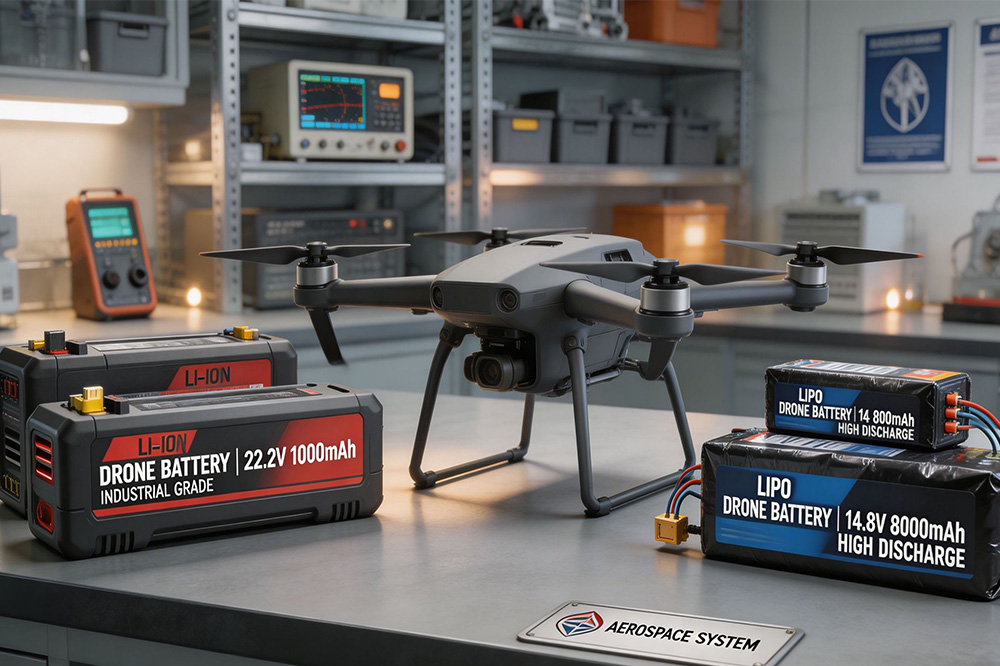
For industrial drone manufacturers, choosing between Li-ion and LiPo batteries is no longer a simple technical decision.
The battery directly affects:
- Flight endurance
- Payload capability
- Aircraft weight
- Heat generation
- Charging efficiency
- Long-term operating cost
And as commercial UAV applications continue expanding, battery selection has become one of the biggest differences between drone platforms built for endurance and those designed for heavy lifting.
The truth is, neither Li-ion nor LiPo is universally “better.”
They are built for different operating priorities.
Why Industrial UAVs Use Different Battery Types
Commercial drones operate under very different workloads.
A mapping UAV flying for two hours has completely different power demands compared to:
- Agricultural spraying drones
- Cargo delivery UAVs
- Inspection aircraft
- Heavy-lift industrial drones
Some projects need:
- Maximum flight time
- Lower power consumption
- Stable cruising efficiency
Others require:
- High burst discharge
- Strong lift capability
- Rapid acceleration
That’s where the difference between Li-ion and LiPo becomes important.
Several industrial UAV battery systems are now developed specifically around either endurance-focused or high-discharge aircraft platforms.

Li-ion Batteries Focus More on Endurance
Li-ion batteries are widely used in long-range UAV projects because of their higher energy density.
In simple terms, they can store more energy relative to their weight.
That makes them popular for:
- Fixed-wing UAVs
- Mapping drones
- Surveillance aircraft
- VTOL endurance platforms
The main advantage is longer flight duration.
For industrial UAV operations, longer endurance usually means:
- Fewer landings
- Reduced battery swaps
- Better coverage efficiency
Especially on long inspection routes or mapping missions, endurance matters much more than aggressive acceleration.
LiPo Batteries Deliver Higher Power Output
LiPo batteries are different.
They are designed to provide high discharge current very quickly.
That makes them common in:
- Agricultural spraying drones
- Heavy-lift UAVs
- Cargo drones
- Multirotor industrial platforms
These aircraft often require strong instant power during:
- Takeoff
- Climbing
- Payload lifting
- Rapid maneuvering
LiPo batteries handle these high current demands better than most Li-ion setups.
That’s why many heavy payload commercial drones still rely heavily on LiPo systems despite shorter endurance.
Energy Density Changes Aircraft Efficiency
One reason Li-ion batteries are attractive for endurance UAVs is weight efficiency.
Higher energy density helps:
- Reduce aircraft weight
- Improve cruising efficiency
- Extend flight time
On long-range drones, small weight reductions create noticeable improvements in endurance.
This becomes especially important on:
- Fixed-wing aircraft
- VTOL cruise platforms
- Long-distance inspection drones
LiPo batteries usually carry more weight for the same stored energy, but compensate through stronger discharge capability.
Discharge Rate Is One of the Biggest Differences
Discharge rate is where LiPo batteries usually have the advantage.
Heavy-lift industrial drones often generate sudden current spikes during:
- Vertical takeoff
- Payload lifting
- Aggressive maneuvering
LiPo batteries are better suited for handling these rapid power demands.
Li-ion batteries can struggle under extremely high discharge conditions unless specifically engineered for industrial UAV use.
That’s why many commercial drone battery manufacturers now develop hybrid battery solutions balancing endurance and power output together.

Thermal Performance Matters in Real Operations
Heat management affects both battery lifespan and flight stability.
LiPo batteries typically generate more heat during:
- High-current discharge
- Heavy payload operation
- Aggressive flight patterns
Li-ion batteries generally operate more efficiently during steady long-duration cruising.
However, both battery types still require proper:
- Cooling design
- Thermal protection
- Charging management
especially in industrial UAV environments with:
- High outdoor temperatures
- Continuous operation
- Fast charging cycles
Flight Style Often Determines Battery Choice
Battery selection usually follows aircraft mission type.
Li-ion Is Commonly Preferred For:
- Long-endurance flights
- Mapping missions
- Surveillance UAVs
- Inspection routes
- Fixed-wing drones
LiPo Is Commonly Preferred For:
- Agricultural spraying drones
- Heavy-lift UAVs
- Cargo transport drones
- High-thrust multirotors
- Fast-response industrial drones
In many commercial UAV projects, the battery is selected around the mission profile rather than simply maximizing specifications.
Charging Characteristics Are Different Too
Charging workflow becomes important for large UAV fleets.
Li-ion batteries usually:
- Charge more steadily
- Support longer cycle life
- Handle storage better
LiPo batteries:
- Often support faster high-current discharge
- May require more careful charging management
- Can degrade faster under repeated stress
Industrial drone operators usually balance:
- Flight efficiency
- Charging speed
- Battery lifespan
- Daily operational workflow
instead of focusing on only one factor.
Safety and Battery Management Systems Matter
Modern industrial UAV battery systems rely heavily on smart BMS technology regardless of chemistry type.
Commercial drone operators increasingly expect:
- Temperature monitoring
- Voltage balancing
- Health diagnostics
- Remaining power estimation
- Fault protection
Several high capacity UAV battery platforms now integrate intelligent communication directly with UAV flight systems for safer fleet operation.
Battery chemistry alone is no longer the only factor affecting reliability.
Cost Is Not Just About Initial Purchase Price
Li-ion batteries often cost more initially for industrial UAV applications.
But they may provide:
- Longer cycle life
- Better endurance efficiency
- Lower long-term replacement frequency
LiPo systems may offer:
- Stronger power delivery
- Better lifting performance
- Lower upfront cost in some cases
Commercial UAV companies usually evaluate:
- Cost per flight hour
- Maintenance requirements
- Battery lifespan
- Operational efficiency
rather than comparing only purchase price.

Some Industrial UAVs Use Hybrid Approaches
Interestingly, many advanced UAV platforms no longer rely entirely on one battery type.
Some manufacturers combine:
- High-energy cells
- High-discharge configurations
- Smart power management systems
to balance:
- Endurance
- Payload capability
- Thermal stability
- Operational flexibility
As industrial UAV applications become more specialized, battery system design is becoming much more application-specific.
Final Thoughts
Li-ion and LiPo batteries are built for different industrial UAV priorities.
Li-ion systems usually perform better for:
- Long endurance
- Efficient cruising
- Extended missions
LiPo systems are often stronger for:
- High discharge demands
- Heavy payload lifting
- Aggressive flight performance
For commercial drone manufacturers, the best battery choice depends more on aircraft mission requirements than on marketing specifications.
And as industrial UAV technology continues evolving, battery design is becoming one of the most important parts of overall drone performance.
Before comparing Li-ion and LiPo drone batteries, it is important to understand why LiPo technology became widely used in UAV systems. The reason is not only capacity but also discharge performance and weight advantages. Learn more about the role of LiPo batteries in drones here: Why Are LiPo Batteries Used in Drones?


Leave a Reply