
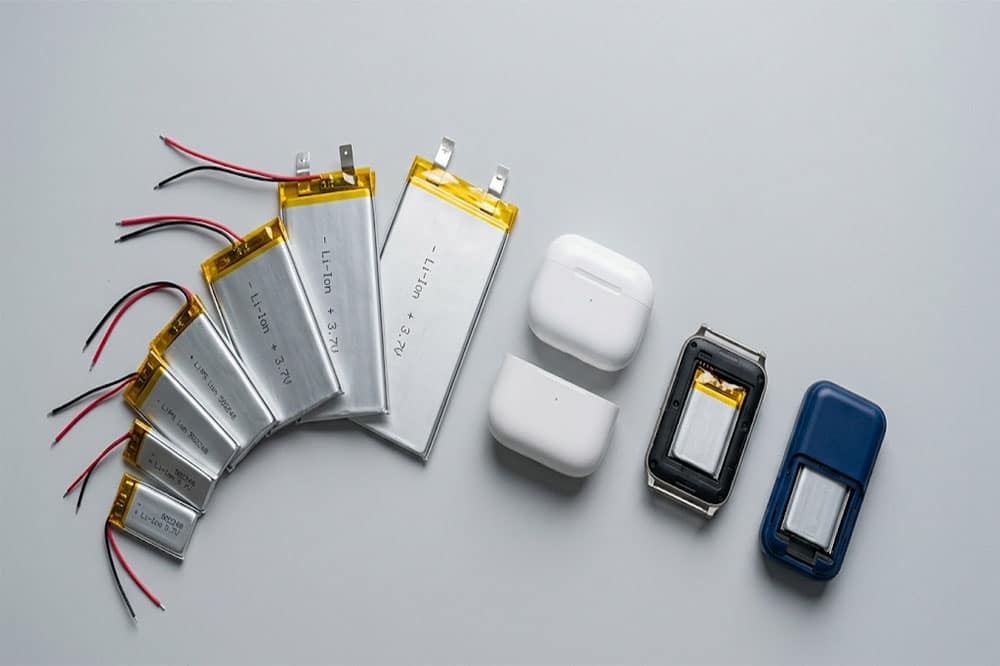
Every portable product starts with the same constraint: the battery has to fit whatever space the industrial design team left, and it has to last a full working day. Cylindrical cells handle the first problem badly in slim devices. Prismatic cells waste margin on rigid steel casings. That gap is why lithium ion pouch cells now sit inside most earbuds, smartwatches, trackers, and smart cards shipped today.
A pouch cell is a lithium ion cell sealed in a laminated aluminum pouch instead of a hard can. Without the metal shell, manufacturers can build cells a few millimeters thick, in nearly any footprint, with the energy density that comes from not carrying dead weight. For device makers, though, the format raises its own questions: how do you size a cell against your load profile, which chemistry fits your product, and what should you verify before committing to a bulk order? This guide works through those decisions in the order they usually come up in a real project.
Why the Pouch Format Suits Portable Devices
Space efficiency in tight housings
A 502248 cell measures 5 mm thick, 22 mm wide, and 48 mm long — dimensions chosen to fill a specific cavity, not to suit a production line. That is the core advantage. A supplier offering the pouch cell battery category in standard sizes from 502248 up to large-format cells, plus custom dimensions, lets engineers design the housing around the electronics rather than around an off-the-shelf cylinder. In earbuds charging cases and card-format devices, that flexibility is often the difference between a product that fits and one that doesn’t.
Weight and energy density
The aluminum laminate shell weighs a fraction of a steel can. For a device worn on the body all day — a hearing aid, a medical sensor, a fitness band — every gram shows up in the user experience. Pouch cells deliver roughly 10–15% better gravimetric energy density than the equivalent cylindrical cell, which translates directly into either lighter products or longer runtime in the same weight budget.

Matching Cell Specifications to Your Device
Capacity: start from runtime, work backward
List what the device draws in standby, active use, and transmission bursts. Multiply the average draw by your target hours, add 20% for aging and cold-weather derating, and you have a minimum capacity. A Bluetooth tracker pulling 15 µA in sleep and 80 mA during transmission, targeted at 6 months of battery life, lands comfortably on a small cell like the 3.7V 700mAh Li-polymer pouch cell. A power bank or portable speaker needs the next class up — something in the range of the 3.7V 2000mAh pouch cell battery is the mainstream choice for that segment.
Discharge rate and load profile
Capacity ratings get all the attention; discharge capability causes most field failures. A cell that delivers 1200 mAh at 0.2C may sag badly under a 2C pulse, tripping the low-voltage cutoff during a radio transmission burst. Check the datasheet’s continuous and pulse discharge ratings against your worst-case load, not your average. For high-drain applications — RC devices, portable instruments, anything with a motor — a larger cell such as the 134365 4500mAh 3.7V rechargeable lithium polymer battery holds voltage far better under load than a small cell pushed to its limit.
Operating temperature and cycle life
Consumer-grade pouch cells typically carry a 0–45°C charge window and a −20–60°C discharge window. Devices that live outdoors, or that charge inside a car, need cells qualified beyond those limits. Ask for cycle-life data at your actual operating temperature, not the standard 25°C test condition. A supplier who publishes swelling and cycle data on request — as part of standard documentation rather than a special favor — is telling you something useful about their quality system.
Chemistry: NMC vs LCO for Smart Devices
Two chemistries dominate the portable segment. LCO (lithium cobalt oxide) offers high volumetric density and stable discharge curves, which suits low-drain compact devices: smart cards, hearing aids, small trackers. NMC (nickel manganese cobalt) trades a little volumetric density for better thermal stability and higher discharge rates, which fits Bluetooth audio, GPS trackers with frequent transmissions, and anything with a display that stays on.
If your device sits between those profiles, our article on NMC vs LFP pouch cells breaks down the chemistry trade-offs in detail. Chemistry is not a spec to delegate to the supplier — it changes safety behavior under abuse conditions, and it changes your certification path.

Protection: Bare Cells, PCM, or Full BMS
Almost no portable device should run a bare pouch cell. At minimum you need a PCM (protection circuit module) guarding against overcharge, over-discharge, overcurrent and short circuit. Multi-cell designs need balancing, which moves you toward a BMS. For single-cell smart devices, many buyers specify the PCM integrated at the pack level — for example, ordering a finished 3.7V 1200mAh Li-polymer pouch cell battery with wire and connector termination to their board, rather than handling bare cell assembly in-house.
Two practical notes. First, the PCM’s cutoff thresholds must match your cell’s datasheet, not a generic value; mismatched thresholds are a common cause of “battery died early” complaints. Second, if your product combines multiple cells, read our guide on how pouch batteries are connected in series and parallel before finalizing the pack topology — series counts change your voltage class and your certification scope.
Quality Inspection Before You Commit to Volume
Sample units always look good. The batch is what matters. Before releasing a purchase order, run or request:
- Capacity grading — every cell in the sample batch graded and matched within a tight tolerance band, so cells in one shipment age together
- Internal resistance matching — mismatched IR between cells creates uneven load sharing and early failure
- Swelling test data — pouch cells expand over cycle life; you need to know how much, at what cycle count, so your housing tolerances account for it
- Certification documents — UN38.3 test summary and MSDS for freight, IEC 62133 where your market requires it
Our detailed walkthrough, Lithium Ion Pouch Cell Quality Inspection: What Should Buyers Check?, covers each of these with the specific values buyers should demand. For the safety engineering side — what causes thermal events in pouch cells and how design choices mitigate them — see the companion article on pouch cell safety risks and design considerations.

A Sourcing Checklist for Device Manufacturers
When you evaluate a pouch cell supplier for portable electronics, weight these factors in roughly this order:
- Batch traceability. Date codes and lot numbers on every shipment, so any field issue maps to a production run. Without this, quality problems are unfixable.
- Certification scope per model. Not “the factory has UN38.3” — the specific model you are buying does.
- Sample policy. Can you buy 10–50 units of the exact SKU before committing? Sample-first programs cut development risk dramatically.
- Custom sizing capability. If your housing needs a non-standard footprint, confirm the supplier supports custom dimensions and what tooling MOQ that implies.
If catalog sizes don’t fit your enclosure, read what OEM manufacturers can customize on a lithium ion pouch cell — dimensions, chemistry, tabs and protection are all specifiable.
- Documentation quality. Datasheets with real discharge curves, cycle-life data, and swelling data — not marketing tables.
Apsenx covers all five: capacities from 300 mAh to 15,000 mAh, NMC and LCO options, UN38.3 and IEC 62133 support per model, MOQ from 1,000 pcs with sample quantities available, and in-house pack assembly with PCM/NTC/PTC integration. If you are building wearable-class products specifically, the design and selection guide for pouch cells in wearable devices goes deeper on the skin-contact and miniaturization constraints that segment adds. And if you are new to the format entirely, start with what a pouch cell battery is, then read the practical buyer’s guide for battery wholesalers for MOQ, pricing tiers and supplier vetting.
Frequently Asked Questions
Space and weight. A pouch cell can be made a few millimeters thick in almost any footprint, filling cavities a cylindrical cell would leave empty. The laminate shell also removes dead weight, giving roughly 10–15% better energy density per gram — directly useful in devices worn on the body or carried in a pocket.
Work backward from runtime. Measure the device’s average current draw across standby, active, and transmission states, multiply by target hours, and add about 20% margin for aging and temperature derating. Small trackers and smart cards typically land at 300–800 mAh; speakers, power banks and display-heavy devices need 1500–5000 mAh.
Yes. UN38.3 test summary and MSDS documents are required for air and sea freight on every model, regardless of size. Many markets additionally require IEC 62133 compliance for cells in consumer products — confirm this per model with your supplier, not just at factory level.
Most established manufacturers support custom dimensions, usually with a higher MOQ for tooling. If your housing is flexible, check the supplier’s standard size list first — sizes like 502248 or 134365 exist because many devices converge on them, and standard sizes avoid tooling cost and lead time entirely.
Order 10–50 samples of the exact SKU, then check capacity grading and internal resistance matching across the batch, request swelling and cycle-life data at your operating temperature, and verify the certification documents name the specific model. A structured inspection protocol is laid out in our quality inspection guide for buyers.
Lithium Ion Pouch Cells
-

11.1V 3S 850mAh li-ion Polymer Pouch Cell Battery Pack
-

134365 4500mAh 3.7V Rechargeable Lithium Polymer Battery
-

3.7V 1200mAh Li-Polymer Pouch Cell Battery
-

3.7V 15Ah 148198 Pouch Lithium Ion Battery
-

3.7V 1S2P 3000mah lithium Polymer Battery
-

3.7V 2000mAh Pouch Cell Battery
-

3.7V 502248 500mAh Lithium Ion Polymer Battery
-

3.7V 700mAh Li-Polymer Pouch Cell Battery
-

3.7V 800mAh Rechargeable Pouch Li-Polymer Battery
Leave a Reply