
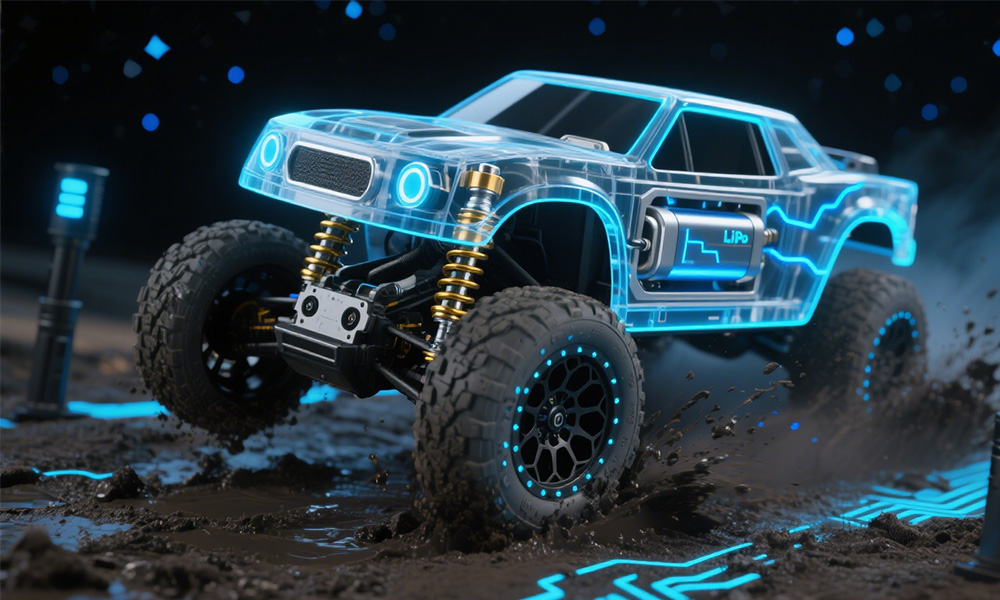
I still remember when I first got into RC cars—I had no clue about batteries. The shop guy told me, “You can go NiMH if you want simple and safe, or LiPo if you want double the performance.” All I heard was “double the performance.” My first LiPo almost scared me out of the hobby. The charger had a million settings—storage voltage, over-discharge protection, C-rating… I didn’t understand a thing. I even slept next to a bag of sand that night, worried the battery might start smoking.
After some time, I realized RC batteries aren’t that complicated—but you can’t ignore safety either. Here’s what I learned from my mistakes, and a look at different battery types.
LiPo Batteries: The Standard for Performance
LiPo batteries are basically standard in RC now—light, packed with energy, and capable of serious power. Want to drift or do off-road jumps? You need LiPo. I have a 3S 5000mAh hard-case pack in my short course truck. Hit the throttle, and it feels like the car could fly.
But LiPo has its quirks. Over-discharge once, and it’s dead. You need to store it around 3.8V per cell. Lots of beginners kill their first LiPo by leaving it drained in the car. I’ve wasted two packs before learning to charge to storage voltage right after play.

LiHV Batteries: One Step Up
LiHV is basically a souped-up LiPo. Each cell can go up to 4.35V, giving a bit more punch and top speed. I tried it once—it’s noticeably faster on straight runs. The downside? Charging is trickier. Use a normal charger without LiHV mode, and you risk puffing the pack. I nearly did.
For casual play, LiHV isn’t necessary. It’s really for speed junkies.
NiMH Batteries: Beginner-Friendly and Safe
Even though LiPo is popular, NiMH still has its place. A friend plays RC with his kid and only uses NiMH. His reasoning: safe, simple, plug-and-play. Sure, no explosive acceleration, but fine for casual runs. Most importantly, he doesn’t worry about packs dying if they’re left in the car.
If you’re starting out or don’t care about top speed, NiMH is stress-free. The only drawbacks are heavier weight and shorter runtime—you’ll notice the car feels sluggish compared to LiPo.
Choosing a Battery: What to Watch
One mistake I made was just going for bigger capacity. More mAh means more weight. I once jumped a heavy pack and bent the suspension.
Things that matter:
- Voltage: Match your ESC. Don’t throw an 11.1V pack in a 7.4V setup.
- Capacity: Bigger isn’t always better—fit it to your car’s weight and motor.
- Connectors: XT60, EC5, Deans… pick what fits your setup.
- Case Type: Hard-case = crash-resistant (off-road). Soft-pack = light (good for drones).

Safety: Are LiPos Really That Dangerous?
Scary videos are everywhere—explosions, black smoke, fire. In real life, I’ve only seen one accident. A guy fast-charged a pack on a sofa—smoke alarm went off. Since then, he uses a fireproof bag.
My tips:
- Store in a fireproof bag or ammo box (don’t seal airtight).
- Charge to storage voltage if you won’t use it soon.
- Don’t over-discharge—stop driving when the car loses power.
I admit, sometimes I’ve left packs lying around after use—but that’s risky, especially in summer.
What the Community Says
In forums, beginners often say LiPo is too complicated. Some veterans say, “Just use NiMH, no fire risks.” Others reply, “You’ll need LiPo eventually—performance is way better.”
One clever player never fully charges packs. He starts at storage voltage and still gets 15–20 minutes of runtime—enough for fun. That changed how I think about charging.
Final Thoughts
Batteries are just one part of RC. Beginners can start with NiMH—safe and easy. Once comfortable, move to LiPo for real speed. If you’re chasing extremes, LiHV can push it further.
I keep two sets: NiMH for my kid, LiPo for myself. LiPo is more work, but seeing the car rocket off makes it worth it.
Not every detail is here—like lifespan calculations or brand differences. That comes with experience. RC is about trial, error, and finding what works for you
Leave a Reply