
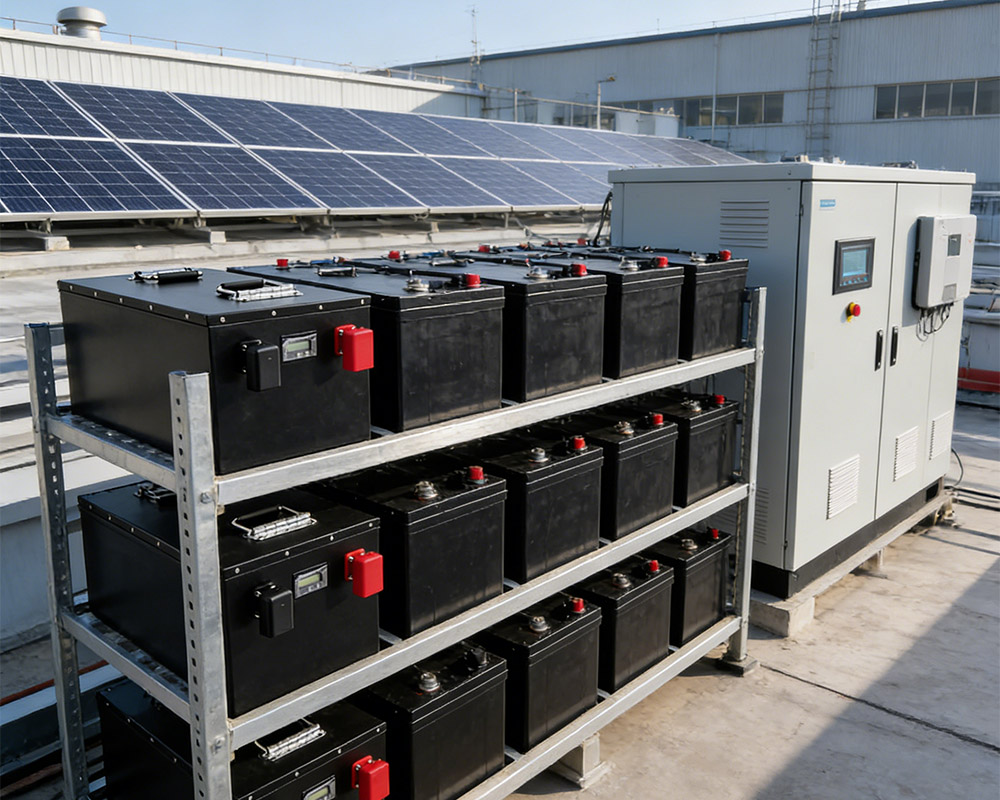
A few months ago I was walking through a solar installation site with an engineer who had worked on dozens of energy storage projects.
He pointed at a battery cabinet and said something interesting.
“Five years ago this room would have been filled with lead-acid batteries.”
Now it had just a compact rack of 48V 100Ah LiFePO4 modules.
That moment summed up something happening across the industry: these batteries are quietly becoming the standard building block for many commercial energy systems.
Not because they’re trendy—but because they solve real project problems.
Here are five places where they show up again and again.

1. Small Commercial Solar Storage
Many commercial solar systems don’t actually need huge megawatt storage.
Think about:
- small factories
- warehouses
- office buildings
- retail shops
These installations usually need 10kWh–40kWh storage, mainly for peak shaving or backup.
That’s exactly where 48V 100Ah batteries shine.
Each pack typically provides around 5kWh, so installers can simply stack modules:
- 2 batteries → ~10kWh
- 4 batteries → ~20kWh
- 8 batteries → ~40kWh
Simple math. Simple expansion.
Engineers like predictable systems.
2. Telecom Backup Power
Telecom towers have always required reliable backup batteries.
In the past, this was dominated by lead-acid systems. But maintenance and lifespan became major issues.
Lithium batteries changed the equation.
A 48V 100Ah LiFePO4 battery can provide:
- stable 48V output
- long cycle life
- fast recharge capability
I’ve seen telecom operators replace entire battery rooms with smaller lithium cabinets. The weight drops, maintenance decreases, and uptime improves.
For integrators building telecom power systems, these batteries have become a go-to option.
3. Off-Grid Solar Systems
Off-grid projects are where battery quality really gets tested.
There’s no utility grid to fall back on.
These systems show up in places like:
- remote farms
- rural homes
- mountain lodges
- island installations
In those environments, reliability matters more than anything else.
Installers often choose modular 48V systems because they’re easier to transport and scale. If demand grows later, more batteries can simply be added.
It’s not glamorous engineering—but it works.
4. Energy Storage Cabinets
Another place these batteries appear is inside integrated energy storage cabinets.
You’ve probably seen them: all-in-one cabinets containing:
- inverter
- battery modules
- BMS system
- cooling system
Manufacturers love 48V modules because they fit neatly into standardized racks.
For example:
A cabinet might contain 8 to 16 batteries, creating a compact system that installers can deploy quickly on-site.
This approach speeds up projects significantly.

5. Industrial Backup Systems
Some industrial facilities don’t want full UPS infrastructure, but they still need backup power for critical equipment.
Typical examples include:
- control systems
- monitoring equipment
- security systems
- automation controllers
A modular lithium battery bank provides a practical solution.
Instead of massive battery rooms, companies install compact racks with LiFePO4 modules.
Lower maintenance, longer life, and easier monitoring through BMS communication.
Why Integrators Prefer Modular Batteries
After watching dozens of installations, one pattern keeps repeating.
Engineers prefer simple building blocks.
Large custom battery systems can be powerful, but they’re also harder to maintain and expand.
Modular batteries like 48V 100Ah packs offer several advantages:
- predictable system design
- easy scalability
- simpler transportation
- faster installation
It’s a practical engineering choice rather than a marketing trend.
Final Thoughts
48V 100Ah LiFePO4 batteries aren’t the biggest batteries on the market.
But they’ve quietly become one of the most useful ones.
From telecom towers to commercial solar projects, these modules provide a flexible foundation for energy storage systems.
And in many projects, that flexibility ends up being more valuable than raw capacity.


Leave a Reply