
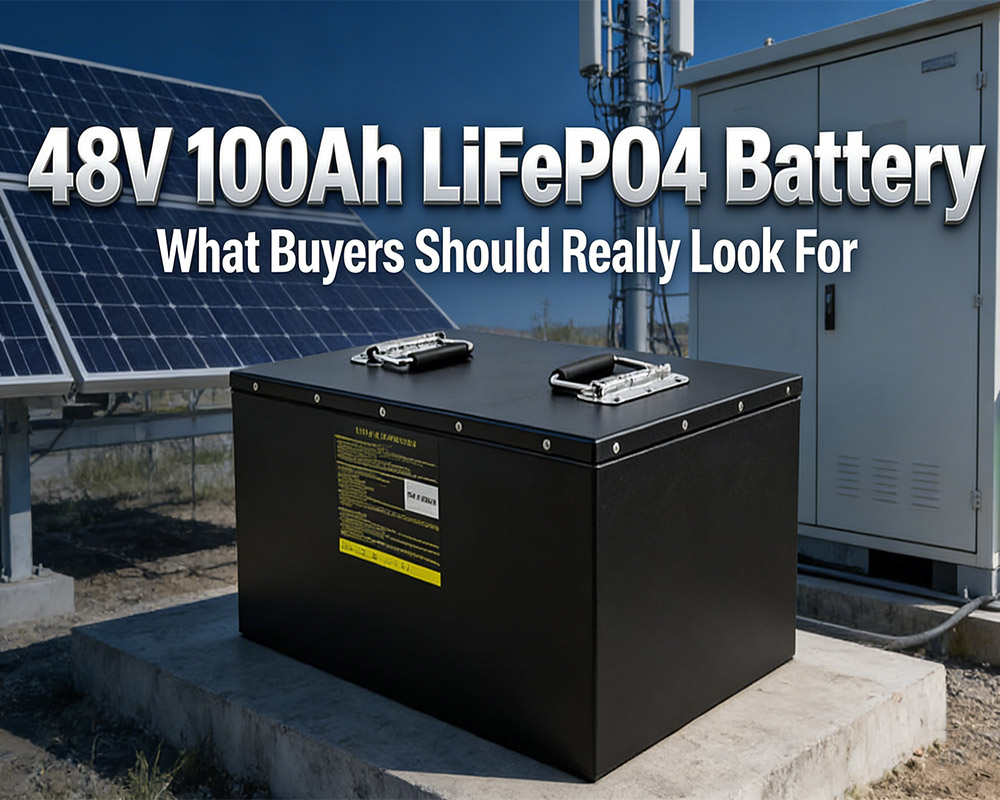
I’ve sat in a few project meetings where someone says, “It’s just a 48V battery, right?”
On paper, yes. In reality, not really.
A 48V 100Ah LiFePO4 battery looks simple on a spec sheet. Same voltage. Same capacity. Sometimes even similar pricing. But once you start deploying them in real systems—solar storage, telecom cabinets, electric mobility—you quickly learn that the internal design matters a lot more than the label.
Some packs run for years without trouble. Others start drifting out of balance after a few hundred cycles.
If you’re buying for a project, a distribution channel, or an equipment integration, here are the things I usually look at first.

Start With the Cells — Everything Else Comes Later
People talk a lot about battery packs, but the truth is the cells decide most of the outcome.
I’ve opened battery packs before where the cells came from completely different batches. Same model number, but different internal resistance. That kind of mismatch slowly causes imbalance over time.
Good manufacturers spend real effort on cell matching. Capacity matching, resistance matching, even temperature testing in some cases.
If you’re sourcing batteries in volume, it’s worth asking questions like:
- Are the cells Grade A?
- Are batches matched before pack assembly?
- How tight is the resistance tolerance?
It might sound like small details, but they often determine whether the battery lasts five years or two.
The BMS Is the Part Nobody Sees — Until Something Goes Wrong
Most buyers focus on capacity and voltage. Very few ask about the BMS.
That’s understandable, because the BMS sits hidden inside the pack. But in practice it’s doing the hard work every second the battery operates.
A decent BMS should handle:
- over-charge protection
- over-discharge protection
- temperature monitoring
- current protection
- cell balancing
And if the battery will be part of a larger system, communication becomes important too. Solar systems, energy storage cabinets, and telecom installations often require CAN or RS485 communication so the battery can talk to the controller.
Without that, system monitoring becomes guesswork.

Outdoor Installations Change the Game
A lot of batteries today don’t live in clean indoor environments.
They end up inside solar cabinets, telecom towers, or outdoor equipment boxes. Heat, dust, humidity—sometimes all of it at once.
That’s why I’ve started paying more attention to IP ratings when evaluating batteries.
An IP67-rated battery means the enclosure is sealed against dust and can tolerate temporary water exposure. That matters more than many people think, especially in coastal or humid regions.
For example, designs like the
IP67 48V 100Ah Solid State LiFePO4 Battery
are specifically built for outdoor energy storage environments where weather resistance actually matters.
It’s one of those features you don’t appreciate until a non-sealed battery fails in the field.
Cycle Life Claims Can Be Misleading
You’ll see a lot of suppliers advertising 6000 cycles.
Technically possible. But only under certain conditions.
Cycle life depends on several things that are rarely highlighted in brochures:
- depth of discharge
- charge rate
- ambient temperature
- cell quality
In practical installations, a LiFePO4 battery used at around 70–80% depth of discharge tends to achieve a very long service life. Much longer than lead-acid systems, which degrade far faster under similar usage.
From a project budgeting perspective, that’s often where lithium starts to make financial sense.
Safety Is One Reason LiFePO4 Became So Popular
Lithium battery chemistry is a broad category. Not all of them behave the same way.
One reason LiFePO4 chemistry became popular in energy storage is its stability. It’s far less prone to thermal runaway compared with many other lithium chemistries.
For large installations, safety isn’t just a technical concern—it’s also a regulatory one. Many industrial buyers specifically request LiFePO4 because it simplifies system approvals and reduces operational risk.
Some newer battery designs also experiment with solid-state structural improvements, which further enhance internal stability and safety margins.
Finally — The Manufacturer Matters More Than the Spec Sheet
This part often gets overlooked.
Two suppliers may offer the same battery specification. Same voltage. Same capacity. Similar cycle claims.
But their manufacturing discipline can be completely different.
When evaluating a supplier, I usually try to understand things like:
- production consistency
- testing procedures
- quality inspection standards
- engineering support
- lead time stability
Because in real projects, supply reliability often becomes more important than price.
A battery that arrives late—or arrives inconsistent—can slow down an entire installation.
Closing Thought
The 48V 100Ah LiFePO4 battery has become something of a standard building block in modern energy systems. Solar storage, backup power, electric mobility—they all rely on this configuration.
But the batteries that perform well long-term usually share a few things in common: good cells, a solid BMS, proper environmental protection, and a manufacturer who understands system integration.
Everything else on the spec sheet is just numbers.


Leave a Reply