
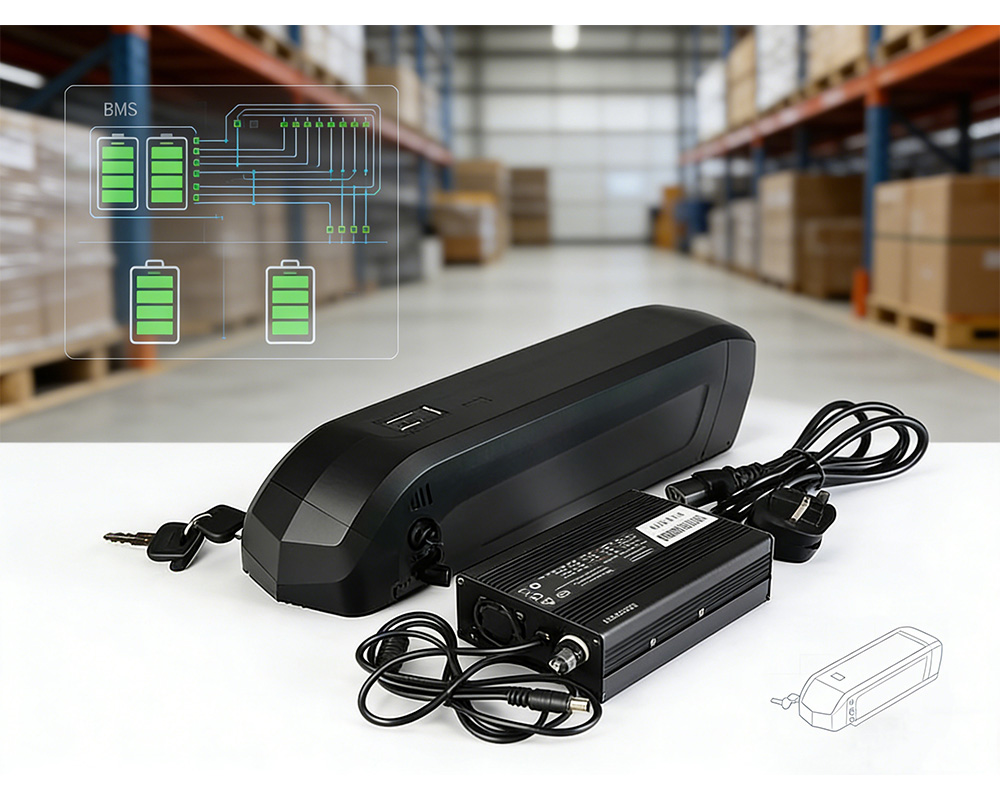
As core parts in the e-bike industry, 18650 e-bike battery is made of multiple 18650 lithium-ion cells. Because its high energy density, good stability, and small size, it has become the mainstream power solution. A standard 18650 battery cell usually has a rated voltage of about 3.6–3.7 V and a capacity ranging from 1500 mAh to 3600 mAh. If you want to dive deeper into battery pack design and maintenance, check out 18650 E-Bike Battery Packs Tips, Design & Maintenance.
For wholesalers, choosing the right ebike battery pack isn’t just about price—it directly affects performance, after-sales costs, and your reputation in the market.
Key Selection Factors: Match Performance with Demand
Before buying in bulk, there are a few core technical parameters you need to understand:
Voltage and Series/Parallel Configuration
- Series (S) determines total voltage. Common e-bike voltages are 36 V and 48 V.
- Parallel (P) determines total capacity—the higher the capacity, the longer the range.
Common configurations include:
- 10S3P: suitable for 36 V systems;
- 13S4P / 13S5P: for 48 V systems with high capacity.
Learn more about pack design and maintenance at 18650 E-Bike Battery Packs Tips, Design & Maintenance.
This is why, for bulk purchases, you need to carefully match configurations with your customers’ motor power, range requirements, and bike design space.

What Wholesalers Should Focus On
1. Cell Quality and Brand
High-quality cells determine real capacity, cycle life, and safety. Low-quality cells may seem cheap initially but often have poor performance, faster aging, and higher safety risks. Avoid “overstated” capacities like 5000 mAh claims, which rarely match reality. For more design and maintenance insights, refer to 18650 E-Bike Battery Packs Tips, Design & Maintenance.
2. Battery Management System (BMS)
Think of the BMS as the “brain” of the battery pack. It monitors voltage, temperature, overcharge, and over-discharge. For wholesale buyers:
- A reliable BMS greatly reduces after-sales issues;
- High-quality BMS ensures precise voltage balancing and temperature control;
- Smart BMS improves system compatibility with the bike.
Check 18650 E-Bike Battery Packs Tips, Design & Maintenance for more practical insights on BMS.
🔌 3. Pack Structure, Thermal Management, and Design
The way a battery pack is structured and how it handles heat affects:
- Ease of assembly;
- Operational heat dissipation and stability;
- Performance in different use scenarios, like shared bike fleets or high-intensity commuter bikes.
Details are available at 18650 E-Bike Battery Packs Tips, Design & Maintenance.

Tips for Bulk Orders
Bulk Purchasing and Inventory Management
Wholesale is about long-term supply, not one-off deals:
- Assess demand for each specification;
- Communicate with suppliers about stable delivery cycles;
- Consider storage conditions and safety risks.
Especially for high-capacity or various voltage configurations of 18650 e-bike batteries, planning for customization and sample verification is crucial. More tips can be found at 18650 E-Bike Battery Packs Tips, Design & Maintenance.
🔧 Technical Support and Supplier Partnership
A reliable supplier usually offers:
- Technical specification sheets (cell model, BMS type, test reports);
- Batch consistency testing;
- Warranty and after-sales support.
This reduces technical communication costs and return risks.
Safety and Maintenance: Don’t Overlook Even in Wholesale
Even though wholesale focuses on production and sales, maintenance affects the end-user experience:
- Avoid over-discharge or overcharge;
- Recommend periodic checks of the battery casing and terminals;
- Provide correct charging methods and storage tips.
You can also offer these as extra value points for your customers. Check 18650 E-Bike Battery Packs Tips, Design & Maintenance for more.

Recommended Product(Wholesale)
Here’s a direct link to explore different specs and configurations, including options for bulk orders:
Visit the Power Battery Pack page, featuring various 18650 e-bike battery packs and customizable power solutions. For more technical details, you can also refer to 18650 E-Bike Battery Packs Tips, Design & Maintenance.
Summary
When wholesaling 18650 e-bike batteries, price is just one factor. What truly affects long-term profit and stability is:
- Matching technical parameters with application needs;
- Ensuring cell and BMS quality;
- Maintaining a stable supply chain;
- Batch consistency testing and after-sales service.
Doing your homework upfront helps you secure a fair price, improve customer satisfaction, and reduce after-sales issues.
You May Also Like
-

18650 2200Mah 10S3P 36V 6.6Ah Electric Scooter Lithium Battery
-

18650 2600Mah 10S3P 36V 7.8ah Scooter Battery
-

18650 36V 5.2Ah Electric Bicyle Battery
-

1S2P 3.7V 1600mAh 14500 Lithium Battery
-

2000Mah 18650 Battery Cell 6Ah 36V Scooter Battery
-

21700 3.7V 4800mAh Rechargeable Lithium-Ion Battery
-

3.7V 21700 Rechargeable Lithium Battery Cells 5000mah
-

3.7V 5000mah 26650 Battery
-

32140 LiFePO4 Battery Cell 3.2V – 10000mAh / 15000mAh
-

32700 Lifepo4 3.2V 6000mah Lithium Battery
-

48V 15ah 720wh Ebike Battery
-

60V 21Ah 18650 16S7P E Bike Battery
-

Customized 48V-72V Triangle Ebike Lithium Battery Pack | 52V 30Ah
Leave a Reply