
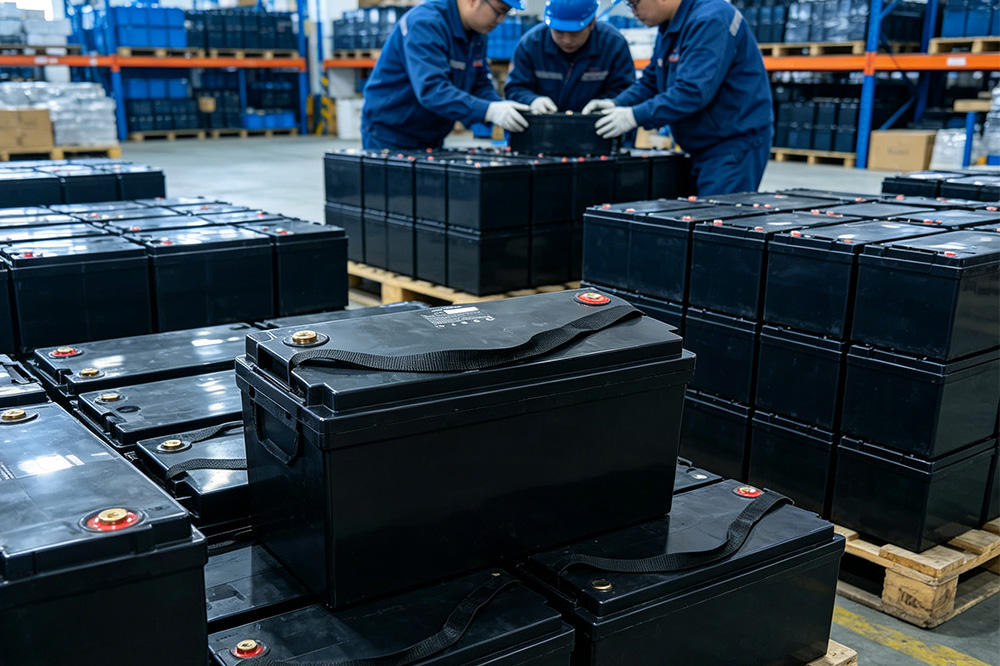
If you’ve ever tried sourcing 12V 100Ah LiFePO4 batteries in bulk, you already know the market looks simple on the surface — but gets complicated fast.
Specs look almost identical.
Prices vary wildly.
And every supplier claims “Grade A cells” and “4000+ cycles.”
But once you start selling or installing these batteries, the real differences show up — in return rates, consistency, and long-term performance.
This guide isn’t about specs.
It’s about how to actually choose a supplier that won’t create problems later.
Why 12V 100Ah Is the Most Common Bulk Configuration
There’s a practical reason this model dominates inventory.
A typical 12V 100Ah LiFePO4 battery delivers around 1280Wh usable energy, which fits perfectly for:
- RV power systems
- Small solar storage setups
- Marine applications
- Backup energy systems
For distributors, it’s also easier to standardize logistics and reduce SKU complexity.
That’s why most entry-level and mid-range systems are built around this capacity.
The Biggest Mistake Buyers Make
Most bulk buyers compare only:
- price
- cycle life claims
- basic specifications
That’s where problems start.
Because two batteries with the same “100Ah” label can behave very differently after a few months in real use.
What actually matters is what’s inside — and how consistently it’s built.

1. Cell Quality and Matching (This Is Where Most Issues Begin)
You’ll often hear “Grade A cells,” but that term is loosely used.
In reality, lower-tier suppliers may:
- mix cells from different batches
- skip strict capacity matching
- ignore internal resistance balancing
The result?
- uneven charging/discharging
- faster degradation
- higher failure rates in bulk deployments
For wholesale buyers, this directly translates into after-sales pressure.
2. BMS Reliability Is More Important Than Specs
Most 12V 100Ah batteries come with a 100A BMS, which sounds sufficient.
But in real applications:
- RV systems with inverters
- trolling motors
- off-grid setups
…can easily push that limit.
A weak or unstable BMS can lead to:
- unexpected shutdowns
- overheating protection triggers
- reduced lifespan
Reliable suppliers usually focus more on BMS stability over marketing numbers.
3. Real Cycle Life vs Advertised Numbers
You’ll see claims like:
- 4000 cycles
- 6000 cycles
- even higher
But these numbers are often based on partial discharge conditions, not real-world use.
In practical scenarios (80–100% depth of discharge), lifespan depends heavily on:
- cell consistency
- thermal control
- charging conditions
This is why two batteries with identical specs can perform very differently over time.

4. Supply Stability Matters More Than Unit Price
Here’s something many new buyers overlook:
A slightly cheaper battery can cost more in the long run if:
- supply is inconsistent
- quality varies between batches
- lead times are unstable
For distributors and project contractors, consistency is everything.
That’s why many experienced buyers prefer working with suppliers that offer:
- stable production batches
- clear quality control processes
- long-term cooperation capability
5. What a Reliable Wholesale-Ready Battery Should Offer
If you’re sourcing for resale or projects, a safer choice is a solution designed for bulk supply — not just retail specs.
For example, a typical
12V 100Ah LiFePO4 battery used in B2B scenarios usually focuses on:
- matched cell grading for consistency
- stable BMS with full protection
- support for series and parallel expansion
- OEM / private label customization
These factors matter far more than small differences in advertised specs.

6. A Quick Reality Check from the Market
One thing that comes up often in real user feedback:
Many systems outgrow a single 100Ah battery faster than expected.
This isn’t a product issue — it’s a system design issue.
That’s why good suppliers don’t just sell batteries.
They help customers plan:
- how many units are needed
- whether to connect in parallel
- how to match load requirements
Conclusion
Choosing a 12V 100Ah LiFePO4 battery supplier isn’t about finding the lowest price.
It’s about avoiding long-term problems.
If you’re buying in bulk, focus on:
- cell consistency
- BMS reliability
- supply stability
- technical support capability
Because once the batteries are delivered, switching suppliers becomes much more expensive than choosing the right one from the start.


Leave a Reply