
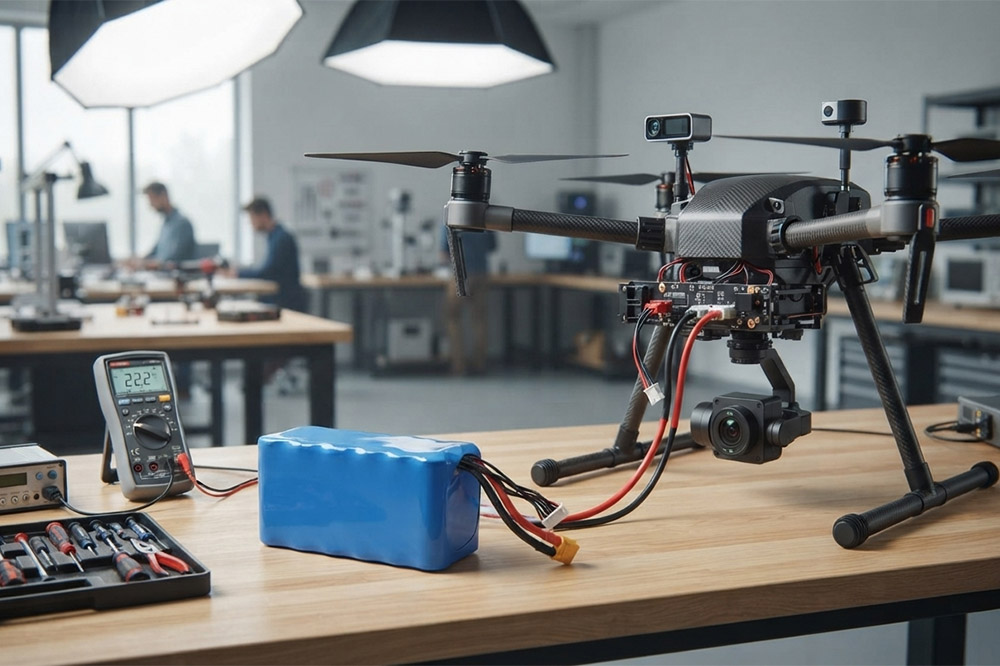
When a drone project reaches a certain performance level, battery selection usually becomes more complicated.
Many drone manufacturers start with a simple question:
“Can we use a larger battery to increase flight time?”
In practice, the answer is not always yes.
A larger battery can store more energy, but it also adds weight. The extra weight changes the motor load, flight efficiency, and even the balance of the entire aircraft.
If you are still evaluating different drone battery technologies, configurations, and customization options, our complete guide LiPo Battery for Drone: Complete Guide for UAV Manufacturers and Buyers explains the key factors to consider before choosing a UAV battery solution.
This is why many professional UAV manufacturers move toward higher voltage battery systems, such as a 6S LiPo battery for drone applications.
A 6S battery provides a higher voltage platform, allowing drones to achieve stronger power output while keeping current demand under control.
For FPV drones, agricultural UAVs, industrial inspection drones, and other commercial platforms, 6S LiPo batteries have become a common choice.
What Does 6S Mean on a Drone Battery?
The “S” in a LiPo battery specification refers to the number of cells connected in series.
A single LiPo cell has:
- Nominal voltage: 3.7V
- Fully charged voltage: 4.2V
Therefore:
- 4S battery = 4 cells × 3.7V = 14.8V
- 6S battery = 6 cells × 3.7V = 22.2V
A fully charged 6S LiPo battery reaches:
6 × 4.2V = 25.2V
This higher voltage allows drone systems to deliver more power without requiring extremely high current.
For manufacturers designing larger UAV platforms, this can make the electrical system more efficient.

Why Are 6S LiPo Batteries Popular in Drone Applications?
From our experience working with battery projects, customers often choose 6S systems when their drone has reached the limits of a lower voltage configuration.
For example, a drone may need:
- Larger motors
- More payload capacity
- Faster response
- Better climbing ability
At this stage, simply increasing battery capacity may not solve the problem.
A 6S system provides another option by increasing voltage.
The benefits include:
Better Power Efficiency
Electrical power is calculated by:
Power = Voltage × Current
When voltage increases, the system can achieve the same power output with lower current.
Lower current can help reduce:
- Heat generation
- Cable losses
- Pressure on electrical components
For high-performance drones, this difference can become noticeable during long operation periods.
6S LiPo Battery Applications
A 6S LiPo battery is used in many different drone applications.
The exact battery specification depends on the aircraft design, but several common areas include:
FPV Drone Applications
FPV drones are one of the most common examples of 6S LiPo usage.
Pilots and manufacturers often choose 6S batteries because they provide:
- Fast acceleration
- Strong throttle response
- High power output
Compared with traditional 4S setups, a 6S system can provide more aggressive performance when paired with suitable motors and ESCs.
However, higher voltage also requires proper matching of electronic components.
A battery upgrade without adjusting the complete power system may create compatibility problems.
Agriculture Drone Applications
Agricultural drones usually have very different requirements compared with hobby drones.
They may need to carry:
- Spraying equipment
- Liquid tanks
- Sensors
- Additional control systems
For these drones, battery performance directly affects working efficiency.
A suitable 6S drone battery can provide:
- Stable power output
- Reliable operation
- Enough energy for repeated flights
For commercial agriculture UAV manufacturers, battery consistency is often more important than achieving the highest possible discharge rate.
Industrial UAV Applications
Industrial drones are often used for:
- Inspection
- Mapping
- Surveying
- Infrastructure monitoring
These applications usually require predictable performance.
The battery needs to support:
- Stable voltage output
- Longer operation cycles
- Safe charging and discharging
This is why many industrial UAV companies prefer working with battery manufacturers that can provide customized solutions.
How to Choose the Right Capacity for a 6S Drone Battery?
Voltage is only one part of battery selection.
Capacity is another important factor.
Common 6S LiPo battery capacities include:
- 3000mAh
- 5000mAh
- 8000mAh
- 10000mAh
- 16000mAh or higher
A higher capacity battery provides more stored energy.
But there is always a trade-off.
More capacity usually means:
- Longer flight time
- Higher battery weight
- Larger physical size
For example:
A small FPV drone may use a compact 6S battery because speed and agility are important.
A large industrial UAV may require a bigger custom battery pack because endurance and payload are the priority.
The right capacity depends on the actual mission.
Understanding C Rating of 6S LiPo Battery
Another specification that drone manufacturers pay attention to is the discharge rate.
The C rating indicates how quickly the battery can deliver current.
For example:
A 6S 5000mAh battery:
5000mAh = 5Ah
If the battery is rated at 40C:
5Ah × 40C = 200A
This means the battery theoretically can deliver a high current output.
High discharge capability is useful for:
- Racing drones
- Heavy-lift UAVs
- High-performance aircraft
However, selecting the highest C rating is not always the best choice.
A battery should match the actual power requirements.
A battery that is oversized for the application may increase cost and weight without providing meaningful benefits.
6S LiPo Battery vs 4S LiPo Battery for Drone
One common question from drone developers is:
“Should we choose 4S or 6S?”
The answer depends on the drone platform.
| Feature | 4S LiPo Battery | 6S LiPo Battery |
|---|---|---|
| Voltage | 14.8V | 22.2V |
| Power capability | Medium | Higher |
| Current demand | Higher | Lower |
| Suitable for | Small and medium drones | Professional UAV platforms |
| Motor requirement | Lower | Higher |
A 4S battery can work well for lightweight drones.
A 6S battery is usually selected when the aircraft requires more power.

Common Mistakes When Selecting a 6S LiPo Battery
Choosing the Largest Capacity Battery
This is one of the most common mistakes.
Some buyers believe:
“Bigger battery means longer flight time.”
But additional weight can reduce the expected improvement.
Battery selection should consider the complete drone system.
Ignoring Battery Dimensions
A battery may have excellent electrical performance but still not fit the drone.
Before production, manufacturers usually confirm:
- Length
- Width
- Height
- Connector position
- Cable arrangement
For OEM drone projects, customized dimensions are often necessary.
Selecting Battery Specifications Without Testing
Battery performance on paper does not always represent real flight conditions.
Professional UAV manufacturers usually follow a process:
Prototype testing → Flight test → Battery adjustment → Mass production
This reduces problems during later production.
Custom 6S LiPo Battery Solutions for UAV Manufacturers
Many drone companies cannot find a standard battery that perfectly matches their aircraft.
A custom battery solution can help solve problems related to:
- Limited installation space
- Special voltage requirements
- Different flight times
- Connector compatibility
Customization may include:
- Battery capacity adjustment
- Cell selection
- Pack structure design
- BMS integration
- Cable customization
For commercial UAV projects, working with a battery manufacturer early in the development process can improve the final product design.

How to Choose Reliable 6S Drone Battery Supplier?
For drone manufacturers, battery suppliers are not only component providers.
They are also development partners.
Important factors include:
Battery Manufacturing Experience
A reliable supplier should understand:
- Cell characteristics
- Pack assembly
- Safety testing
- Production consistency
Custom Development Capability
OEM customers often require:
- Sample production
- Engineering support
- Small batch testing
- Large-scale manufacturing
Quality Control
A professional battery supplier should have processes for:
- Cell inspection
- Welding quality
- Performance testing
- Safety verification
Apsenx Custom UAV Battery Solutions
ANPS provides customized lithium battery solutions for UAV and industrial applications.
Our UAV battery solutions support:
- Custom voltage configurations
- Custom capacity design
- Battery pack development
- OEM/ODM projects
Applications include:
- Agricultural drones
- Industrial UAVs
- Mapping drones
- Robotics systems
Learn more:UAV Battery Product Category
FAQ
Is a 6S LiPo battery better than a 4S battery for drones?
Not always. A 6S battery provides higher voltage and power capability, but the correct choice depends on the drone design and motor system.
How long can a 6S LiPo battery power a drone?
Flight time depends on battery capacity, drone weight, motor efficiency, payload, and flight conditions.
Can 6S LiPo battery be customized?
Yes. Manufacturers can customize capacity, dimensions, connectors, and battery structure according to UAV requirements.
Final Thoughts
A 6S LiPo battery for drone applications is a powerful solution for UAV platforms that require higher voltage and strong performance.
However, choosing the right battery is not only about voltage.
The final solution needs to balance:
- Power output
- Weight
- Capacity
- Safety
- Application requirements
For drone manufacturers, a customized UAV battery solution often provides better results than simply selecting an existing consumer battery.
The right battery partner can help improve drone performance and make future production more reliable.


Leave a Reply