
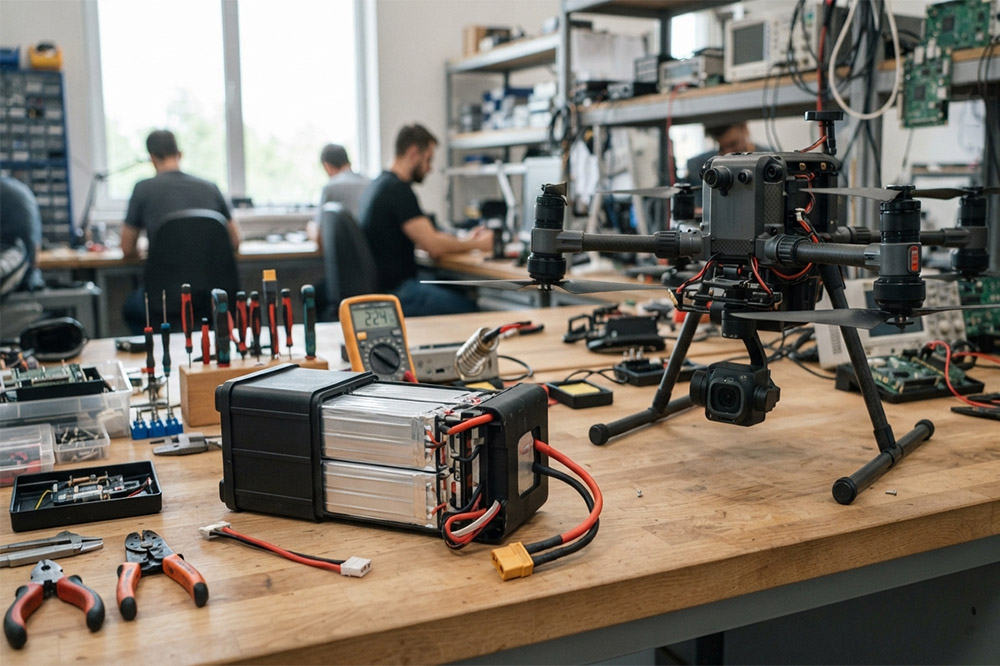
The battery is one of the most important parts of any drone system.
A drone can have advanced flight control software, powerful motors, and high-quality sensors, but without a suitable battery, it cannot achieve stable flight performance.
For UAV manufacturers and drone companies, battery selection is usually not only about finding a battery with higher capacity. The right solution needs to balance:
- Flight time
- Power output
- Battery weight
- Safety
- Cycle life
- Installation space
- Cost
Among different battery technologies, LiPo battery for drone applications remains one of the most widely used solutions because of its high discharge capability and lightweight design.
However, as drones become more specialized, from FPV racing drones to agricultural UAVs and industrial inspection platforms, battery requirements are becoming more complex.
This guide explains how drone manufacturers and buyers can evaluate LiPo batteries and choose the right UAV battery solution.
Why Drone Battery Selection Is Critical
Many drone projects start with a simple goal:
“Make the drone fly longer.”
But in real development projects, increasing flight time is not only about adding more battery capacity.
A larger battery means more energy storage, but it also increases the overall weight of the aircraft.
More weight can lead to:
- Higher motor power consumption
- Reduced maneuverability
- Lower payload capability
For this reason, professional drone manufacturers usually evaluate the entire power system before selecting a battery.
The battery must match:
- Motor specifications
- Flight controller settings
- Drone frame design
- Payload requirements
- Operating environment
Choosing the right battery is only the beginning. Proper charging, storage and inspection are equally important, especially for commercial UAV operators. See our drone battery safety guide for practical battery care advice.
What Is LiPo Battery for Drone?
A LiPo battery, short for Lithium Polymer battery, is a rechargeable lithium battery that uses a polymer electrolyte structure.
Compared with traditional battery designs, LiPo batteries can achieve:
- Lightweight construction
- High current output
- Flexible packaging options
These characteristics make LiPo batteries suitable for drone applications where weight and power are important.
A typical drone LiPo battery pack includes:
- Battery cells
- Protection system
- Wiring harness
- Connector
- Protective packaging
For professional UAV applications, battery packs are often customized according to the drone structure and electrical requirements.

Why Are LiPo Batteries Popular in UAV Applications?
High Discharge Capability
Drones require fast power response.
During:
- Takeoff
- Acceleration
- Climbing
- Carrying heavy payloads
motors may suddenly demand high current.
A LiPo battery with suitable discharge performance can provide stable power output during these situations.
Lightweight Design
Weight is always a major concern in drone design.
Reducing battery weight can improve:
- Flight efficiency
- Payload capacity
- Operation time
This is one reason LiPo batteries remain popular in many UAV applications.
Flexible Battery Design
Different drones have different installation requirements.
Battery manufacturers can customize:
- Size
- Shape
- Voltage
- Capacity
- Connector
This flexibility is valuable for OEM drone manufacturers.
Types of Batteries Used in Drones
Although LiPo batteries are widely used, drone manufacturers may select different battery technologies depending on the application.
LiPo Battery
Common applications:
- FPV drones
- Racing drones
- High-power UAVs
Advantages:
- High discharge rate
- Lightweight
- Fast response
Li-ion Battery Pack
Common applications:
- Long endurance drones
- Mapping UAVs
- Inspection drones
Advantages:
- Higher energy density
- Longer cycle life
For UAV manufacturers looking beyond conventional LiPo packs, 21700 Li-ion cells offer another route toward higher energy density and longer endurance. Read our guide to 21700 battery packs for drones.
Once you have selected the battery type, the next question is where to source it. Our wholesale drone batteries buying guide covers MOQ, certification, delivery and supplier quality control.
LiFePO4 Battery
Some industrial applications choose LiFePO4 because of:
- Better safety
- Long cycle life
- Stable performance
The best battery technology depends on the drone mission.
How to Choose the Right LiPo Battery for Drone?
Selecting a drone battery usually requires evaluating several specifications.
1. Battery Voltage
Drone batteries are commonly described by the number of cells connected in series.
Examples:
3S:
11.1V
4S:
14.8V
6S:
22.2V
Higher voltage systems can support higher power requirements, but the battery must match the motor and electronic system.
For UAV platforms requiring higher power output, 6S LiPo battery for drone configuration is one of the most commonly discussed options. It provides higher voltage compared with 3S and 4S systems, making it suitable for many professional drone applications.

2. Battery Capacity
Battery capacity is measured in mAh.
Common drone battery capacities include:
- 2200mAh
- 5000mAh
- 10000mAh
- 20000mAh+
Higher capacity can provide longer operation time.
However, manufacturers need to consider the relationship between:
Capacity increase → Weight increase → Power consumption increase
3. Discharge Rate
The C rating shows how quickly the battery can deliver current.
High discharge batteries are commonly required for:
- FPV drones
- Heavy payload UAVs
- Industrial drones
The correct discharge rate depends on actual power demand rather than choosing the highest value.
4. Battery Size and Weight
A battery must physically fit the drone.
Before production, engineers usually confirm:
- Length
- Width
- Height
- Connector position
- Mounting method
For OEM drone projects, customized battery dimensions are often required.
Drone Battery Requirements by Application
FPV Drone Battery
FPV drones focus on:
- High power output
- Lightweight design
- Fast response
LiPo batteries are commonly preferred.
Agriculture Drone Battery
Agricultural UAVs usually require:
- Large capacity
- Reliable operation
- Frequent charging capability
Battery performance directly affects daily working efficiency.
Mapping Drone Battery
Mapping drones usually prioritize:
- Stable output
- Long endurance
- Reliable operation
Industrial UAV Battery
Industrial drones may require customized battery solutions for:
- Inspection
- Security
- Surveying
- Infrastructure monitoring
Industrial drones have very different battery requirements depending on their mission. See our guide to industrial UAV battery solutions for commercial drones for examples from agriculture, power inspection and mapping.
LiPo Battery vs Li-ion Battery for Drone
There is no universal answer to which battery is better.
The choice depends on the drone application.
| LiPo | Li-ion | |
|---|---|---|
| Power output | Higher | Moderate |
| Weight | Lower | Higher |
| Energy density | Medium | Higher |
| Cycle life | Moderate | Longer |
| Best use | High power drones | Long endurance UAVs |
Many commercial drone projects evaluate both options before finalizing the battery design.

Custom LiPo Battery Solutions for Drone Manufacturers
Standard batteries cannot always meet the requirements of professional UAV projects.
Drone companies may need:
- Custom voltage
- Custom capacity
- Special dimensions
- Customized connectors
- Battery management system
A custom battery solution allows manufacturers to optimize:
- Flight performance
- Battery installation
- Safety
- Production consistency
Apsenx provides customized UAV battery solutions for drone manufacturers, robotics companies, and industrial applications. Product category:UAV Battery
When a standard battery cannot meet the UAV’s mechanical or electrical requirements, an OEM solution may be the next step. Learn more about custom drone battery pack manufacturing and OEM solutions.
If your UAV has strict limits on weight, dimensions, current or flight time, a standard battery may not be enough. See our guide to Custom LiPo Battery Pack Design for Industrial Drone Projects to understand how an OEM battery moves from requirements to mass production.
How to Choose Reliable Drone Battery Manufacturer?
For wholesale buyers and UAV companies, selecting the right supplier is as important as selecting the battery.
Important factors include:
Manufacturing Capability
A reliable supplier should support:
- Prototype development
- Sample testing
- Mass production
Battery Quality Control
Key processes include:
- Cell selection
- Assembly control
- Performance testing
Certification Support
Common requirements include:
- UN38.3
- IEC62133
- CE
- UL
OEM Experience
A supplier with customization experience can help reduce development time.
Once you know what type of battery your UAV needs, the next challenge is finding a manufacturer that can actually deliver it consistently. See our guide to choosing a reliable UAV battery manufacturer in China.
Wholesale LiPo Battery for Drone Projects
For distributors and drone manufacturers, wholesale purchasing usually requires more than competitive pricing.
Important considerations include:
- Stable supply
- Consistent quality
- Customization capability
- Production capacity
- Technical support
Working directly with a battery manufacturer can provide better control over product quality and development.

Frequently Asked Questions
What is the best LiPo battery for a drone?
The best battery depends on the drone type, power system, payload, and flight requirements.
How long does a drone LiPo battery last?
Flight time depends on battery capacity, drone weight, motor efficiency, and payload.
Can drone batteries be customized?
Yes. Professional battery manufacturers can customize voltage, capacity, dimensions, connectors, and battery structure.
Are LiPo batteries good for commercial drones?
Yes. LiPo batteries are widely used in UAV applications that require high power output and lightweight design.
Conclusion
Choosing the right LiPo battery for drone applications requires balancing performance, weight, safety, and reliability.
For hobby drones, high discharge capability may be the main consideration.
For commercial UAV manufacturers, battery customization and supplier capability often become more important.
A suitable UAV battery solution can improve flight performance, reduce development problems, and support long-term product reliability.
For drone companies looking for customized battery solutions, working with an experienced UAV battery manufacturer can make the development process more efficient.
How to Choose the Right LiPo Battery for Drone?
Before selecting a drone battery, manufacturers should understand how flight time is calculated and what factors influence endurance. Learn more about how long does a drone battery last and the key factors affecting UAV operation time.
Battery capacity alone does not tell you how long UAV will stay in the air. For a closer look at payload, battery weight, motor efficiency, and other real-world factors, see our guide on how long does a drone battery last.
Not sure what mAh, voltage and C rating actually mean when comparing drone batteries? Our guide to drone battery capacity breaks down these specifications from a practical purchasing perspective.
LiPo is not the only option for UAVs. If you are deciding between the two major lithium battery approaches, read our comparison of LiPo vs Li-ion drone battery for FPV, agriculture and mapping applications.
If your main goal is longer UAV flight time, battery weight and energy density become especially important. See what is the best battery for long range drone for a practical comparison.
For racing and high-power FPV applications, battery discharge performance becomes particularly important. See our guide to high discharge LiPo batteries for FPV drone racing.


Leave a Reply