
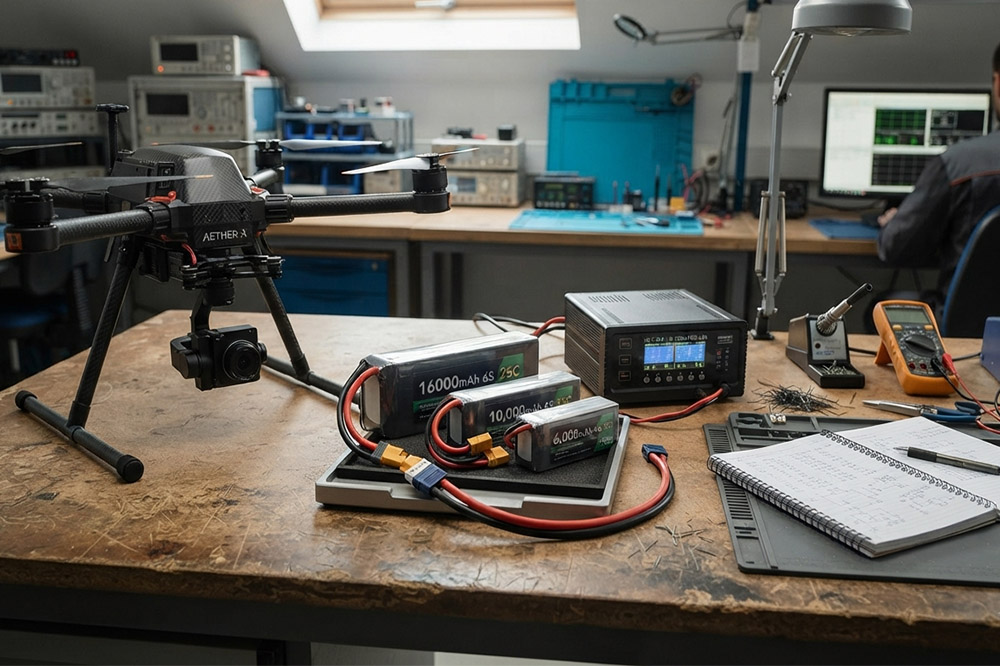
When a drone manufacturer asks for a battery, the first specifications are often something like:
“We need 6S, 10,000mAh, 30C.”
It sounds straightforward.
But there is usually a second conversation after that.
What does the drone actually weigh? How much payload does it carry? What current does the motor system draw during takeoff? How much space is available for the battery?
This is where drone battery capacity becomes more interesting.
mAh, voltage and C rating describe different parts of a battery. They should not be treated as three numbers that can simply be compared from one battery to another.
For buyers sourcing batteries in bulk, understanding the difference can also prevent a fairly expensive mistake: ordering a battery that looks good on paper but does not suit the actual UAV.
If you are still comparing battery chemistry, voltage configuration and pack design, our LiPo Battery for Drone: Complete Guide for UAV Manufacturers and Buyers is a useful starting point before choosing a specific battery specification.
What Does mAh Mean on Drone Battery?
mAh means milliampere-hour.
It describes the battery’s charge capacity.
For example:
- 3000mAh = 3Ah
- 5000mAh = 5Ah
- 10000mAh = 10Ah
- 20000mAh = 20Ah
Generally, a 10,000mAh battery can store more charge than a 5,000mAh battery.
But there is a catch.
mAh alone does not tell you how much energy the battery contains.
Voltage needs to be considered as well.
A simple way to estimate battery energy is:
Wh ≈ V × Ah
So a 6S LiPo battery has a nominal voltage of around 22.2V.
A 6S 10,000mAh battery would therefore have roughly:
22.2V × 10Ah = 222Wh
This gives a much better basis for comparing batteries.
Why Two Batteries With the Same mAh Can Perform Differently
Imagine two batteries:
- Battery A: 10,000mAh, 4S
- Battery B: 10,000mAh, 6S
They have the same mAh rating.
They do not have the same nominal energy.
The 4S pack is around 14.8V nominal, while the 6S pack is around 22.2V.
That is a big difference when you are designing a high-power UAV.
This is something worth remembering when comparing supplier quotations. If one supplier only gives you the mAh figure without voltage, you are missing an important part of the specification.

What Does C Rating Mean?
The drone battery C rating describes the battery’s discharge capability.
A simple calculation is:
Maximum theoretical current = Capacity (Ah) × C rating
For example, a 5000mAh battery is 5Ah.
If it is rated at 30C:
5Ah × 30C = 150A
That does not necessarily mean the drone should continuously draw 150A.
It is a theoretical maximum based on the stated rating, and real-world performance depends on the cell, temperature, battery construction, and manufacturer specifications.
This distinction is particularly important for commercial buyers.
A supplier saying “40C” does not automatically mean one 40C battery will perform the same as another 40C battery.
Does Higher C Rating Mean Better Drone Battery?
Not necessarily.
This is probably one of the easiest specifications to misunderstand.
A racing drone may need very high current for rapid acceleration. In that case, a high-discharge LiPo battery makes sense.
A mapping UAV that spends much of its flight cruising or hovering may have a different requirement.
If the aircraft only needs moderate current, paying more for an extremely high C rating may not give you much practical benefit.
There is a balance between:
- Discharge capability
- Energy density
- Weight
- Cost
- Cycle life
For a wholesale buyer, I would rather see the battery matched to the actual power demand than simply choose the highest C rating on a supplier’s datasheet.

Battery Capacity and Flight Time Are Connected, But Not Directly
A larger capacity usually gives the drone access to more energy.
That does not mean:
2× capacity = 2× flight time
The additional battery capacity also adds weight.
Suppose a UAV currently uses a 5Ah battery and flies for 25 minutes.
Moving to a 10Ah pack might increase endurance, but probably not to 50 minutes. The heavier battery requires additional power, and the result depends on the aircraft’s motors, propellers, payload and aerodynamics.
This is why drone battery testing is so important.
For commercial UAV development, the battery is usually tested as part of the complete aircraft rather than in isolation.
Capacity is closely related to endurance, but it does not tell the whole story. For a more practical look at the factors behind UAV endurance, see our guide on how long does a drone battery last
Voltage Changes the Way the Power System Works
Voltage is another specification buyers should pay close attention to.
Common UAV configurations include:
- 4S — 14.8V nominal
- 6S — 22.2V nominal
- 8S — 29.6V nominal
- 12S — 44.4V nominal
Higher voltage can be useful when the UAV requires substantial power.
Since:
Power = Voltage × Current
a higher-voltage system can deliver the same power at lower current.
That can help reduce losses in cables and other components.
However, voltage cannot be changed independently.
The motors, ESCs and other electronics must all be designed for the selected voltage.
A Realistic Example: Choosing Battery for UAV
Let’s say a customer is developing a commercial quadcopter.
The prototype weighs 7kg with its normal payload.
The team wants around 35 minutes of flight time.
The first request might simply be:
“Can you quote us a 20,000mAh battery?”
That is not enough information for a useful battery recommendation.
We would want to know:
- Required voltage
- Continuous current
- Peak current
- Available battery space
- Maximum battery weight
- Connector
- Expected operating temperature
- Required flight time
Maybe 20,000mAh is suitable.
Maybe it is too heavy.
Maybe the aircraft would perform better with a different voltage configuration and a slightly smaller capacity.
This is why battery selection for OEM UAV projects often involves several rounds of sample testing.

What Should Wholesale Buyers Ask Drone Battery Supplier?
When requesting quotations, don’t only ask:
“How much is a 10,000mAh battery?”
A better specification would include:
Voltage: 6S / 22.2V
Capacity: 10,000mAh
Discharge requirement: actual continuous and peak current
Dimensions: maximum available space
Weight: target or maximum
Connector: required model
Quantity: sample and production quantity
This gives the supplier something practical to work with.
It also makes quotations from different manufacturers much easier to compare.
When Custom Battery Makes More Sense
Standard drone batteries are useful when your aircraft is already designed around a common battery size.
Custom packs become more attractive when the drone has:
- Limited installation space
- Unusual dimensions
- Specific weight limits
- High peak-current requirements
- Special connectors
- Large production quantities
For example, a battery compartment might technically fit a standard pack, but leave unused space on both sides.
For a few prototype units, that may not matter.
For several thousand production drones, using that space more effectively could make the battery design more worthwhile.
Choosing Battery for Wholesale UAV Projects
For B2B buyers, the cheapest battery is not necessarily the lowest-cost solution.
If the pack has inconsistent cells, poor welding, unsuitable connectors or insufficient discharge performance, the problems show up later during assembly and field testing.
For this reason, I would look at the supplier’s:
- Cell sourcing
- Pack assembly process
- Quality inspection
- Battery testing
- Customization capability
- Production capacity
A battery supplier that can provide samples before a larger order is also useful. It gives your engineering team a chance to test the battery under actual flight conditions.
ANPS provides custom UAV battery solutions for commercial and industrial applications, including different voltage, capacity and pack configurations.
You can view the UAV Battery product range when comparing available battery solutions.

A Few Questions Buyers Usually Ask
Is a higher mAh battery always better?
No. Higher capacity means more stored energy, but usually also more weight. The right capacity depends on the complete aircraft.
What is a good C rating for a drone battery?
There is no universal number. FPV and high-performance drones may need much higher discharge capability than mapping or inspection UAVs.
Is 6S better than 4S?
Not automatically. 6S provides a higher voltage and can suit higher-power systems, but the motor and ESC system must support it.
How do I compare two drone batteries?
Start with voltage, capacity, energy in Wh, weight, dimensions and actual discharge requirements rather than comparing mAh alone.


Leave a Reply